A construction permit for KYA-FM was issued in September 1957 to the owners of KYA, J. Elroy McCaw (the father of future telecommunications magnate Craig McCaw) and John Keating. The two had paid $150,000 for KYA back in 1950 and before the new FM station would go on the air, they sold KYA and the FM construction permit to Golden State Broadcasters, controlled by the Milwaukee-based Bartell family, for a reported $1.2 million.
KYA had just moved across the street, from facilities in the basement of the Fairmont Hotel to an annex of the Mark Hopkins Hotel. That building bore the memorable address of 1 Nob Hill Circle.
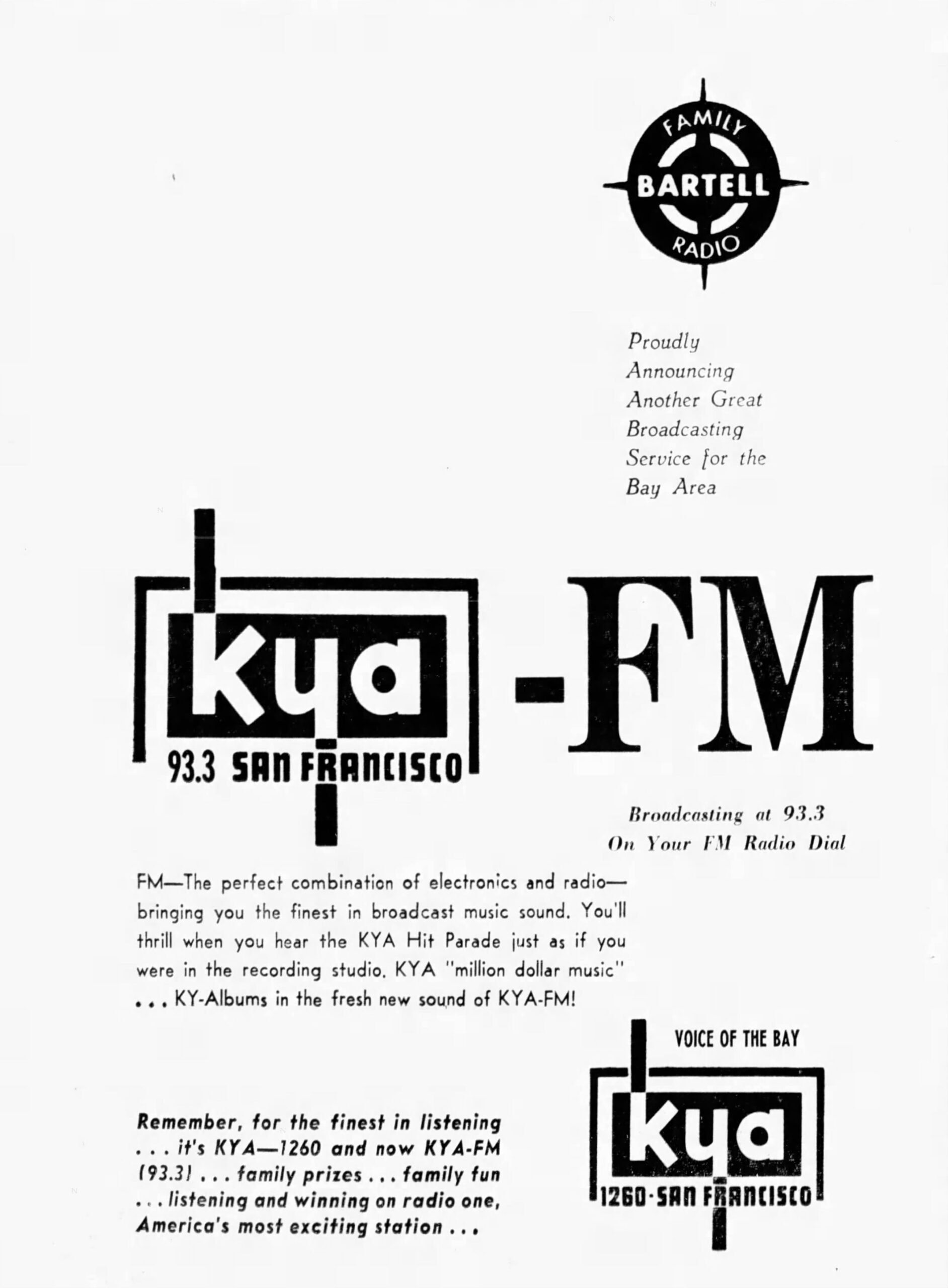
In early 1959, transmitting from the same hilltop facility in San Francisco’s Bayview District that housed KYA’s transmitter, KYA-FM made its debut. Programming was an exact duplication of what was airing on KYA. KYA-FM’s launch came at a time when FM radio ownership was starting to climb; an industry survey showed about a third of Bay Area homes had FM receivers, which was nearly double the penetration of two years earlier.
Bartell’s programming concept was called “Family Radio”. The stations promised a dozen records per hour, ranging from Benny Goodman swing classics to jazz standards to “Golden Upcoming Hits” from the likes of Della Reese.
By 1960, Bartell was referring to the “Golden Sound” of its San Francisco duopoly, running newspaper ads urging listeners to experience what it called “Stereoradio”. Not that KYA-FM was yet broadcasting a multiplex stereophonic signal; what KYA was proposing was that listeners tune one radio to 1260 AM and another to 93.3 FM and set them ten feet apart.
A year later, the “two-radio stereo” concept involved another FM station, KAFE. The competing stations set up broadcasts which they said would provide “true Stereo-FM” if listeners would tune each station in on one receiver and set the radios up 10-12 feet apart. Newspaper ads didn’t specify the content, but it’s likely that it wasn’t a simulcast of KYA, which by then had launched the Top 40 format that would catapult the station to national prominence for the next several years.
Another joint KYA-FM/KAFE project was the Junior Red Cross Voice of Friendship program in which Bay Area teenagers exchanged recorded music with fellow teens in other countries. The tapes were aired on both KYA-FM and KAFE.
The Bartell ownership era ended in 1962. Veteran Buffalo, NY broadcaster Clinton D. Churchill, through his Churchill Broadcasting Corporation, acquired KYA and KYA-FM for $1.25 million in a deal that closed in August 1962.
In 1965, KYA-FM got a new set of call letters: KOIT. The nod to San Francisco’s emblematic Coit Tower would wind up gracing a different radio station years later, but for now, KOIT was the FM version of KYA.
For the next several years, KOIT, like many other FM stations co-owned by an AM station operator, faithfully re-transmitted whatever was on the AM station. That came to a screeching halt for many stations on New Year’s Day 1967, when new Federal Communications Commission regulations targeting so-called “satellite stations” required that half or more of programing on these FM stations be separate from what was airing on the AM side.
KYA and KOIT had been sold to Avco Broadcasting a few months earlier. Avco was the broadcasting division of the Aviation Corporation, based in Cincinnati, OH, formerly known as the Crosley Broadcasting Corporation. Crosley was one of the pioneering names in American radio and television. Avco paid $4.4 million for the stations, representing a healthy profit for the seller, Churchill Broadcasting.
KOIT began to create separate programming, including a show called Tower of Hits. By 1968, automation had hit the radio industry and KOIT was carrying rock music via an automated format, even as KMPX and then KSAN were pushing the boundaries of what a rock music format might sound like. The station caught the ear of San Francisco Chronicle columnist Herb Caen, who wrote, “KOIT plays so many uninterrupted hours of rock and jazz that you begin to wonder how they pay their light bill.”
In 1972, Avco announced it was changing the station’s call letters back to KYA-FM. Puckish San Francisco Chronicle columnist John Wasserman greeted the news thusly: “KYA-AM says KYA-FM is ‘the adult alternative’. It does not say to what. It’s just as well. There’s always been something vaguely salacious about KOIT. Surprised the FCC hasn’t cracked down long before this.”
For the next several years, KYA-FM was a largely-automated rock music jukebox. That ended in 1976 when programmer Kent Burkhart was hired to oversee a transition to a “live” sound, re-branding the station as “Y-93” and moving toward progressive rock.
A few months later, both KYA and KYA-FM were sold again, this time to Seattle-based King Broadcasting. The new owners ditched the prog-rock “Y-93” format and switched back to a Top 40 format. At about the same time, KMEL was born and a shakeup of Bay Area FM listening habits was underway.
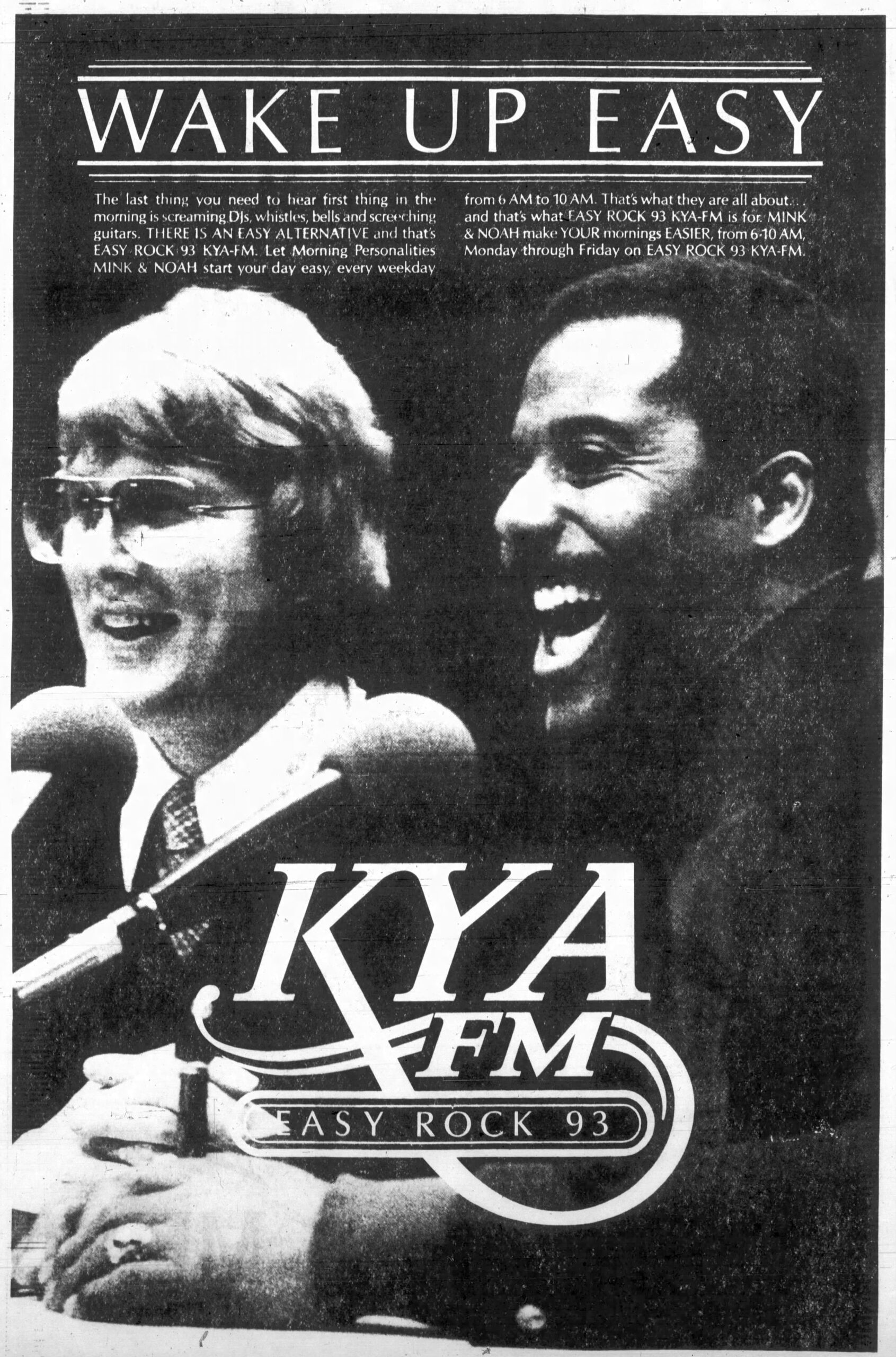
KYA-FM positioned itself as an album-oriented rock (AOR) station in the late 1970s. By 1980, it was calling itself “Easy Rock 93″with morning team “Mink & Noah” (Bill Minckler and Noah Griffin) leading off the day. The station and its AM counterpart had moved from Nob Hill to new facilities on Broadway, on the edge of the North Beach neighborhood.
In the summer of 1981, KYA-FM became KLHT. Oakland Tribune columnist Rick Malaspina wrote that the station’s “K-Lite” branding referred to its “marshmallow-rock sound”. Air staff included morning host Rob Conrad, afternoon host Sam Van Zandt and news director George McManus.
None of these changes were making a dent. In the fall of 1982, K-Lite was the lowest-ranked San Francisco station in the market (two other stations appearing lower on the chart were based in San Jose). The station could claim to be #10 among 18-34 year olds.
One claim to fame: John Madden. The former Oakland Raiders coach, on his way to becoming a football-broadcasting legend, had started doing regular evening sports segments that aired on KYA and KLHT. Madden’s relationship with the stations evolved into a regular morning segment with KYA’s Gene Nelson, the beginning of a lengthy run for Madden as a Bay Area morning radio fixture.
In late 1983, King Broadcasting sold KYA to Bonneville International, which changed the call letters to KOIT to match its existing FM station. At the same time, King acquired KSFO from Gene Autry’s Golden West Broadcasting, moving the legendary station from its longtime home at the Fairmont Hotel to the Battery Street facility King had built out a few years earlier.
When the dust had settled, KLHT had been switched back to KYA-FM and was airing a “golden oldies” format, branding itself as “93 KYA FM”. The format change didn’t help with the ratings; KYA-FM continued to rank near the back of the pack among Bay Area stations.
By mid-1986, Bay Area listeners had to wrap their minds around the fact that two historic sets of San Francisco call letters were carrying the same programming. After the Federal Communications Commission loosened simulcasting rules in an effort to help struggling AM stations, King Broadcasting began to simulcast the rock-oldies format on KSFO and KYA-FM. The merging of the two stations (helped by baseball broadcasts on KSFO) boosted their combined ratings into the market’s top ten by the fall of 1987.
In late 1991, King Broadcasting worked out a deal to sell KSFO and KYA-FM to First Broadcasting, controlled by Ron Unkefer. Unkefer had founded The Good Guys, Inc. almost twenty years earlier and built the electronics store into a major chain.
Barely two years later, Unkefer sold KYA-FM to Walnut Creek-based Alliance Broadcasting, which already owned oldies-formatted KFRC-FM. The transaction spelled the end of not only the oldies format on 93.3 FM, but the KYA call letters as well. The station’s format was shifted to “Young Country” and on April 22, 1994, the call letters were changed to KYCY.
RELATED EXHIBITS:
1260 AM in San Francisco–Historical Timeline