KAFE was the personal project of Daniel Xavier Solo, who’d dropped out of Oakland’s Fremont High School to become a teenaged announcer at KRE in Berkeley. Dan Solo earned a First Class Radiotelephone Operator’s License from the Federal Communications Commission. He’d read a lengthy piece in Broadcasting/Telecasting magazine about the status of FM radio and had realized that there were Bay Area FM radio licenses available. In 1957, he filed for one.
When the FCC granted Solo his license on the 98.1 frequency, KAFE became the Bay Area’s 13th FM station on the air. After an initial burst of interest when FM licenses opened up in 1947, broadcasters found themselves facing a chicken-and-egg problem: how could you build a business out of broadcasting on FM if there weren’t enough people with FM receivers? By 1957, Blaupunkt offered the only FM radios for cars and few motorists had them.
Solo originally intended to use newly-developed automation technology to broadcast from his home in the Oakland Hills near Joaquin Miller Park. He’d erected a tower in his yard all by himself (“Just about the worst thing I’ve ever done,” he told the Oakland Tribune) before Oakland city planners told him he was violating zoning laws.
Instead, KAFE went on the air in 1958 from studios at the Leamington Hotel. Solo had found a transmitter location atop Grizzly Peak. The format was not unusual for FM stations of the era: a menu of light classical music.
What did set the brand-new KAFE apart was an irreverent tone that some loved and others…didn’t love. Through the fall of 1958, Oakland Tribune broadcast columnist Bill Fiset ran many letters from listeners panning or defending what they heard on KAFE. The station had a habit of running mock-serious public service announcements with messages such as “Friends, don’t commit murder. Murder is frowned upon in modern society so remember, friends: don’t commit murder.”
Solo wrote to Fiset, describing his station’s programming as “subtle, erudite comedy material”. His letter went on to say, “Give a listen to KAFE and I’m sure you’ll find us fresh and refreshing.”
In another offbeat move, Solo persuaded officials at Napa State Hospital and San Quentin Prison to pipe the station’s broadcasts throughout those two locked-down facilities.
Barely a year after Solo put KAFE on the air, he sold it for a reported price of “approximately $57,000”. Solo would later be heard as an announcer on KSAY and became a renowned typographer.
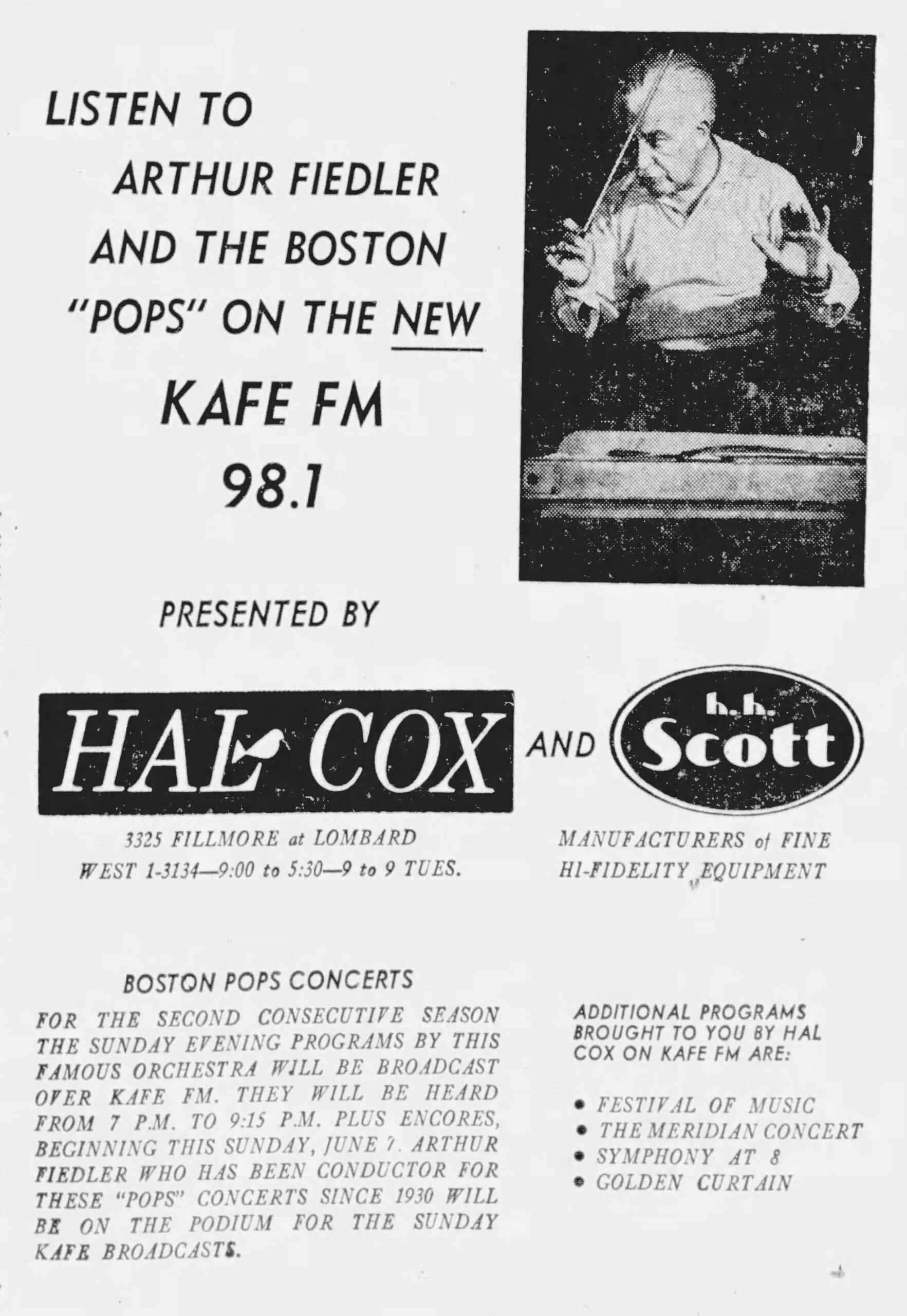
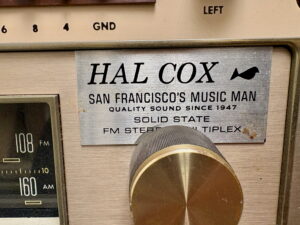
The buyer was Hal Cox, who ran a high-fidelity music equipment business in San Francisco. Cox immediately filed for permission to move the studios from Oakland to his hi-fi store at 3325 Fillmore Street in San Francisco’s Marina District and the transmitter to Sausalito’s Mt. Beacon. He also requested FCC permission to boost the station’s power to 100,000 watts.
Cox hired Sandy Paul as announcer and program director. Dennis Lewis, who’d worked at Pittsburg’s KKIS, became a second full-time announcer. Cox announced plans to create a 1,000 square foot “concert hall”, allowing the station to provide live broadcasts of chamber and operatic music. He also bought the record library from KEAR, which had switched to religious programming.
By the fall of 1959, KAFE was broadcasting 24 hours a day. In the early 1960s, it began adding stereo broadcasts to its schedule (it had participated in a 1961 stunt with KYA-FM which called on listeners to set up two receivers–one tuned to each station–while the two stations broadcast a “left” and “right” channel of a stereophonic program).
Cox sold KAFE to Gordon McLendon’s McLendon-Pacific Corporation in a deal approved by the FCC in April 1965. The selling price was a reported $200,000. A Berkeley Gazette report on the sale noted that McLendon and Cox had spent more than four years negotiating the deal.
The call letters were changed to KABL-FM in May 1965 and the station began simulcasting the “beautiful music” format already heard on KABL.
I know this is a long shot but are there any archives of stations like this? I was interested in John Wilde’s broadcast from KAFE in the early 60’s. in any format of tape or digital. Thanks.
Hi Matt,
So far, we have not come across any recorded examples from KAFE. “New” (actually, old!) content pops up from time to time so we’ll keep our fingers crossed.