KABL came into being in May 1960, when legendary Dallas broadcaster Gordon McLendon added the Bay Area to his stable of major market radio holdings. He purchased venerable Oakland station KROW from Sheldon F. Sackett, publisher of the Oakland-based Olympic Press weekly newspaper for $800,000 and set out to shake things up.
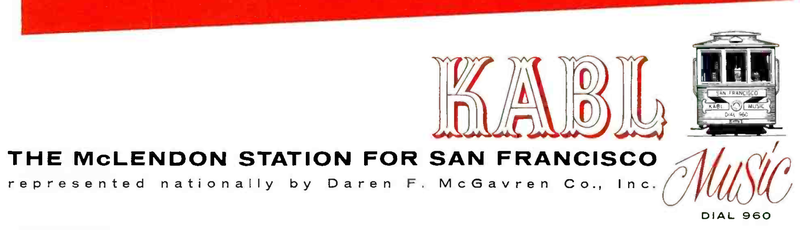
Most of McLendon’s stations pounded out an energetic Top 40 format, but while KROW had a strong signal, the Bay Area was already crowded with Top 40 competitors. McLendon’s team decided to go in a different direction, broadcasting an “easy listening” format and choosing those iconic call letters in a nod to San Francisco’s cable cars. Never mind that the station was licensed to Oakland, which had no cable cars.
As was McLendon’s wont, the format change was preceded by a stunt: in this case, three straight days of the goofy rockabilly-style theme from “The Giant Gila Monster,” a cheesy 1950s movie produced by Gordon McLendon and his father, B.R. McLendon.
Within a few months, KABL had reached the top of the Bay Area ratings chart. An early hire was morning host Bill Moen, who managed to become a popular voice on KABL during his 33-year run despite the fact that for many years, announcers weren’t allowed to say their names on the air.
KABL presented a mix of easy-listening and orchestral music, newscasts heralded by cable car bells, and a sense of sophistication that appealed to Bay Area aesthetes.
In 1972, McLendon sold KABL and its FM sister station to conservative icon William F. Buckley Jr.’s Starr Broadcasting Group for $10.8 million, a tidy return on investment. In 1978, the Starr group was acquired and merged into Roy Disney’s Shamrock Broadcasting Company, Inc. In 1995, Shamrock was in turn acquired by Chancellor Media Corporation. Then in 1999, Chancellor was acquired by Clear Channel Communications, Inc. (later re-named iHeart Media, Inc.).
KABL’s version of sophisticated music for a sophisticated market worked until the late 1990s, when changing musical tastes and an aging audience saw the station start mixing in more adult standards and big-band tunes.
The KABL era came to an end in 2004 when ownership abandoned the format and the call letters, re-branding the station as “960 The Quake” under the call letters KQKE. The programming shifted to a progressive talk format affiliated with the “Air America” network.
More change at the 960 frequency in 2007: the station was now KKGN “Green 960”, featuring programs focused on environmental issues. In 2012, iHeart brought back the KNEW call letters used by an earlier Oakland station and began transmitting a mix of progressive and conservative talk hosts.
Found this station streaming online 2025 . I’m 68 from NJ absolutely the best musical collection to be found thank you, Mario
I lived in San Francisco From 1986 until 2001 and that station was my favorite. I loved the music and it’s format! I also loved when they used to say KABL, the station of the stars! I catered an ASPA event one year and met with Radio personality, Jan Wahl who was one of the guests. She was wearing one of her signature hats and was so down to earth. We had a heartfelt conversation. Just after she left the station. She shared with me that she was asked to leave because of she was accused of outing, a famous TV personality before they actually outed themselves live on the air. She said there was no evidence to support that and they were looking for a creative way to force her retire. It was so sad, I gave her a hug and wished her the best! I’ll never forget that. ❤️