
Leon A. “Lee” Crosby’s $146,000 purchase of KHIP from Franklin Mieuli gained Federal Communications Commission approval in June 1962. Within two months, Crosby had made some moves.
One was literal: studios were relocated to the Villa Roma, a circular motel at 1212 Columbus Street in San Francisco, billing itself as “San Francisco’s most elegant motor hotel and cocktail lounge.” The other created a legendary San Francisco radio brand: changing the call letters to KMPX (for “MultiPleX“) , to herald the beginning of multiplex stereo operation by the station.
Also in 1962, Crosby filed FCC paperwork to reflect a new official licensee of the station: Cross-Pacific Corporation, of which he owned 40%. The company received approval for an increase in power to 82,000 watts. Two years later, that signal would be emanating from Mount Beacon, above Sausalito.
KMPX struggled along with a middle-of-the road format, moving its studios to the basement of a warehouse at 50 Green Street in 1965.
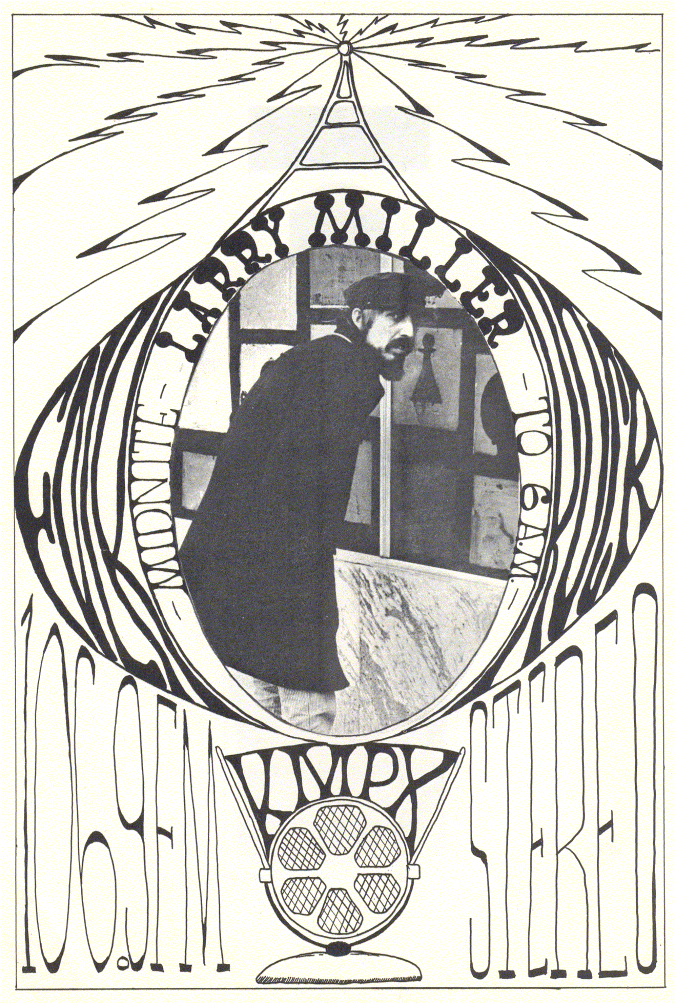
Ronald C. Hunt was named station manager of KMPX in 1966; at this time, the station was broadcasting blocks of brokered programming, generally in foreign languages. In February 1967, Larry Miller, a 26-year-old folk musician and disc jockey who had recently arrived from Detroit, met with Leon Crosby and Ron Hunt in the hope of landing a job at KMPX. He was given the vacant overnight shift — midnight to 6 AM — and began what he called a “folk rock” show.
Miller’s overnight gig was barely a month old when an enterprising former KYA air personality named Tom Donahue approached Crosby and Hunt with his own pitch: he’d take over the station’s programming and replace the brokered foreign-language shows.
What Donahue had mind was something San Francisco hadn’t heard before: album-oriented rock music with an emphasis on local bands, and announcers who took a more laid-back, less frenetic approach to their jobs. The concept struck like a San Andreas Fault earthquake.
Crosby and Hunt signed off on the plan and on April 7, 1967 Donahue settled his impressive frame down behind a KMPX microphone to sign on for the first time. His 8 PM to midnight show led into Miller’s air shift. Free-form FM radio was being born.
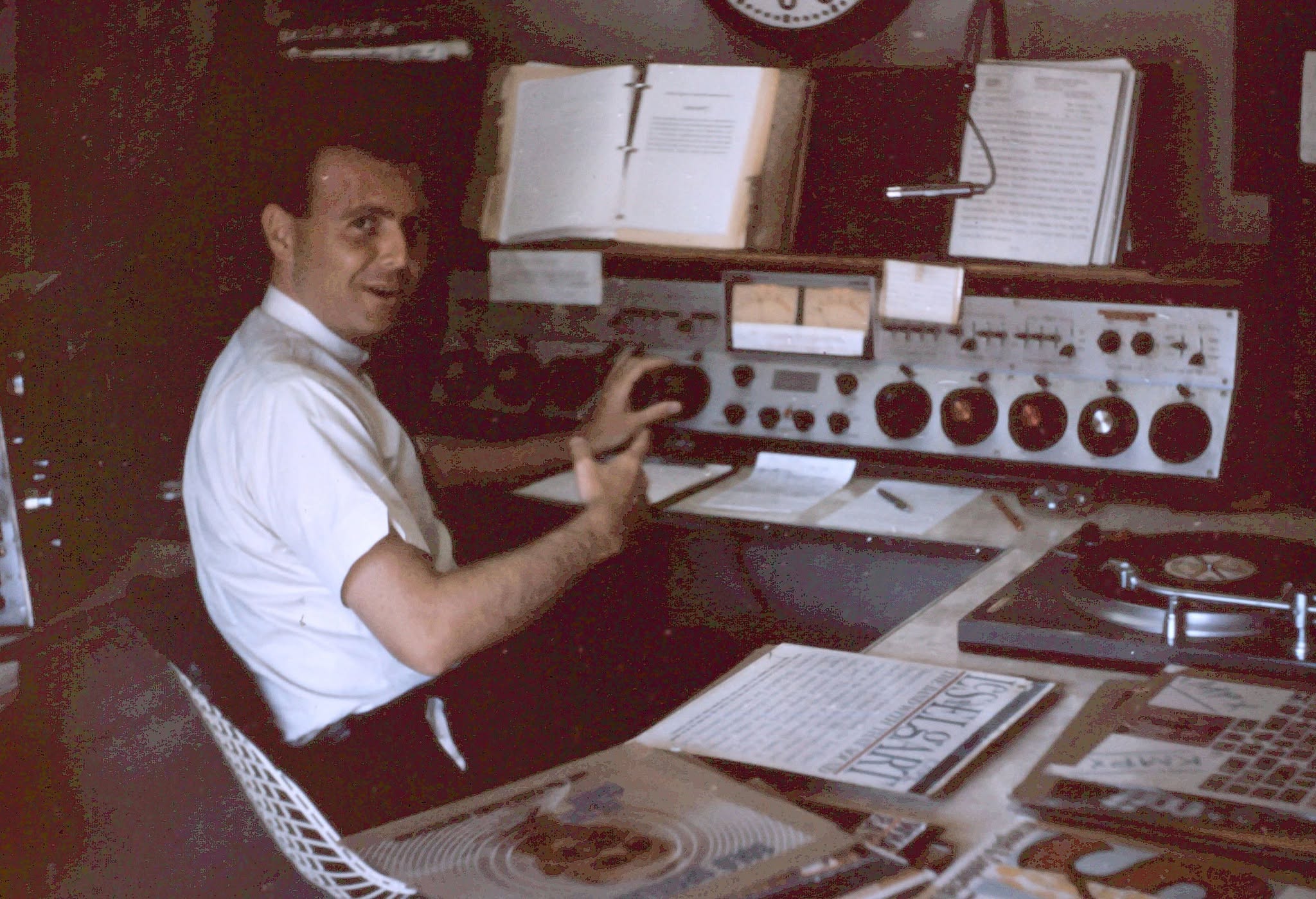
Donahue moved quickly to build the station he had in mind. He added several new voices who met his criteria for the evolving format, including Bob McClay, Abe “Voco” Keshishian and Edward Bear, and hiring what were known at the time as “chick engineers” as board operators. Among the earliest hires in this latter group was a young woman named Dusty Street, who would go on to greater fame behind the microphone as one of the leading stars of progressive rock radio.
August 6, 1967 was the milestone day when the last of the foreign-language contracts expired and KMPX could be heard in full. Listeners tuned in quickly, zooming KMPX up the ratings charts.
In November 1967, Leon Crosby acquired a sister station for KMPX, purchasing KPPC in Pasadena. Donahue immediately began splitting his time between northern and southern California, consulting KPPC and hosting his show on both stations.
This situation, which caused Donahue to occasionally miss doing his show on one or the other station, began a deterioration in relations between Leon Crosby and the staff of the stations, and led directly to a general strike by the KMPX staff in the early hours of Monday March 18, 1968, after Donahue was replaced by Bob Prescott as program director the previous Thursday.
The KMPX staff said its bargaining unit was called Amalgamated American Federation of International FM Workers of the World, Ltd. (or, simply, AAFIFMWW), North Beach Local No. 1, though there’s no record that the AFL-CIO ever recognized the group.
What ensued captured plenty of attention: long-haired bead-wearing pickets, visits by local musical icons the Grateful Dead, Blue Cheer, and Creedence Clearwater Revival, and crowds of bemused onlookers.
Under the headline “Rock Radio in the Streets”, the San Francisco Chronicle ran a lengthy story on the first day of the walkout and continued to closely follow what was dubbed the “hippie strike”.
Crosby brought in a replacement staff at KMPX, which included Larry Miller (who had left the station to return to Detroit), Gus Gossert (who hosted a six-hour Sunday night oldies show on KMPX and later became a popular oldies DJ on New York’s WCBS-FM) and a young disc jockey named Larry Ickes, who had been working at KKIS in Pittsburg and KNBA in Vallejo; Ickes worked mornings at KMPX as “Larry The Lion,” crossing the picket lines despite threats (“Wait until we give your name to the Hell’s Angels”), and eventually came to believe that the strikers were ganging up on Crosby. Miller, a victim of adverse press in the local underground papers, returned to Detroit after a short time and became a favorite among rock radio fans there.
The strike dragged on for eight weeks. When it ended, the original KMPX staff was gone. On May 21, 1968 Donahue and several others started working at KSAN-FM (94.9), recently acquired by Metromedia. Thus began the “Jive 95” era.
Back at KMPX, meanwhile, Crosby brought in Tom Yates (working as “Tom Swift”) as program director, with Bobby Cole serving as music director. Both men would later work at multiple Bay Area radio stations.
Crosby was busy: at the end of 1968, he acquired an additional ten percent ownership interest in KMPX. He’d also launched San Francisco UHF TV station KEMO (Channel 20).
In November 1969, Lee Crosby sold KMPX for $1,084,000. The purchase price included Crosbys’s Pasadena stations KPPC AM and FM. The buyer was National Science Network, Inc. (Ludwig W. Frohlich, et al.).
The German-born Frohlich had come to the U.S. as an exchange student in 1931 and proceeded to build a major advertising agency as well as a market-research company focused on science and medicine. A bachelor, his only immediate heir was his sister when he died in 1971.
The station stayed with a Progressive Rock format into 1972, when it shifted to Big Band/Swing/Nostalgia. The San Francisco Examiner‘s report on the format change said KMPX had been “operating exuberantly, but with monetary unsuccess.” Five on-air staffers were fired, then told they could audition for roles in the new format. Station manager Jeri Lesser was quoted as saying all five chose to do so.
The new format was overseen by John Jensen, whose well-documented history of the station’s big band years is useful reading. Jensen had found a niche at Santa Clara’s KREP for the music he loved and collected. Jensen quickly became general manager of KMPX, a position he held until 1978.
Jensen attracted quality air talent to KMPX, though many announcers were much younger than the music they were playing. The station also staged big public events, including a memorable October 1975 remote broadcast from a hangar on Treasure Island to salute the US Navy on its 200th birthday. Bing Crosby, Mel Blanc and other luminaries lined up to take part.
In August 1975, published legal notices showed the intent of Ludwig Frohlich’s sister and her husband, the executors of Frohlich’s estate, to sell the station to film producer/director Francis Ford Coppola for $850,000. News reports indicated Coppola planned to install the station at his recently-acquired Little Fox Theater property in San Francisco.
In March 1976, San Francisco Chronicle columnist reported Coppola had backed out of the deal in a change of course (he’d already taken a big loss to shutter City magazine). Wrote Caen, “Terse statement from Coppola’s corporate cupola: ‘There have been changes in our media plans.'”
A few months after that report, National Science Network served notice of plans to unload the station via an unusual four-way deal involving three licenses. The announcement triggered protests, led by the KMPX Listeners’ Guild and the Women’s History Research Center in Berkeley, when word emerged that the new owners of KMPX planned to ditch the Big Band music in favor of an Adult Contemporary format.
A blizzard of filings with the Federal Communications Commission argued that listeners should have a say in what’s aired on stations that are, under Federal law, granted in “the public interest, convenience, and necessity”.
As the battle dragged on, representatives for filmmaker George Lucas met with Jensen and signaled their interest in buying or launching a Big Band station. Nothing would come of that.
Petitions were signed and submitted, counter-filings were made, and in the end, the FCC decided to let the deal go through.
The Commission did require the station’s call letters to survive the frequency swap. An agreement was also in place for the format to continue for at least two years.
The sale of KMPX by National Science Network, Inc., was closed in the second week of September 1978 to Family Stations, Inc., for $1 million. Concurrently, Family Stations Inc. sold its KEAR (97.3 FM) to CBS Inc. for $2 million, while CBS Inc. sold its KCBS-FM (98.9 FM) to a new minority-owned entity, Golden Gate Radio, for $850,000.
Golden Gate Radio was to take over the former KMPX Big Band format and call letters, broadcasting on 98.9 FM, while the new KCBS-FM (at a more powerful signal on 97.3) switched to a “Mellow Sound” light rock format known as “97K.” Family Stations’ religious programming would still carry the call letters KEAR–but now at 106.9 FM. With the sale of KMPX, NSN Inc. was out of the broadcasting business.
As for who was in charge of KMPX, the new entity known as Golden Gate Radio was controlled by Lloyd Edwards and his wife Barbara. The Edwards’ ethnicity (he was Black and Native American; she was Black) made them Northern California’s first local Black radio station owners. Barbara became station manager.
Lloyd Edwards had worked at KSFO, breaking color barriers as a street reporter, before setting out to launch a bank and a significant political consulting and communications firm. He served on the KQED Board of Directors.
The Edwards did not own 100% of Golden Gate Radio. Each held a 30% share of ownership, and the remaining 40% was held by Gene and Susan Chenault. Yes, that Gene Chenault. He was the owner of KYNO in Fresno, where his hiring of a young program director named Bill Drake led to the phenomenally-successful Drake-Chenault consulting and syndication business.
Under Golden Gate’s ownership, KMPX did maintain the Big Band format, but as Jensen (who departed when Golden Gate Radio acquired the call letters) would later write, “without the in-depth library, the remote broadcasts and other trademarks of the old station, it was abundantly clear that KMPX 107FM was gone.”
It was really and truly gone by the summer of 1982, when Golden Gate Radio sold KMPX to Broadcast Associates, Inc., owned by two New Jersey attorneys. The company announced plans to take the station off the air for a few days.
When it was heard again, it was as a rock station, KQAK, and KMPX faded off the Bay Area radio dial for good.
“On May 21, 1967 Donahue and several others started working at KSAN-FM (94.9)…”
Shouldn’t this be 1968?