 Oakland’s KROW was first heard in 1925 as KFWM. The station was owned and operated by the Oakland Educational Society, which had a close contractual relationship with the Watch Tower Bible and Tract Society (renamed Jehovah’s Witnesses in 1931).
In January 1930, the KFWM license was transferred to the Educational Broadcasting Corporation, with Henry P. Drey becoming the president, general manager and 37.9% stockholder. The remaining ownership consisted of more than 100 individuals associated with the Watch Tower Bible and Tract Society, with no one person’s share exceeding 10%.
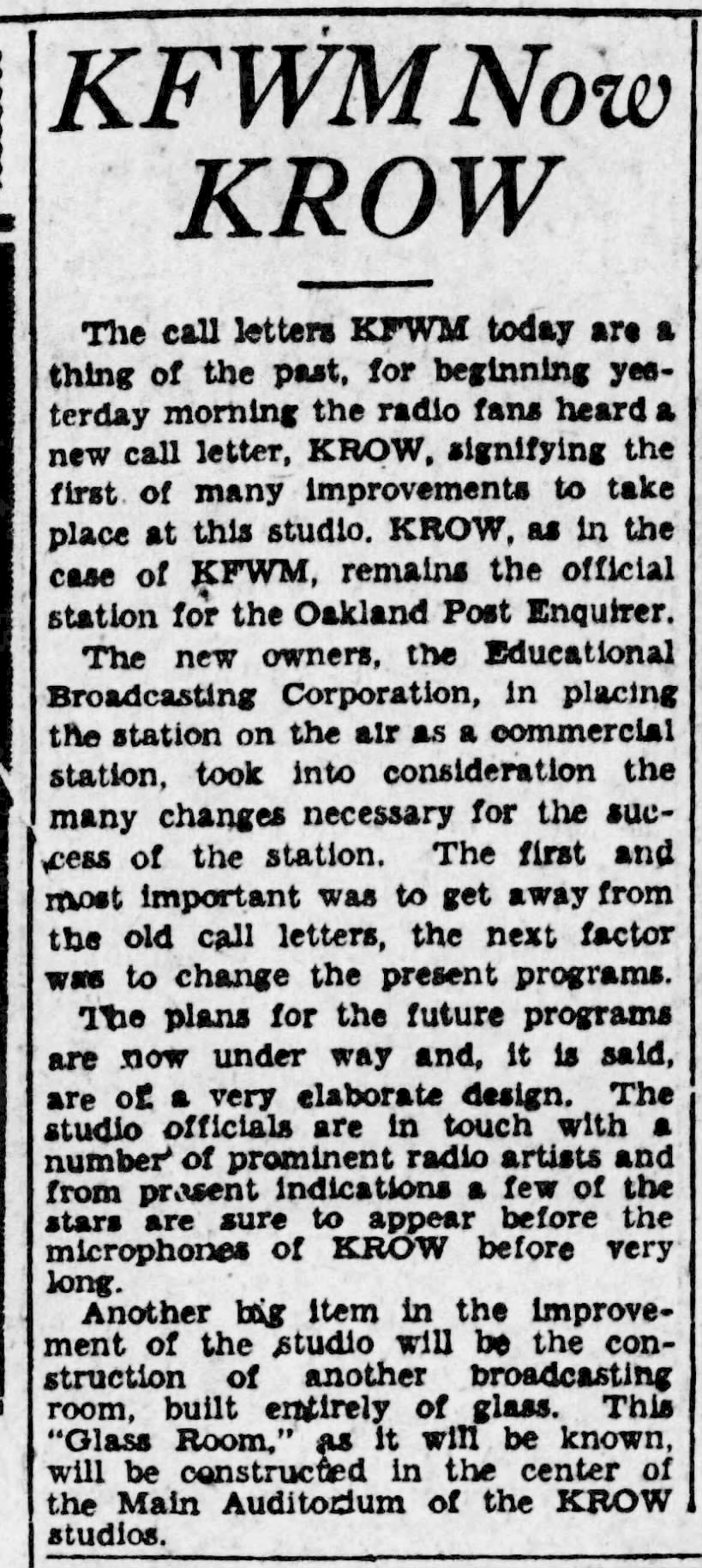
Shortly after the change in ownership, the station’s call letters were changed to KROW. The station, though no longer controlled by the Watch Tower Bible and Tract Society, continued to carry some of the organization’s programs. The new ownership cemented an arrangement with the Oakland Post-Enquirer, making KROW the “official broadcaster” of the newspaper.
Post-Enquirer sports editor Al Santoro, described by the paper as “the pioneer western sports reporter on the air”, began delivering regular sports updates on KROW. Santoro had indeed been an early sports voice on radio, having been heard on KGO and KFRC since the mid-1920s. Other members of the Post-Enquirer sports staff got their own slots on KROW.
A popular program called The Campfire Revue launched on KROW in mid-1930. The 8:30 PM Tuesday show was described as a broadcast that would “depict some of the interesting and amusing incidents of campers around the evening campfire”. Other early KROW programming included live musical performances and news updates.
A teenaged Ralph Edwards began working at KROW in 1930; he would go on to widespread success in radio and television including roles as host of the popular shows Truth or Consequences and This Is Your Life. Future Bay Area bandleader and station owner Del Courtney was another early KROW hire.
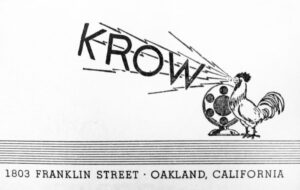
For the first few years of its existence, KROW’s studio and transmitter were in Richmond. In 1933, the studios were moved to 1803 Franklin Street in downtown Oakland and the transmitter moved back to KFWM’s original site on 8th Avenue, near Lake Merritt. That same year, San Francisco station KFWI went off the air, allowing KROW to end a longstanding frequency-sharing arrangement and broadcast full-time on 930 kHz.
1936 saw KROW move a couple of blocks to the second floor of the building it called “Radio Center” at the corner of Broadway and 19th Street in downtown Oakland. The new studios were designed and built by the broadcast division of the Remler Company in San Francisco. Construction was overseen by KROW Chief Engineer C.E. Downey. There was a model electric kitchen studio, used for the broadcast of housewife cooking shows. Auxiliary studios were installed in the Bellevue Hotel in San Francisco.
In 1939, KROW was purchased for $110,000 by an investor group led by Wesley I. Dumm, the owner of KSFO in San Francisco. Dumm was a 49% stockholder; former KQW manager Fred J. Hart owned 30%; Philip Lasky, KSFO’s general manager, owned 17.5%, and Wallace F. Elliott, 3.5%. Lasky resigned from KSFO and became the new manager of KROW. Fred Hart reportedly sold his interests in the station shortly afterwards.
In later years, Wesley Dumm explained that he was obligated to honor an agreement with the Tenth Avenue Baptist Church in Oakland that he had made when he purchased its station KTAB (later to become KSFO). The agreement stated that he would continue to provide free air time to the church on KTAB for its “Hour of Prayer” program. However, KSFO had recently become the San Francisco affiliate of the Columbia Network, and CBS required control over all programs on the station. Dumm’s purchase of KROW gave him another station on which to broadcast the church program.
A 1944 change in Federal Communications Commission rules forced Dumm to relinquish his interest in KROW; the “duopoly rule” prohibited the ownership of more than one radio station in a community by a single entity. The $250,000 deal put the license under the ownership of KROW, Inc. Pacific Northwest broadcaster Sheldon Sackett held a 65% share of the station, and manager Phil Lasky kept a 35% share and remained as manager. However, Lasky sold out in January of 1946, went back to KSFO and soon became the manager of KPIX-TV when KSFO opened its new TV station in 1948.
Under new station manager Wilt Gunsendorfer, KROW began billing itself as “The Home Interest Station”, with an emphasis placed on local news and community events. Station identifications included the recorded sound of a crowing rooster. Programming included Pacific Coast League baseball games called by Lloyd “Speed” Maddock”, a popular noon newscast by John K. Chapel, and Scott Weakley’s “man on the street” interviews, along with a mix of symphonic and dance music.
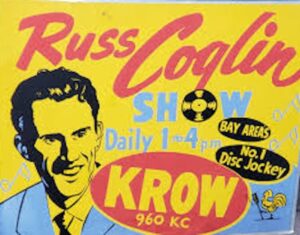 The 1945 hiring of a young former Armed Forces Radio announcer named Russ Coughlan (he would be listed as “Coglin” in KROW advertising) marked the start of KROW’s glory years. Coughlan would become program director and oversee a shift into the 1950s disc jockey-centric programming proving popular nationwide.
The station’s “Nick and Noodnick” morning show was a major hit. “Nick” was Nick Nicholsen and his “Noodnick” sidekick was a young announcer named Don Sherwood, who’d been canned at KCBS for a lack of seriousness. At KROW, Sherwood was encouraged to push the boundaries. The station’s advertising copyrighter, Phyllis Diller, contributed “bits” and a cuckoo named Cuthbert provided a squawk used as a time signal.
In 1946, KROW was shifted from 930 to 960 on the dial as part of the postwar reshuffling of frequencies that affected numerous stations.
Through all of this, KROW had been operating with its original 1920s-era transmitter, still limited to 1,000 watts of daytime power and 500 watts at night. Finally, in 1947, KROW was able to lease an island from the Port of Oakland near the Oakland approach to the Bay Bridge. It was dubbed “KROW Island”, and a three-tower directional antenna system was erected. The move included a power increase to 5,000 watts.
By 1954, KROW’s morning show trailed only KSFO in the Bay Area ratings and KSFO dealt with the challenge by hiring Sherwood, Diller and station manager Alan Torbet away from KROW. Ray Yeager and Bruce “Skipper” Sedley became the new “Nick and Noodnick” at KROW.
Russ Coughlan left in 1957, continuing a legendary career in Bay Area radio and television. He would eventually become the general manager of KGO-TV.
In 1959, Sheldon Sackett sold KROW to the McLendon Pacific Corporation for $800,000. The “McLendon” was successful Texas broadcaster Gordon McLendon, who originally planned to install the Top 40 format he’d been using in Dallas, Houston and Louisville. But realizing that the Bay Area was already home to Top 40-formatted KOBY, KYA, KEWB, and KFRC, McLendon went in the opposite direction.
On May 11, 1959, after 52 hours of playing the same song (“Giant Gila Monster”), KROW vanished, to be replaced by the beautiful music sound of KABL.
RELATED EXHIBITS:
KROW Reception Verification Letter, 1937