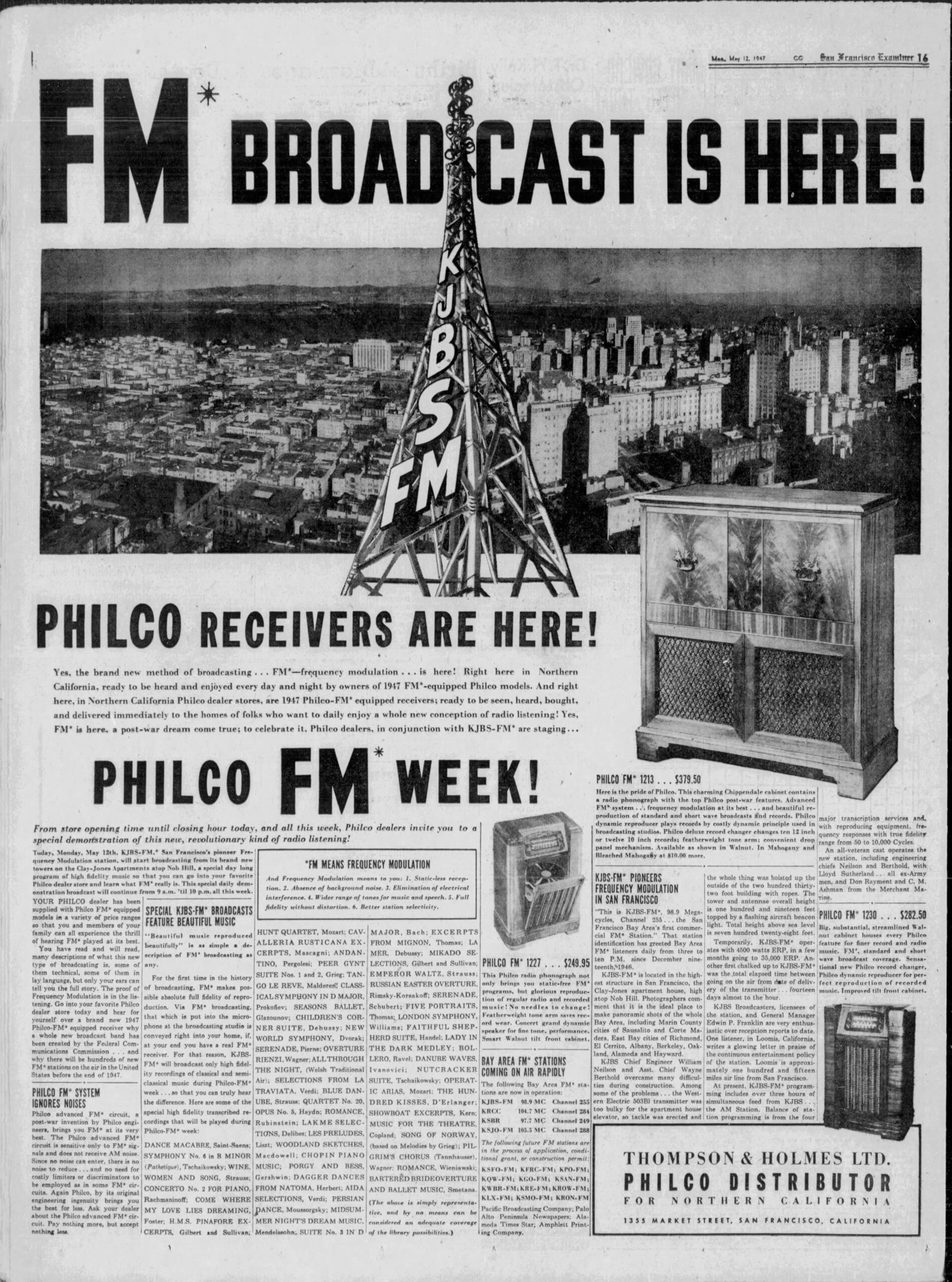
San Jose’s KSJO wasn’t the first Bay Area commercial FM station to go on the air. That honor went to San Francisco’s KJBS-FM, which made its initial broadcast on December 19, 1946. But KSJO is the only one of the Bay Area’s “first wave” commercial FM stations to still be broadcasting with the same call letters more than 75 years later.
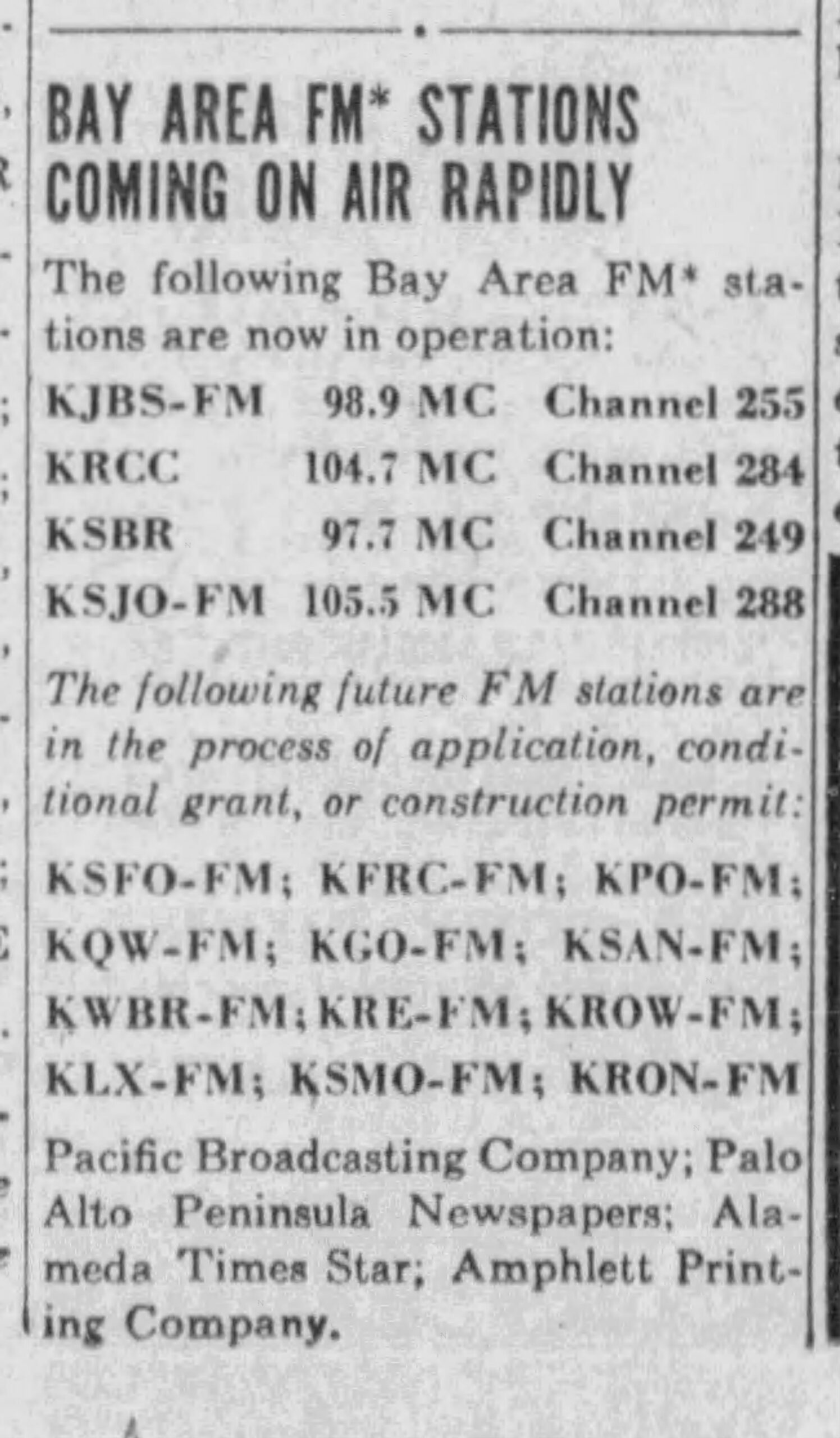
KSJO-FM began broadcasting in 1947, licensed to the Redwood Broadcasting Company. It was controlled by Patrick Peabody, a wealthy Santa Clara Valley newspaper publisher who had put KSJO on the air a year earlier. The FM station was originally assigned a frequency of 105.5 MHz but that was changed to 95.3 MHz shortly after the station hit the airwaves.
The change to the long-standing 92.3 MHz frequency didn’t happen until 1958, a shift that apparently led to enough technical difficulties that the station went off the air for several weeks to sort things out.
At the outset, KSJO-FM broadcast what was known at the time as “good music” or “background music”–what would be known in later years as an “easy-listening” format. Programming was separate from co-owned KSJO, something that was uncommon among AM/FM duopolies of the era.
Soon after the June 1961 decision by the Federal Communications Commission to authorize stereo multiplex broadcasting, KSJO-FM joined James Gabbert’s KPEN as one of the Bay Area’s earliest FM stations to broadcast a stereo signal. KSJO’s coverage area remained somewhat limited due to its low power and the fact that its transmitter location was on the Santa Clara Valley floor. Owner Patrick Peabody told reporters he planned to move the transmitter site to the hills east of San Jose and file for an increase in power.
In 1967, KSJO-FM’s newspaper listings still showed programs like “Morning Bright” and “Music For Your Dining and Relaxation”. But there was also “Rhythm Ranch: Country and Western Music With Lonesome Bob”. In the spring of that year, the station was sold to SRD Broadcasting. The “S” was Scott Elrod of San Francisco, the “R” was noted broadcast salesman Richard “Dick” Garvin, and the “D” was Don Bekins of Bekins Van Lines.
Though AM sister station KSJO had been sold in 1960 and the call letters changed to KLIV, ending the need for the “-FM” suffix, KSJO wasn’t officially listed in Federal Communications Commission records as just plain KSJO until June of 1971.
SRD Broadcasting would move the station into the progressive rock format that was exploding in major markets across the country. In one flavor or another, KSJO would remain a rock music station until 2004.
 The sale of KSJO to an entity controlled by Seattle millionaire Fred Danz came in 1974. By then, KSJO and San Jose rival KOME were engaged in a heated battle for the ears of rock listeners, and the “bumper sticker war” between the two stations was in full swing.
Dominance ebbed and flowed in a pitched competition for album-rock dominance in the South Bay.
After the death of founder Fred Danz, Sterling Recreation Organization sold KSJO and co-owned KHTT (the former KXRX) to Narragansett Broadcasting in 1985.
In late 1991, KSJO was sold again. The buyer, BayCom Partners, paid $5.5 million for KSJO and co-owned KSJX. BayCom was headed by former K-101 general manager Jack McSorley. The transaction put the station back in local ownership for the first time since 1978.
By 1994, KOME had flipped to modern rock and KSJO was the stand-alone AOR station in the Santa Clara Valley. KSJO rode a wave of popularity during the decade heavily driven by morning personalities Lamont and Tonelli. By 1998, KSJO’s signal was being simulcast on three other separate stations (located near 92.3 on the dial) around the San Francisco Bay Area: 92.7 KXJO in Alameda/Oakland, 92.7 KMJO in Marina (Monterey County) and 92.1 KFJO in Walnut Creek.
The Telecommunications Act of 1996 triggered massive consolidation in radio. BayCom sold KSJO and KUFX plus two Portland, OR stations to American Radio Systems in a $103 million deal. ARS would soon merge with CBS Corporation. That deal required the spinoff of some stations to remain within ownership-cap restrictions, and as a result, KSJO would up in the hands of Jacor Communications in 1997. Jacor would be acquired by Clear Channel Communications (later iHeartMedia) in 1999.
By the late ’90s, the station’s ratings were still in the top ten in the San Jose market and generally in the top twenty in the San Francisco market. Fortunes began to change at KSJO, hastened by the departure of Lamont and Tonelli to San Francisco’s KSAN in 2002. KSJO’s ratings continued to slump as listeners found new ways to listen to rock music, and in October 2004, KSJO switched to a Spanish-language oldies format called “La Preciosa”.
Ownership would change again in 2008 as Clear Channel was forced to spin off stations to comply with FCC ownership limits. With KSJO now operating as part of the Aloha Station Trust, a modern rock format was launched in 2009, with the station branding itself as “Channel 92.3”.
In 2011, Universal Media Access bought KSJO and switched to a Chinese-language format, calling the station “China 92.3″.
From 2014 to 2016 Cumulus Media leased the 92.3 signal, using it as a Bay Area affiliate for its fledgling “Nash FM” brand. When that arrangement ended, KSJO launched a Bollywood format known as “Bolly 92.3.”
Universal Media Access sold KSJO to Silicon Valley Asian Media Group in 2022. New ownership kept the “Bolly 92.3” brand and format intact.
RELATED EXHIBITS: