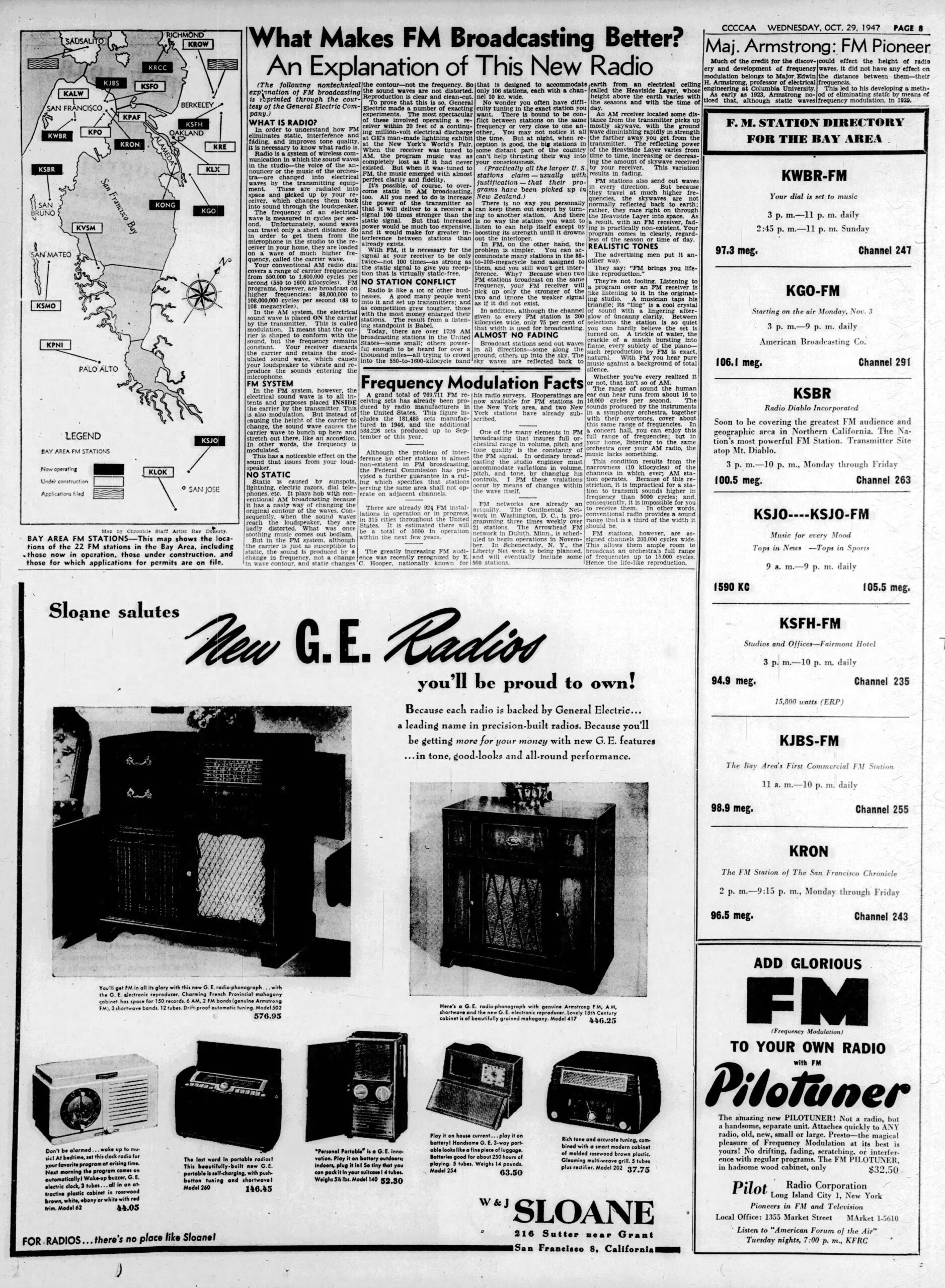

In the summer of 1940, the San Francisco Unified School District filed the paperwork to request a permit to build not only the Bay Area’s first FM station–but the first west of the Mississippi. KALW was first licensed as a non-commercial educational station in March of 1941 and on September 1, 1941 regular broadcasts began from studios at Samuel Gompers High School–a few months before the United States would enter World War 2.
Ken Nielsen, known to many as “the father of KALW”, was the guiding force at the station’s launch. Among his accomplishments: getting the school district to purchase the RCA demonstration FM station used at the 1939 Golden Gate International Exposition on Treasure Island (the school district paid $22,000 for all of the RCA gear). Nielsen would continue his engineering and teaching work at KALW into the 1970s. Another Gompers High teacher, Ken Dragoo, was a significant early figure at the station.
When the war reduced the ranks of available radio and communications technicians, KALW took the lead in pioneering women’s classes in code work, radio operation, and broadcasting. By 1942, ninety women were enrolled and involved in all aspects of radio. The students were under the direction of James C. Morgan, who’d worked at CBS, and the San Francisco News described their facility as “the first in the world to be operated entirely by students, as a laboratory”. The focus was on radio as a trade rather than an art form.
As for the audience: at the outset, the only expected listeners were students in San Francisco public school classrooms, because FM receivers were few and far between. The programming was mostly educational in nature, although the 9 AM to 9 PM broadcast schedule left time for some musical programs in the evening.
The district bought 80 FM sets from General Electric and scattered them throughout the city’s schools. Much was made of the crisp audio quality of the FM signal and the lack of interference as the FM radio waves penetrated steel-formed school buildings with ease.
According to a 1943 San Francisco Examiner report, an early programming favorite was the thrice-weekly Schoolcast current affairs show delivered by the newspaper’s librarian, Dwight Newton. The program was also aired on commercial station KYA and would be a KALW fixture into the 1960s.
Three years into the life of KALW, the San Francisco Chronicle described the station as “the pioneer FM station in the West, and a pioneer in education by means of radio.”
After the war ended, KALW became a training ground for veterans looking to re-integrate into the American workforce. The San Francisco Unified School District set up a program to help vets tap into the GI Bill of Rights, and for some, radio work was in their future.
In 1947, KALW settled at its permanent spot on the dial, 91.7 MHz. By then, about a half-dozen commercial FM stations had joined the Bay Area’s airwaves (more were on the way) and the San Francisco Chronicle noted the demand for skilled workers in broadcasting. “Station KALW…is in a curious predicament,” columnist Paul Speegle wrote. “It has been so succesful in placing its students in paying jobs in Bay Area radio that it is running out of people to teach. In other words, boys and girls (particularly girls), if you’re interested in either the technical or producing side of radio, ankle out to KALW.” The shortage of girls signing up for the radio program would be a recurring theme for years.
KALW entered the 1950s as a weekday-only operation (just like schools). For the 1950-1951 school year, it introduced new programming: re-broadcasts of San Francisco public high school sports events. Students would record their play-by-play coverage from the sidelines for later airing. The Fifties also saw the opening of John O’Connell Vocational High School, which would become KALW’s home base.
The school district added television production courses to the trade school curriculum in 1952 (the school had been re-named John O’Connell High School in 1951). The studios built for that program would become the original home of KQED-TV in 1954.
KALW offered airtime in 1954 to The City’s best young middle-school spellers. For several weeks, contestants in the citywide spelling bee sponsored by The San Francisco News held practices rounds live on KALW before heading to the finals at Mission Junior High School’s auditorium. The spring spelldown would become a regular fixture on the station.
By the mid-1950s, the Radio-TV program at San Francisco State College was providing announcers to KALW. The station was carrying San Francisco Board of Supervisors and San Francisco Board of Education meetings live.
The 1970s saw the station carrying live coverage of San Francisco public school sports, and a handful of University of San Francisco basketball games. By then, the station had three large studios and employed professional announcers and engineers, yet in 1970, was only on the air for six hours a day, five days a week. Veteran San Francisco teacher Ted Samuel joined the station as program director that year and by 1980, KALW was broadcasting 18 hours a day, seven days a week. Programming was expanded to include a variety of music and cultural content. One notable example was Bill Moriyama’s Swing Shift, a big band program later heard on KCSM.
In 1972, the newly-formed National Public Radio network (NPR) began providing programming to KALW. That same year, the station launched a Chinese-language broadcast of KGO-TV’s 11 PM news (the idea was that Chinese-speakers would watch the show on TV and listen on the radio). San Francisco Chronicle columnist Terrence O’Flaherty quipped, “Even if you don’t understand Chinese, the news may sound better than it does in English these days.” Published reports indicate KGO-TV paid the perennially cash-strapped radio station $100 a week to carry the translated newscasts.
By the mid-70s, the station was no longer functioning as a classroom for San Francisco public high school students. It was being operated in the manner of many other public radio stations, albeit one with a complicated relationship with its license-holder, the school district.
A longstanding voice on KALW joined the station in 1975. Alan Farley would go on to create programs like Book Talk, Explorations in Music and Open Air. Farley remained on the air until a few weeks before his death in 2012.
When KALW marked its 40th anniversary in 1981, station manager Leon Del Grande said, “That’s a lot of mileage for a station that has been running on a shoestring all these years.” A year later, a combination of federal funding cutbacks and a school district budget crisis nearly put KALW off the air. The station managed to hang onto some of its SF Unified funding and a series of fundraisers kept the bills paid.
It wouldn’t be the last crisis at KALW. A flap over a petty-cash account led the school district to transfer Ted Samuel back to classroom duty in 1985 while advocates for the station complained of what they viewed as political interference by the San Francisco Board of Education and school administration. Headlines in 1987 pointed to yet another funding crisis as the school district dealt with perennial budget problems.
By then, the station’s programming was heavy on NPR and other public radio content, leaning heavily toward spoken-word content. Joe Burke joined as morning host in 1988 and would stay until 2016.
At age 50 in 1991, KALW was saluted by San Francisco Examiner media critic David Armstrong, who wrote, “Budget cuts notwithstanding, KALW remains a bright spot on the dial.” Two years later, in yet another story focusing on the station’s financial challenges, general manager Jerry Jacob noted that the majority of KALW’s budget came from membership pledges. We don’t feed a fat-cat hierarchy,” he told the Examiner. “We’re real lean–we’re positively anorexic.”
Part of the station’s challenge was to carve out a niche in the public radio space with better-funded and more-powerful KQED-FM also broadcasting from San Francisco. Both stations carried many NPR programs, but KALW also picked up British Broadcasting Corporation fare and tried to go hyper-local with news and arts coverage. A local quiz program launched in 1993, Minds Over Matter, would still be running more than 30 years later.
KALW faced an existential challenge in the late 1990s. A group of part-time KALW announcers filed a petition to deny KALW’s application for renewal of its FCC license, arguing that the school district’s stewardship of the station was untenable. The group known as Golden Gate Public Radio wanted the license, saying it should be taken away from the school district. The matter would remain unsettled until 2006, when the school district was ordered to pay a small fine but retained the license.
In the meantime, former KPFA general manager Nicole Sawaya had arrived at KALW. Her five-year tenure at the station led to the creation of a number of new programs, including Philosophy Talk, started by Stanford professors Kenneth Taylor and John Perry. The program continues to be heard on many public radio stations nationwide. Among the locally-focused programs launched in this era was Your Call, an interview program that Rose Aguilar would take over in 2006.
2008 saw the launch of daily local news magazine program Crosscurrents.
By 2011, a 70th anniversary San Francisco Chronicle piece by Ben Fong-Torres would be headlined “A Public Radio Station is Spry at 70”. General manager Matt Martin said KALW was endeavoring to differentiate itself from KQED-FM by being “local, global and creative.” While the ever-present financial problems remained, Martin expressed confidence that KALW was in no danger of suffering the fate of KUSF. The once-independent station was being sold by the University of San Francisco to Classical Public Radio Network for $3.75 million; it would have its call letters changed to KDFC.
The relative stability of KALW as it passed age 70 had been aided by a $200,000 line of credit from San Francisco Unified (Martin described it as “a bridge loan”); it was the first direct funding the station had received from the school district in 20 years. Of course, the district provided free rent for KALW’s studios and handled a number of administrative tasks; the station’s own financial statements valued that support at more than $230,000 a year.
At age 75, KALW was getting a spruce-up. New studios were installed at Philip and Sala Burton High School. The station was deeply into streaming and was an early entrant into the world of podcasting; the program 99% Invisible found its way into the podcast world after launching in the broadcast world. The show’s creator, Roman Mars, had approached KALW with an idea but no broadcasting experience and was trained and supported in-house. He would eventually leave the station with the rights to the project before setting up a podcast network.
In 2014, KALW reached back to its roots and launched a program to train broadcast journalists. Called Audio Academy, it offered a ten-month tuition-free program.
A 2017 episode was a reminder that KALW was always going to deal with the realities of the name on the license: the San Francisco Unified School District (it’s worth remembering that for many years, the official licensee was The Board of Education of the San Francisco Unified School District). Two board members made it clear: they wanted to hear more news about the school district on KALW. One said, “This is our radio station and I just feel like that you would never know this is ours.” News director Ben Trefny told The San Francisco Examiner, “We will continue to cover the SFUSD just as we cover any other school districts in our listening area.”
Like many radio stations, KALW faced challenges during the Covid-19 pandemic. Live local broadcasts were pared back as the station dealt with pandemic protocols, often replaced by pre-recorded segments run through an automation system.
In 2020, In 2020, KALW established KALW Public Media as a 501(c)(3) nonprofit to handle operations, fundraising, and distribution under an agreement with the SFUSD, which retains the FCC license.
On September 1, 2021 the station marked its 80th birthday. San Francisco Mayor London Breed attended a celebration and declared the day “KALW Day” in San Francisco.