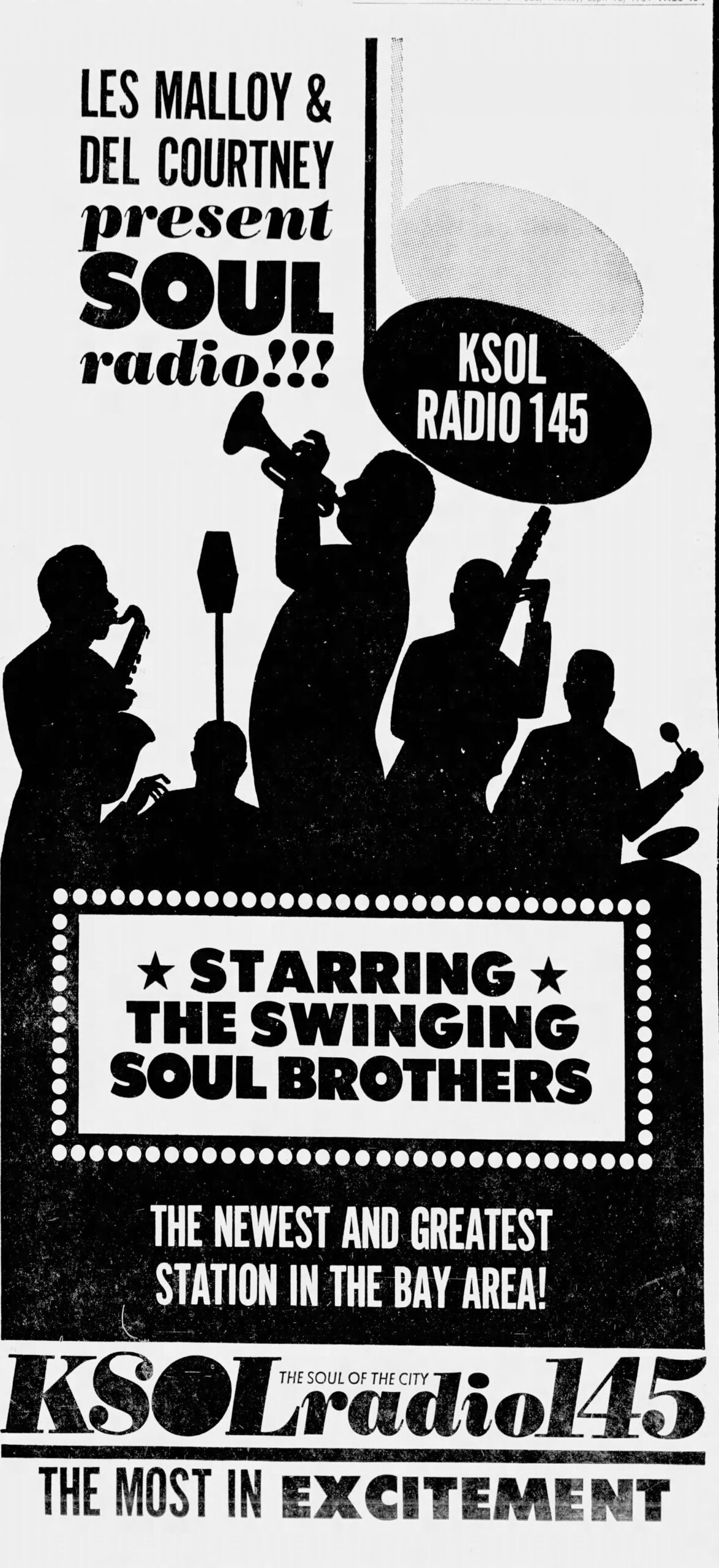
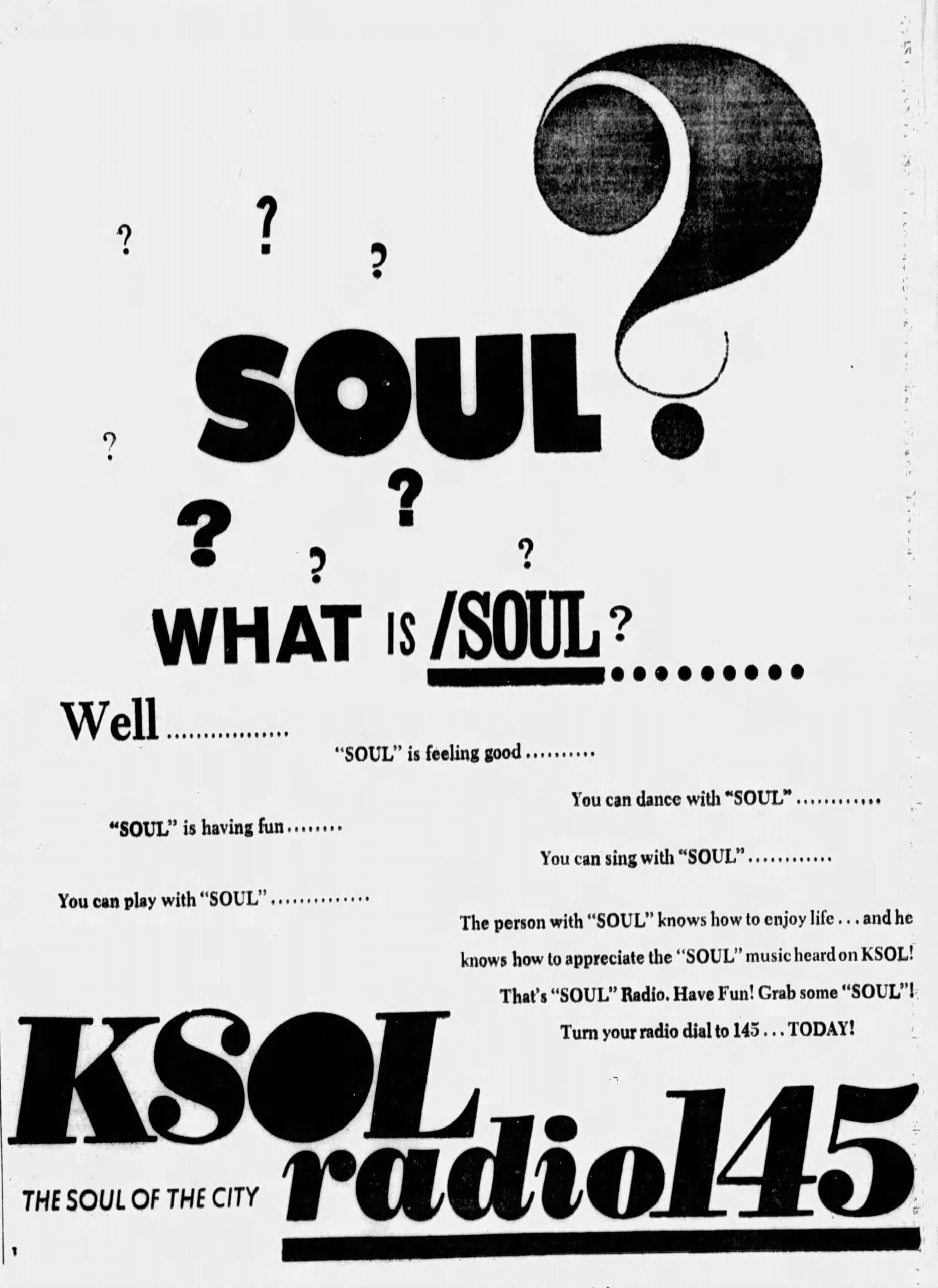
Earlier known as KSAN (AM) and descending from pioneering San Francisco stations KGTT and KGGC, KSOL came into being in 1964. The station was purchased by entertainers Les Malloy and Del Courtney, who changed the call letters to KSOL, reflecting the evolution of rhythm and blues into “Soul” music. The meager 250-watt signal (later 1,000 watts during daytime hours) emanating from KSOL’s tower atop the Merchandise Mart on San Francisco’s Market Street limited the station’s coverage area.
Malloy and Courtney were household names in the Bay Area. Malloy had actually worked at KGTT as a teenager and would go on to a lengthy career as a disc jockey (including a lengthy run on KSAN) and television personality. Courtney was a bandleader whose career dated back to the 1930s. He was no stranger to radio, as the medium relied upon live big band music for many years. The two were able to tap into their extensive show business contacts–as an example, convincing popular singer Nat “King” Cole to record station promos not long before his death in 1965.
Before the Malloy/Courtney purchase and call letter change, the station had already shifted toward rhythm and blues music aimed at the area’s Black population. The new owners went all-in, billing the station as “Super Soul Radio 145”.
Despite the challenges of a low-powered station at the higher end of the AM dial, KSOL managed to grab attention. In 1966, San Mateo Times columnist Bob Foster wrote, “‘This station is one we must all really contend with,’ a station manager told me recently. It now has topped KCBS in some ratings, and has skipped past a couple of the music stations.”
Air talent included morning man Charlie Brown (born Larry O’Brien), midday mainstay Bert Bell (air name of Herb Campbell), and a weekend evening host who would go on to iconic status as a music star: Sylvester “Sly Stone” Stewart.
KSOL carried San Francisco State College football games for several seasons, and was the radio home of the San Francisco Shamrocks. The Shamrocks, based at Winterland Arena, made news in the world of Roller Derby by poaching Bay Bombers legend Ann Calvello to join the newly-formed rival National Skating Derby league.
In May 1966, KSOL sent public affairs director Roy Wood to Vietnam. The station asked listeners to send in the names of Black soldiers on duty there and Wood’s assignment was to track them down and record messages for the hometown audience. One newspaper columnist remarked, “This is the sort of public service that radio stations can do best, if they’ll only do it.”
Malloy won an FM license grant in San Jose, putting middle-of-the-road formatted KPLX (later KEZR) on the air n 1967. At the time, San Francisco Chronicle columnist Herb Caen noted, “…the saturation point has now been reached. Mo more spots available on either the AM or FM bands in this area.”
Throughout its brief history, KSOL competed for the Black audience with KDIA in Oakland (formerly KLS and KWBR). By mid-1970, the battle was over. KSOL laid off its air staff in September 1970, shifting to a beautiful music format. Malloy said,”We’ll be playing the same kind of music as KABL and KFOG.” Lawsuits and protests ensued, with claims that Malloy had targeted Black employees.
In late 1970, the station applied for new call letters and in early 1971, they were granted: KEST.
RELATED EXHIBITS:
The Complete KSAN/KSOL Airchecks Collection
KSOL Soul Power 20 Survey, 1970