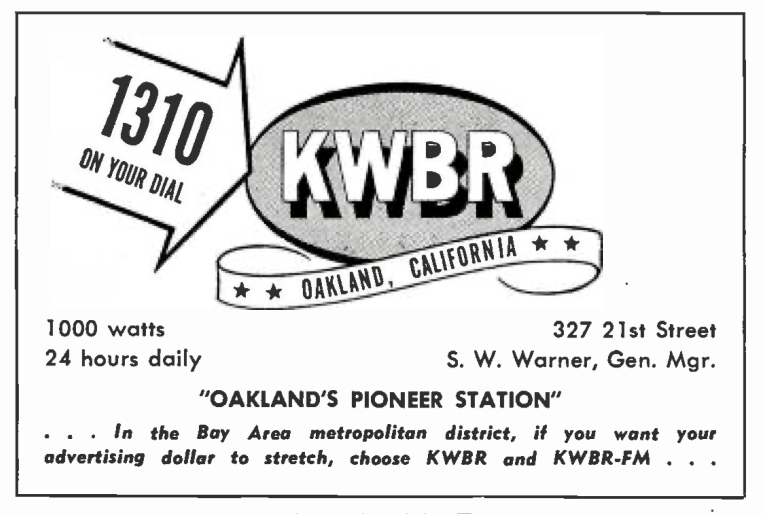
Pioneering Bay Area broadcasters Stafford and Eugene Warner had operated Oakland station KLS since March 6, 1922 after obtaining a commercial license (they’d already been on the air regularly, operating an amateur station out of their wireless store at 22nd and Telegraph). On September 10, 1945, the station adopted the call letters KWBR (for Warner BRothers).
The Warners had created “Warner Brothers Radio Village”on 21st Street in 1936 . Several shops were constructed next to the second-floor studios in the form of an indoor shopping mall, and it was hoped that the presence of the radio studio would draw people to the shops. The plan never really took off. The “Radio Village” site would later be redeveloped and is now covered by a multistory parking garage attached to the Kaiser Center complex.
As KLS, the station had become one of Northern California’s first to operate 24 hours a day. There was a brief foray into the new FM frequency band. In 1947, the Warners launched KWBR-FM. Armed with a tiny transmitter literally built into a home in San Francisco’s Diamond Heights neighborhood, the station carried a simulcast of KWBR’s AM programming. An exception was the Sunday morning services from San Francisco’s Grace Cathedral, carried live on KWBR-FM. Within two years, the FM station was off the air.
KWBR had an affiliation with the short-lived Associated Broadcasting Corporation, a Michigan-based entity that provided coverage of boxing matches, among other content. The station carried several hours a week of foreign-language programming, notably in Spanish, Portuguese, and Italian.
As musical tastes changed in the 1950s, KWBR leaned into what, in that era, was often referred to as “race music”. The evolving R&B sound was championed by KWBR disc jockeys like “Bouncin’ Bill” Doubleday and “Jumpin’ George” Oxford. The station’s increasing focus on the Black audience included affiliation with the National Negro Network. That organization launched in early 1954 with a serial entitled The Story of Ruby Valentine. Plans for a broader slate of programming never materialized and within just over a year, the network was shut down.
KWBR became known as a place where Black performers could be heard. San Francisco 49ers football star Joe “The Jet” Perry held down the morning show for a time, pre-recording episodes for playback on days when his football job took him out of town. Jeannie Blevins was first heard as Perry’s sidekick and later had her own midday show. And another Black sports hero, basketball star Don Barksdale, was a KWBR mainstay. Tarea Hall Pittman, a civil rights leader whose Sunday morning Negroes In the News program dated back to the 1930s on KLS, continued the broadcasts throughout the KWBR years.
Stafford Warner died in 1955 at the age of 63, setting in motion the decision to sell KWBR. Stafford Warner had been the guiding spirit of the partnership that had operated KWBR and its predecessor KLS for more than thirty years. His brother Eugene initially took control of the station, then made plans to sell it, eventually placing KWBR in trust pending its sale to Sonderling Broadcasting Corporation for $550,000.
Sonderling was headed by German immigrant Egmont Sonderling, who realized there was money to be made targeting urban audiences with so-called “soul” music, a tack that KWBR had already embarked upon. Sonderling owned WDIA in Memphis, and when the company acquired KWBR in 1959, it was rechristened KDIA.
RELATED EXHIBITS:
Bouncin’ Bill Doubleday on KWBR, July 1956