KQBY came into the world fighting. The station previously known as KOBY switched from Top-40 to a “fine music” format in September 1960 and immediately sued KABL, claiming its established competitor had poached KQBY’s marketing slogans.
Specifically, Broadcasting magazine reported KQBY alleged KABL had “inaugurated a teaser ad campaign using the letters ‘I.Q.’ and made announcements that ‘intelligent quality programming’ would be on KABL”.
After an initial injunction in KQBY’s favor, the suit was quickly settled, with KQBY owner Sherwood “Sherry” Gordon claiming exclusive use of the slogans “I. Q. Radio” and “America’s First Family of Fine Music Stations” (Gordon also owned stations in San Diego and Phoenix).
San Mateo Times radio columnist Bob Foster, never a fan of rock music, mused that the station made the programming change “realizing that ‘rock ‘n’ roll was rapidly dying.” In reality, the dial was ever-more crowded with stations playing rock tunes and KOBY was being pounded by the competition.
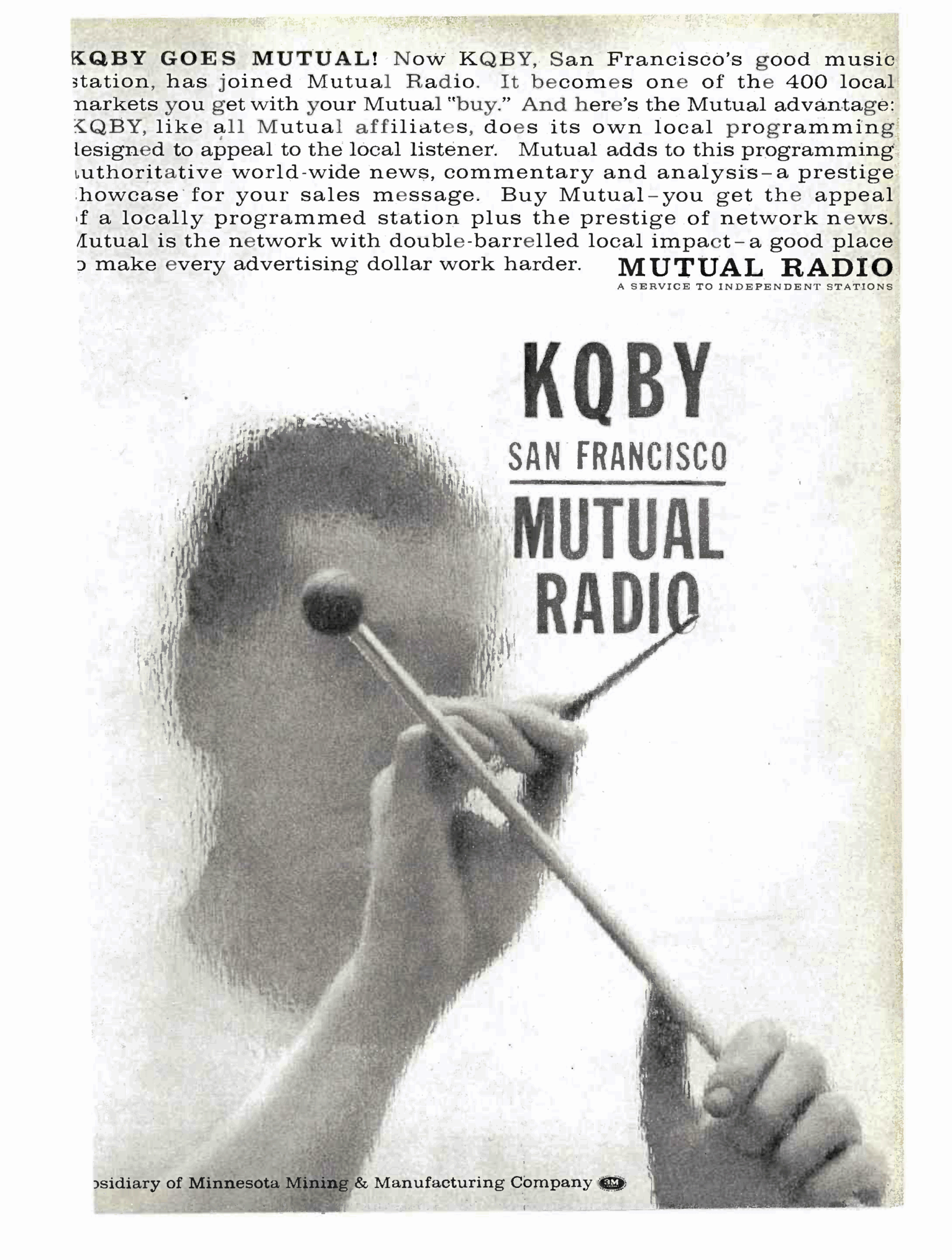
KQBY maintained KOBY’s affiliation with Mutual Radio, allowing it to offer regular newscasts and special events coverage, including extended coverage of the 1960 presidential election.
Whatever grandiose plans Gordon had for KQBY, they were dashed quickly.
By the summer of 1961–less than a year after he’d purchased the station–Gordon was unloading it, claiming he’d lost a quarter of a million dollars in a short time. His reported selling price of $720,000 was $52,000 less than he’d paid for the station.
Gordon blamed what he called the “Hooper-Pulse-Nielsen rating rat race,” calling out the three services used by advertising agencies and radio spot buyers to measure station audiences. Gordon claimed that KQBY was reaching influential audience of “thought leaders”.
Born in controversy, Gordon’s ownership of KQBY ended the same way. He took the station dark at 6:05 PM on July 16, 1961 while the Federal Communications Commission pondered his sale of KQBY and KQBY-FM (95.7) to Chicago radio veteran Frank Atlass and his wife Patricia.
Atlass Broadcasting inherited an off-the-air radio station and labor trouble. The National Association of Broadcast Engineers and Technicians (NABET) complained to the FCC that it had held off on negotiating a new contract upon the July 1961 expiration of its existing agreement with Gordon, based on representations from the seller and the buyer that the staff would be retained with the same pay and benefits.
Atlass Broadcasting maintained it could hire whoever it chose, and would recognize NABET only if the newly-hired staff designated the union as its bargaining representative.
On a 3-2 vote in October 1961, the FCC approved the sale of KQBY and KQBY-FM, rejecting NABET’s complaint. The FCC said that although it failed to find that NABET had standing to oppose the sale, it considered the allegations and determined that the alleged dealings with the union involve business management and policy, not matters within the purview of the commission.
KQBY would never return to the air. When the dust cleared, Atlass Broadcasting chose the call letters KKHI for both the AM and FM stations.