
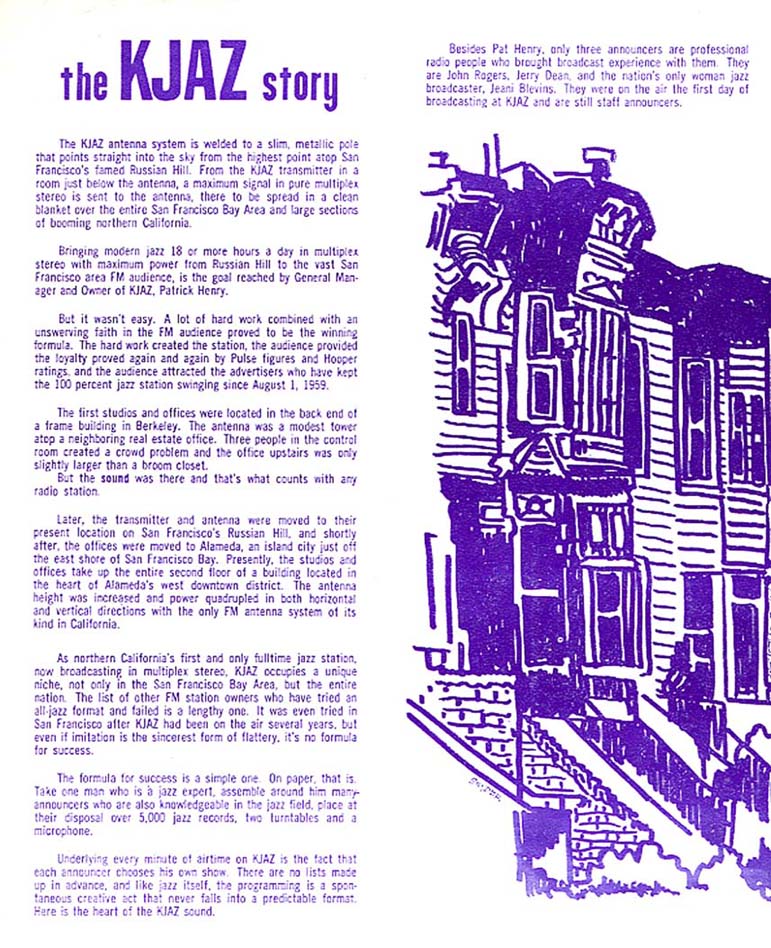
KJAZ went on the air on August 1, 1959, becoming the first commercial Bay Area station to exclusively play jazz music. The founders were Los Angeles radio promotional veteran Dave Larsen and Pat Henry, who had played jazz records on Oakland station KROW, starting in the 1940’s, and had been named “Jazz Broadcaster of the Year” by Metronome Magazine in 1956. After buying out Larsen a year later, Henry ran KJAZ for years with a keen personal sense of what was “in” and what wasn’t.
The station’s early programming gave on-air platforms to numerous Bay Area jazz critics and aficionados, including a semantics professor named S.I. Hayakawa, who would go on to become the president of San Francisco State College.
The station’s original transmitter site and studios were on Telegraph Avenue in Berkeley, with additional studios in the then-new South Shore Shopping Center in Alameda.
Over the years, KJAZ attracted visits from numerous jazz artists. In 1962, it moved its transmitter to San Francisco’s Telegraph Hill, increasing its coverage area. At the same time, studios were moved to Webster Street in Alameda.
A protracted licensing battle in the 1970’s led Henry to sell the station to Oakland Mayor Lionel Wilson and Ron Cowan, the developer of Alameda’s Harbor Bay Isle community. Cowan soon bought out Wilson and would move the station to Harbor Bay Isle.
By the early 1990’s, Cowan instituted spending cutbacks and denied reports that bankruptcy was imminent. In 1993, Cowan found himself in the middle of a development that had industry veterans and regulators scratching their heads: Roseville, CA-based Sunrise Bank filed an application with the Federal Communications Commission seeking a “voluntary transfer of control” of the KJAZ license.
It seems Cowan had pledged the station as collateral for a loan of more than $2 million. He said he had no intention of selling the station or surrendering control to Sunrise Bank and in fact, was planning to create a satellite-distributed “superstation” version of KJAZ.
In the summer of 1993, KJAZ went up on the bird. The National Jazz Radio Network was a joint venture with Oklahoma-based United Video. The service offered KJAZ programming for free to other radio stations as well as cable system operators around the country. It was a bet that KJAZ could attract enough national advertisers to improve its meager finances.
A few weeks after the launch of the National Jazz Network, the FCC ruled against Sunrise Bank’s application to take control of the KJAZ license.
In early 1994, Cowan–facing increasing personal and professional financial pressures–threw in the towel, announcing KJAZ was indeed for sale. He said he would use proceeds from a sale to retire debt on the station and continue the newly-launched satellite delivery plan. Cowan told reporters he was looking for a $7 million selling price, though industry observers thought the station was worth less than half of that.
In fact, the industry observers were right. In May 1994, Cowan signed a deal to sell KJAZ to Z-Spanish Radio Network for $3 million but included a unique caveat. If the station could hustle enough listener donations within 60 days through a “Friends of KJAZ” program to retire the station’s bank debts, the deal would be nullified.
That fell short and KJAZ was sold to Z-Spanish Radio Network. On August 1, 1994, the jazz disappeared as Z-Spanish began Spanish-language programming and the call letters were changed to KZSF.
Bob Parlocha needs to added the the KJAZ Hall of fame rolls