Petaluma’s first broadcast license was granted in 1949 to a group calling itself Petaluma Broadcasters. The company was a partnership of Forrest Hughes and Harold Sparks. Hughes would be the chief engineer; Sparks would serve as general manager of the new 250-watt station while his wife Catherine held the role of program director.

The call letters, meant to mean “Krowing Always For Petaluma”, were a nod to Petaluma’s role as the “Egg Capital of the World”. The Federal Communications Commission grant of the license carried with it one caveat: the new station could not go on the air until Sacramento station KXOA moved from the 1490 kHz frequency to 1470.
The effort to launch a station in Petaluma had actually started in 1946, and as the approval process dragged on, the prospective licensees were forced to find a new transmitter site when an original location on Bodega Avenue west of Highway 101 fell through. By the fall of 1949, a site on Redwood Highway just south of the Petaluma city limits had been selected and construction was underway on a building to house the studios and transmitter. A 180-foot tower was erected on the site.
The first broadcast day at KAFP was January 10, 1950; management had gotten the final go-ahead from the FCC the prior afternoon. Bob Bishop was the first voice heard on the new station. Dick Haag and Dave Rosen were named as additional announcers.
Programming included a variety of musical genres and also focused on local events, including sports coverage. Sunday morning listeners could hear the Comic Weekly Man show on which that day’s San Francisco Examiner comics were read aloud and dramatized.
By the fall of 1950, KAFP could claim a network affiliation: it was becoming a PBS station. In 1950, that meant the Progressive Broadcasting System, a startup network catering to small-market broadcasters. Despite an aggressive program schedule, PBS folded in 1951.
KAFP was also sold for the first time in 1951. Broadcasting magazine reported a selling price of $30,000 for 198 shares of stock in Petaluma Broadcasters. The buyers included V.A.L. Linder, described as a former production supervisor at Portland station KEX, and William Exline, then working at KSLM in Salem, OR. Bill Exline would go on to a lengthy career in broadcasting, including a stint as general manager at Pittsburg station KKIS.
Less than a year later, KAFP was sold again. The buyers were well-known in Bay Area broadcasting circles. Stafford and Eugene Warner were the pair of brothers who’d put Oakland’s KLS on the air in 1921 (by the time they bought KAFP, it was known as KWBR). They paid a reported $35,000 for the Petaluma station.
Ted Kennessey, who’d already served as sports director and program director of KAFP during its brief life, was elevated to station manager. Under the Warner Brothers ownership, the station relocated to studios and offices in the downtown Hotel Petaluma and immediately began branding itself “KAFP Warner Brothers”. The station also opened a satellite studio in Santa Rosa’s Montgomery Village shopping center.
In 1953, KAFP became an affiliate of the Keystone Broadcasting System, which by then was claiming more than 650 stations nationwide.
Whatever drove the Warner Brothers to buy a small-town station in 1952 apparently faded by early 1954. In February, the Petaluma Argus-Courier reported that the Petaluma Chamber of Commerce had received a letter from Arthur T. “Ted” Shields, part-owner of a radio station in Ladysmith, WI. Shields said he’d bought KAFP and would soon arrive in Petaluma to run it.
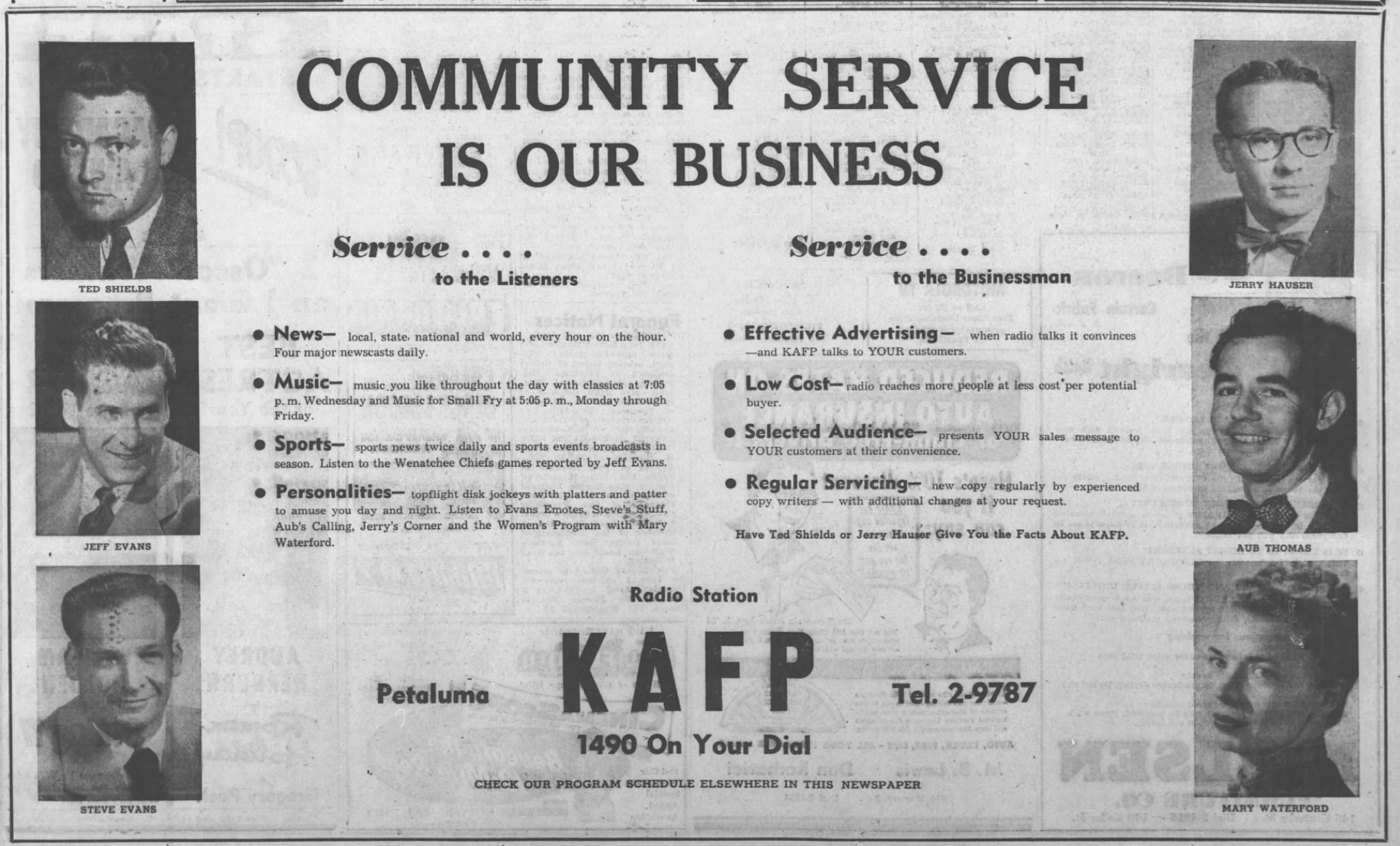
The ownership group included Shields and his wife Corinne as well as three men who’d worked under Shields at WLDY in Wisconsin. Upon arrival in Petaluma, they began placing a few ads in the local newspaper and announced some fresh programing for KAFP.
Twin brothers Jeff and Steve Evans were hired as disc jockeys. Jeff’s show Evans Emotes aired in the morning while Steve’s program Steve’s Stuff had the afternoon time slot. Aubin “Aub” Thomas handled Aub’s Calling during the evening hours.
In mid-1955, there was an ownership shakeup. The Evans brothers were out as partners in Redwood Empire Broadcasting Company and Aub Thomas was in.
By the summer of 1957, it was clear that Sonoma County was about to get at least one more radio license. Until then, the county’s only stations were the venerable KSRO–and KAFP. A lengthy story in The Press Democrat identified one group of would-be licensees: Broadcast Associates, Inc. was fronted by KYA general manager Irving Phillips, who held a 25% interest.
Phillips was quoted as saying Sonoma County had “a potential second to none” among Northern California broadcast markets. He said his group would explore all options for getting its hands on a Sonoma County license–either applying for a new license, buying one from another applicant, or purchasing an existing station.
It turns out Broadcast Associates already had a deal in the works, for a week later, Broadcasting magazine reported the partnership had paid $75,000 to acquire KAFP. If you’re keeping score, that’s five owners in the seven-odd years the station had been on the air.
Under program director Al Daneri and general manager Charlie Powers, KAFP was soon recruiting talent, calling itself “Sonoma/Marin’s top music station”. By late 1958, Santa Rosa’s KJAX was on the air, heating up competition in the market.
And in the summer of 1960, the Petaluma Argus-Courier dusted off a familiar headline: “Radio Station Is Sold Again”. This time, the buyer was Lloyd Burlingham and his wife Mary. They’d been the owners of KCVR AM and FM in Lodi. The Burlinghams paid $115,ooo for the oft-sold station.
On January 10, 1961, the station carried a special evening broadcast listed as Tenth Anniversary of KAFP (Ten Year Review of Petaluma). It was, in fact, the eleventh anniversary of KAFP’s inaugural broadcast, but the call letters were vanishing anyway. The next program on the schedule for January 10, 1961–at 6:45 PM–was KAFP Becomes KTOB–The Station at The “Top of the Bay”.
KAFP, the station perhaps best known for its frequent ownership changes, was now KTOB.