
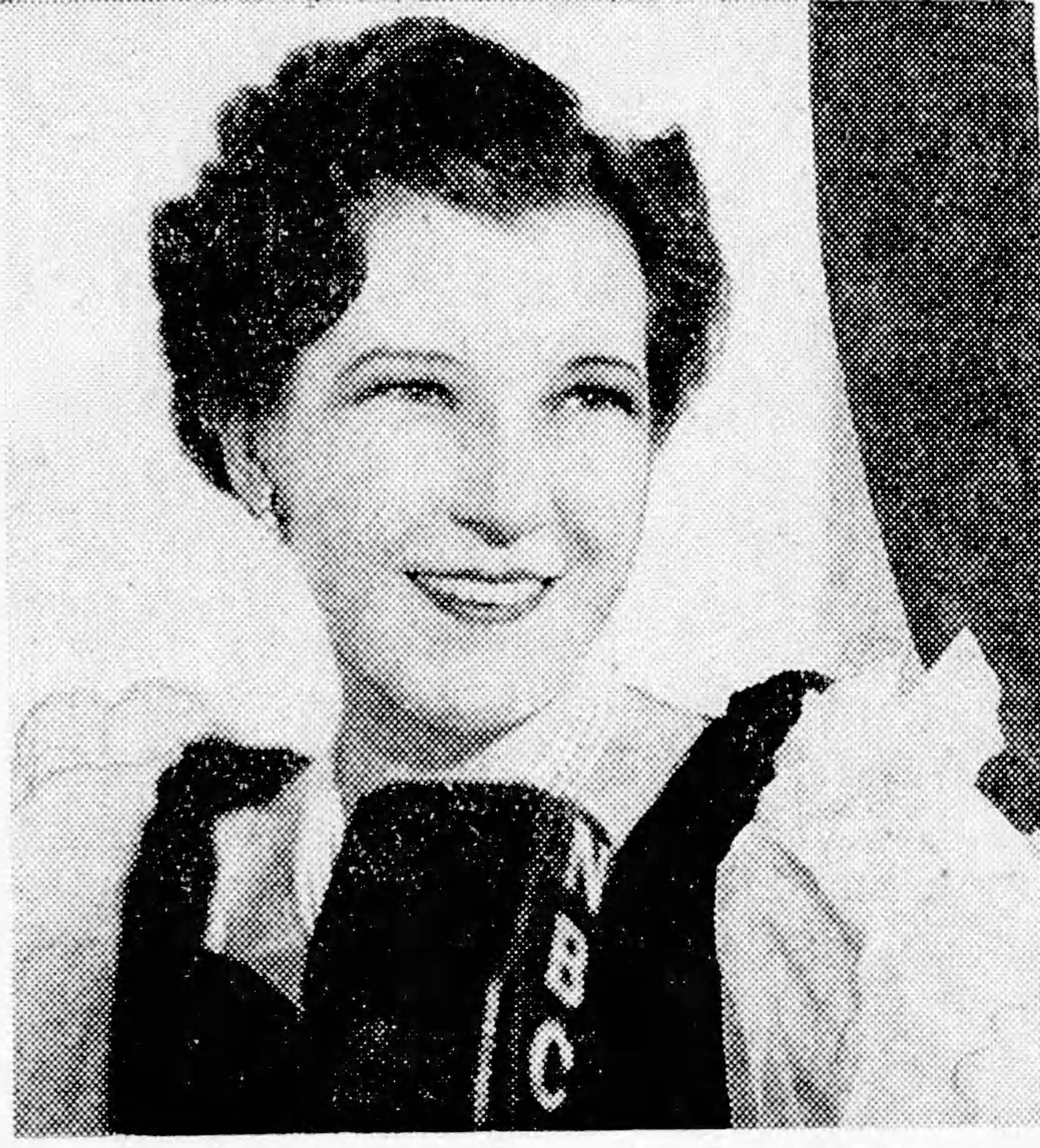
Born in Oakland the year Charles Herrold began his pioneering radio broadcasts in San Jose, Janet Baird would make an indelible mark on the young industry. In one notable event, she took part in a 1937 broadcast stunt that captured the attention of the nation.
Her story has largely vanished into the haze of history. Janet Baird lived to be 96 years old. Any of her many lifetime exploits would make for a fascinating memoir, but what happened at San Francisco’s Land’s End in the summer of 1937 was a remarkable story she would tell and re-tell often in subsequent years.
Janet Baird was born on May 6, 1909. The 1910 US Census shows her living with her parents as “boarders” in a home on Oakland’s 21st Avenue, near San Antonio Park (the census-taker would list her age as “11/12”). By 1920, the Census shows Janet and her mother living in an apartment on Piedmont Avenue, across from the famed Fenton’s Creamery. Her father was not in the picture; mother Margaret Baird was listed as head of the household.
Around the time that 1920 census-taker came by the Baird household, young Janet was giving indications of her future as a communicator. A May 1920 edition of the Oakland Tribune carried a few paragraphs written by Janet in a compendium of youthful submissions to the “Aunt Elsie’s Magazine” page aimed at young readers.
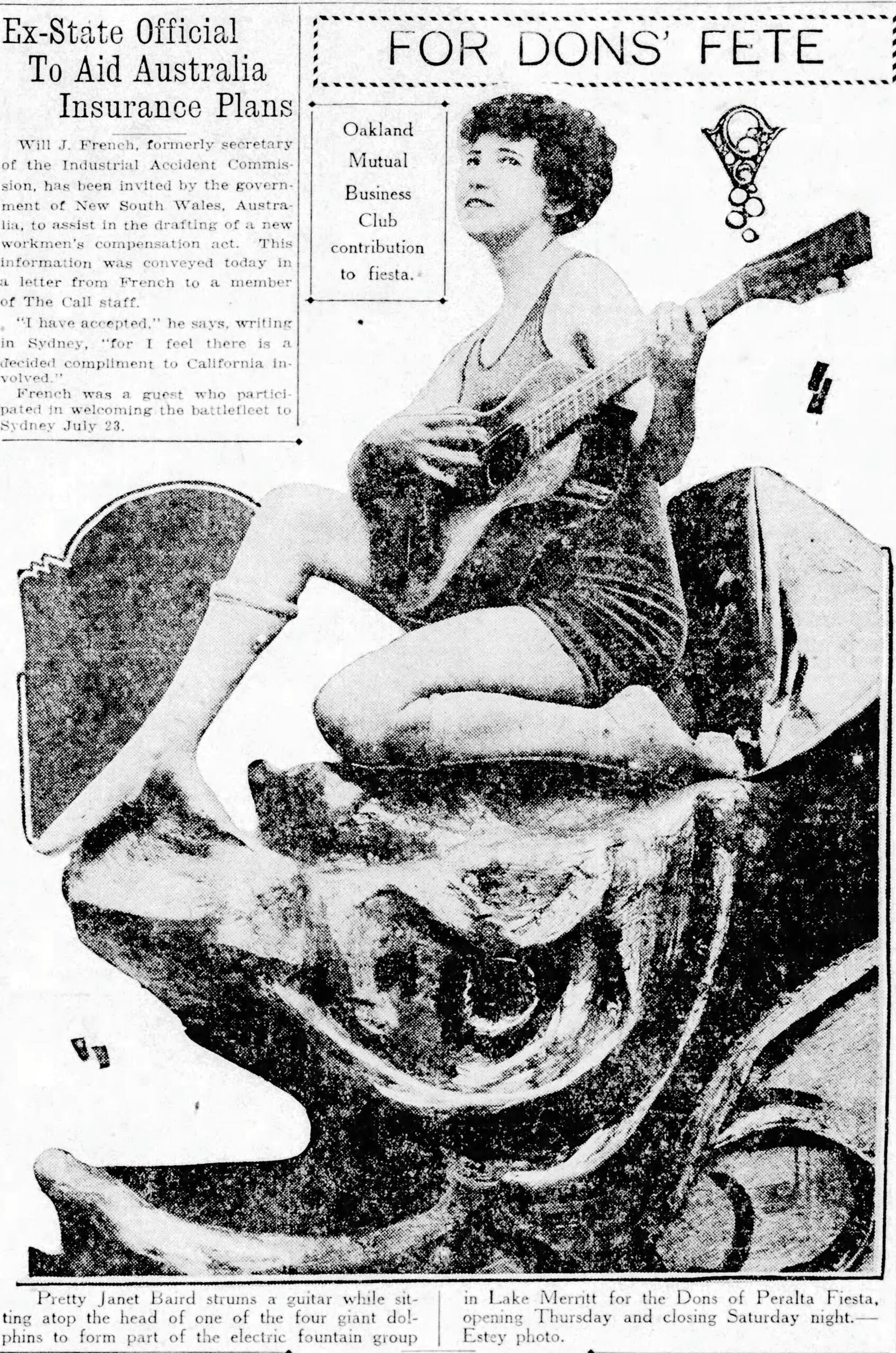
Janet Baird would attend Piedmont Avenue School and graduate from Oakland Technical High School in the Class of 1927. By then, she was already an accomplished public speaker; newspaper listings from several Central Valley towns gave notices of her talks before youth and civic groups. She’d also helped drum up publicity for the 1925 “Dons of Peralta Fiesta”, an Oakland celebration centered around Lake Merritt. For that assignment, Janet posed in a bathing suit while holding a guitar. The accompanying caption in the San Francisco Call-Bulletin described her as “pretty Janet Baird”.
Baird attended the University of California, Berkeley and acted in local dramatic productions. By the time she left Cal, she’d been doing some writing for local newspapers and had made a few radio appearances. She played a role in a radio production called Her First Vote, which aired on Oakland’s KROW in 1933. The production, said to be the first use of a radio drama in a political campaign, was designed to build support for a bond measure that would finance construction of a new Alameda County courthouse. The campaign succeeded; the building now known as the René C. Davidson Courthouse would open in 1936.
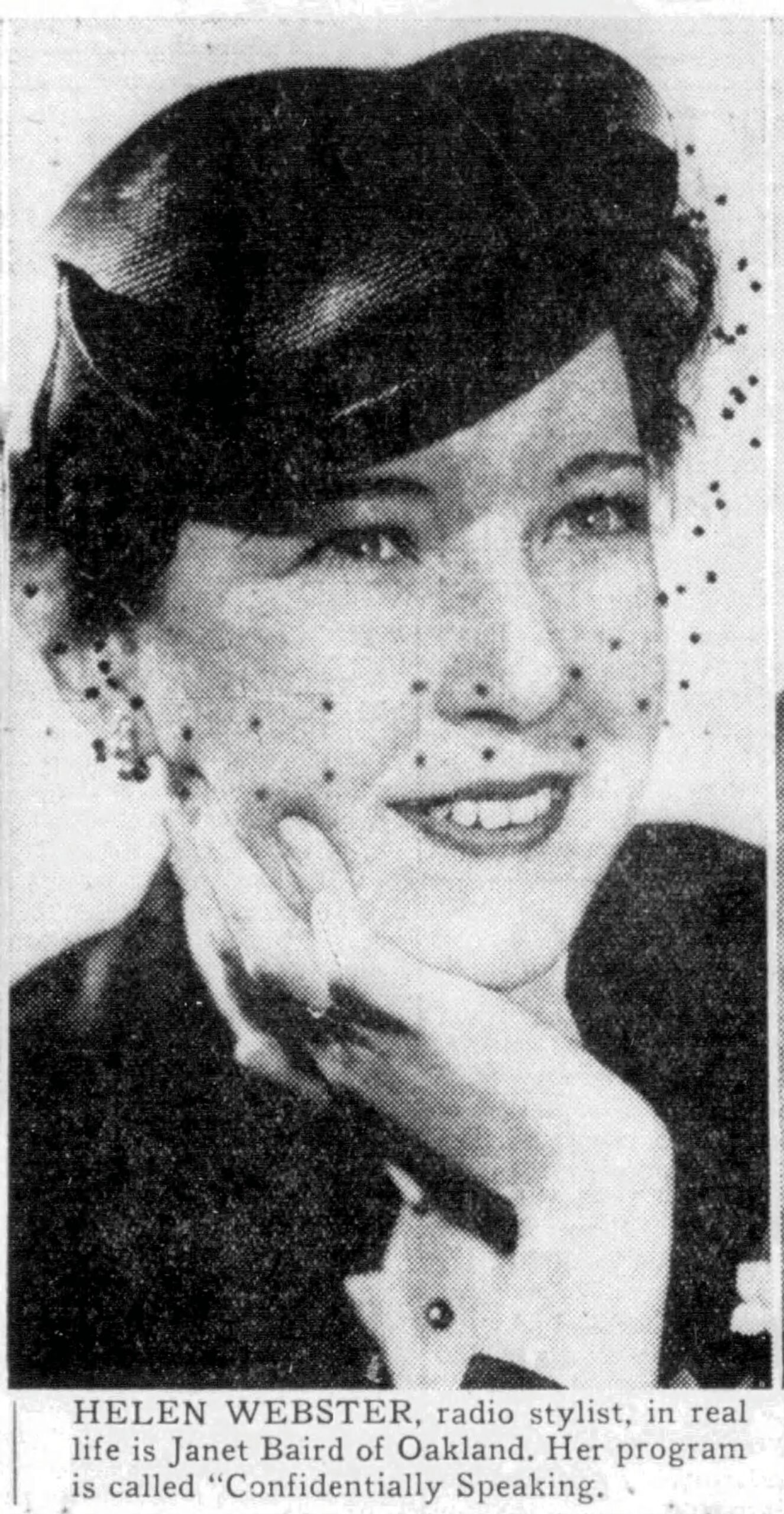
By then, Janet Baird was well on her way to becoming a radio star. She played the role of “Helen Webster” on a woman-focused interview program called Confidentially Speaking, which aired on KGO. The show originated from NBC’s busy facility at the Hunter-Dulin Building on San Francisco’s Sutter Street. Baird was already showing a keen sense of how to generate publicity: when caught in heavy traffic trying to cross the newly-opened Bay Bridge to reach the KGO studios, she enlisted the help of a police officer who escorted her to the building lobby. As a newspaper columnist noted, there was a punch line: Baird had mistaken her air time and rather than arriving with seconds to spare, she was an hour early.
“Helen Webster” was described in trade publications and NBC promotional material as a “household economics expert” and advertisers such as Golden State Dairy and Red Heart Dog Food bought sponsorships on Confidentially Speaking, listing Webster as the talent for commercial messages.
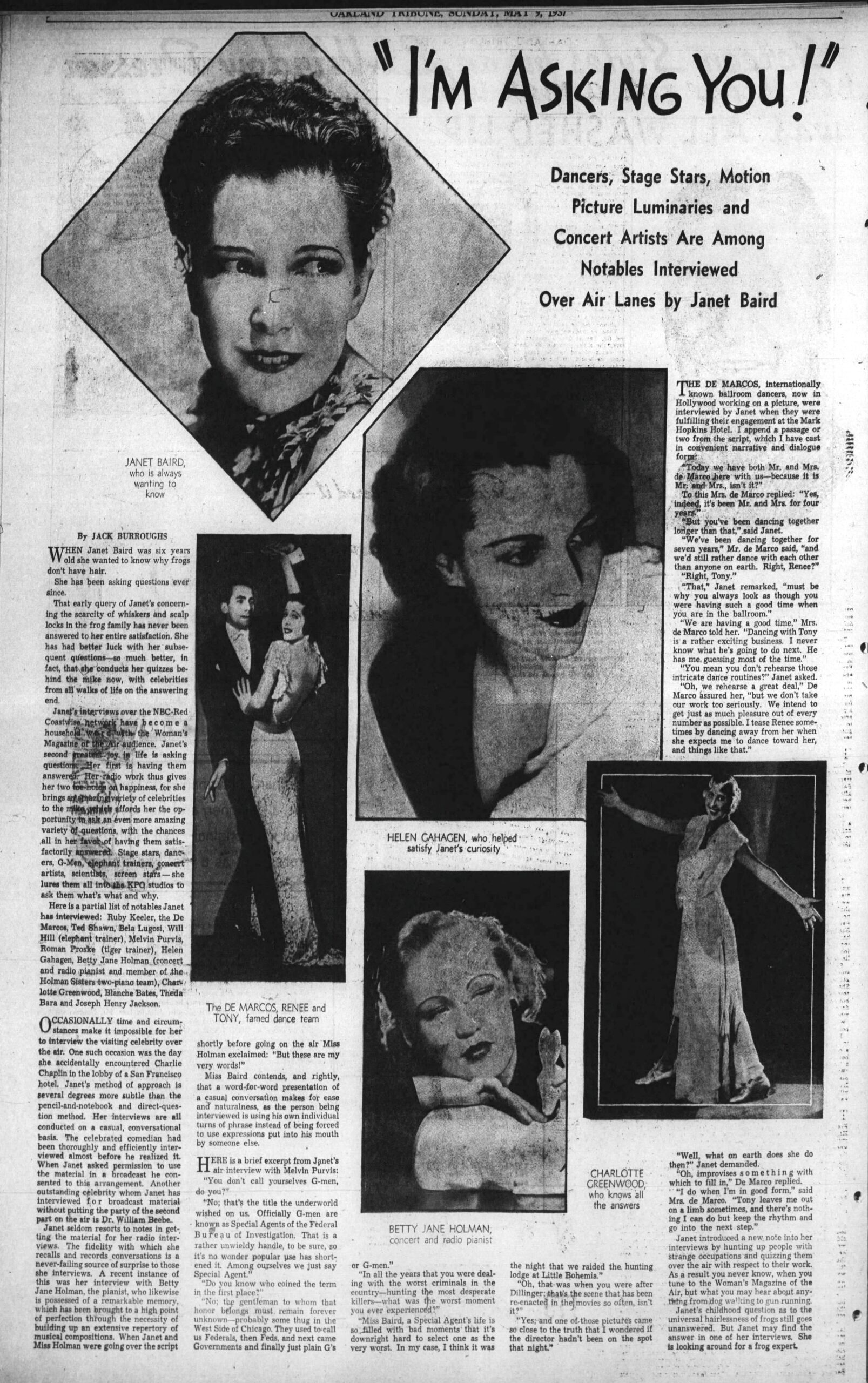
In early 1937, Baird joined the staff of the Woman’s Magazine of the Air, a venerable program that had started in 1928 as a six-days-a-week local broadcast on KPO (later KNBC and then KNBR) before becoming a fixture on NBC’s West Coast Network. It was a significant career move, for it put her on a show that had the heft to attract ever-more interesting and important guests. Among them was Wilda Wilson Church, the pioneering dramatist whose work in the 1920s laid the foundation for the explosion in dramatic radio content over the next two decades. Baird also served as a writer for the show. Within months, her friendly, curious interviewing style was drawing attention, including a full-page layout in the Oakland Tribune.
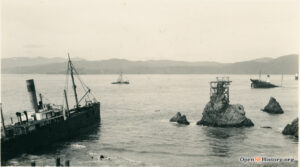
One day, Baird interviewed a deep-sea diver named Bill Wood. Wood was involved in salvage efforts on the SS Ohioan, which had run aground at San Francisco’s treacherous Land’s End in 1936, one of a number of wrecked vessels in the area. Wood had declined Baird’s requests for an interview, finally saying he’d sit before the NBC microphones if she’d reciprocate and come to his place of work.
Having already ridden a circus elephant and climbed a tower of the then-under-construction Bay Bridge for radio segments, Baird readily agreed to suit up, don a diver’s helmet, and plunge into the Pacific.
The NBC promotion machine kicked into gear. Variously listed as Janet Baird’s Dive and Going Down With Janet Baird, the stunt was to be carried live on NBC’s nationwide Red Network. Newspapers across the country offered preview articles leading up to the dive on August 23, 1937. NBC wrestled a quote out of diver Wood, who assured readers that there would be plenty of sea life for Baird to describe and may or may not have actually told Baird, “I’ve heard you can make a clam talk–let’s see you interview an anemone.”
Plans were for Baird to be lowered into the sea, clad in Wood’s diving suit and rigged with a microphone inside the heavy helmet so she could tell a presumably breathless audience what was down there. Wood was in charge of her safety, assuring everyone that a 15-minute stay would be safe for a novice deep-sea diver. It didn’t go exactly according to plan.
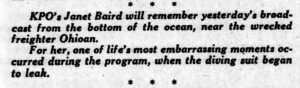
While history does not note the difference between the clothing sizes of Bill Wood and Janet Baird, contemporaneous reports make clear one thing: his wrists were bigger than hers. Accordingly, when Janet Baird started to submerge, seawater rushed in around the wrists of her diving suit. Not technically a “leak”, but still, a problem.
As a young San Francisco Chronicle radio columnist Herb Caen would report, “the suit was not checked until EIGHT MINUTES before dive time, at which point it was discovered that Miss Baird’s wrists were too small to form an airtight contact with the arms of the outfit!”
Rubber bands were pressed into service. They helped, but not enough. Cold water still seeped into Janet Baird’s diving suit. And that wasn’t all.
Wood knew that a deep-sea diving rig required a constant flow of air pumped down from above. The whooshing sound of the air would make it difficult if not impossible to communicate via a microphone inside the helmet. For an experienced diver like Wood, the solution was to twist a valve and cut off the air flow while speaking to the surface. But he didn’t think he could tell a novice like Janet Baird how to turn the valve on and off without risking a tragedy, so he told no one about the air cut-off valve.
So she descended, cold and wet but unaware that the air blowing into her helmet was rendering her comments virtually indecipherable to a national radio audience. As Helen Civelli would report a few days later in the San Francisco News, “Bill Wood happens to believe that a human life is more valuable than a fifteen-minute stunt program that will be forgotten next week.”
What did it actually sound like? We don’t know. The extensive NBC Radio archive held by the Library of Congress lists many other radio broadcasts in August 1937, but not this one. Nor are there any known photos of the event. It seems that NBC was less interested in publicizing what actually happened than it was in selling the sizzle of possibility beforehand.
A career setback for Janet Baird? Hardly. Though the exposure to cold water was reported as the reason that she missed a few weeks of work (she was said to “still be treating an injured throat” two weeks later and was reported to be “still in bed following a tonsil and nasal operation” in October 1937), Baird was a hot property. The San Francisco Examiner said her “interviews with unusual people has brought her to the fore as a radio reporter” while another publication lauded her as a “brilliant young NBC interviewer.”
Later in 1937, she launched a new program aimed at kids. Story Store would air on the NBC Blue network. On those broadcasts, Baird would invite youthful listeners into a make-believe world with a white fur rug and a crackling fireplace, in front of which she’d sit and read stories.
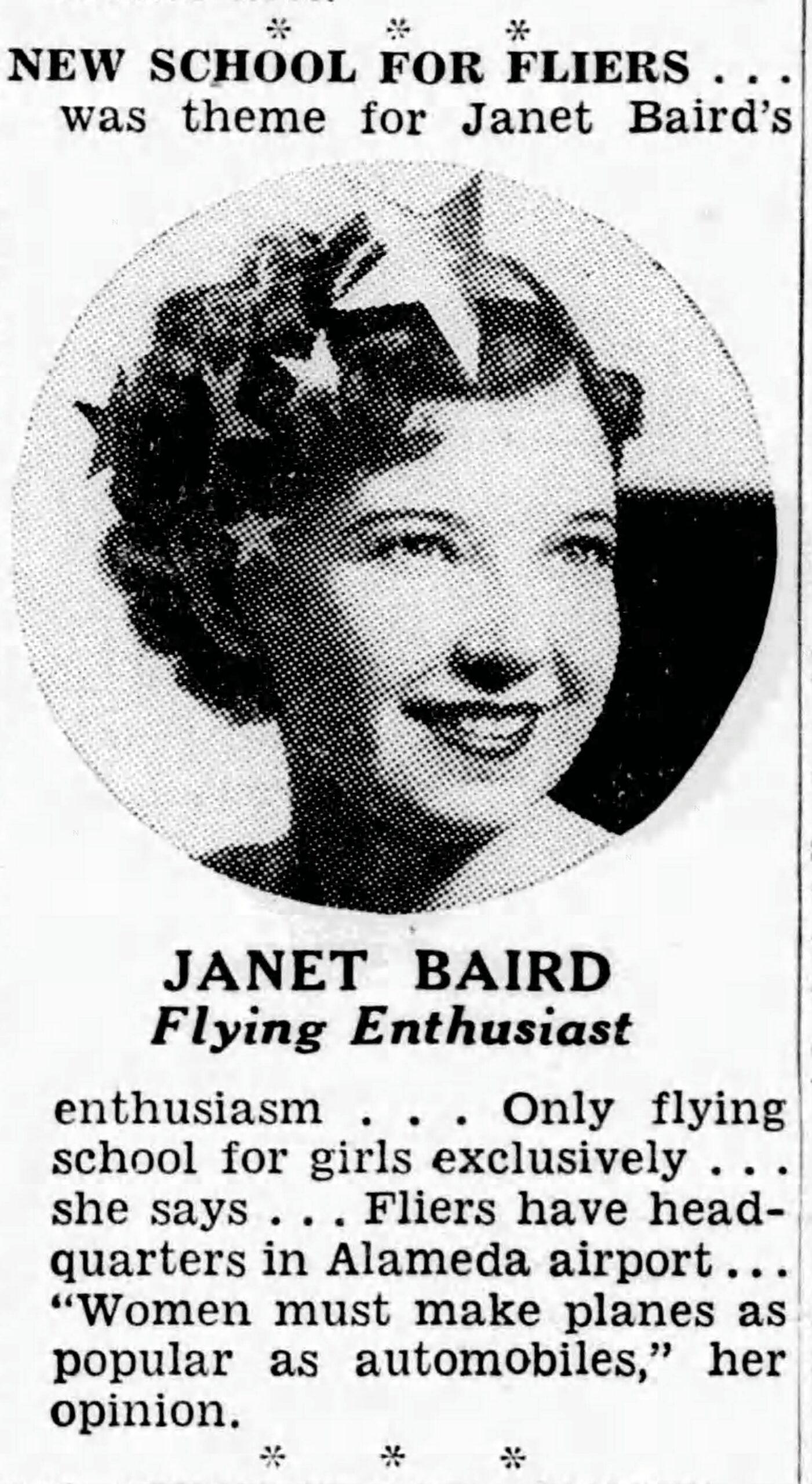
And Janet Baird decided to take up flying. She’d interviewed legendary barnstorming aviator “Tex” Rankin, who told her that flying would never reach the level of acceptance of driving until women took it up in a big way. Baird took her first flying lesson on May 7, 1939, soloed two weeks later, and became a licensed pilot. By that time, Baird was living in the hills above Lake Merritt. In later years, she would claim to have flown beneath the span of the Golden Gate Bridge and to have received a Federal Aviation Administration reprimand for the stunt.
Not long after getting her pilot’s license, Baird helped start a flying school for women at the San Francisco Bay Airdrome, a then-busy flying field near today’s Webster Street in Alameda. Her reported partners included Johnny Allen and Jimmy Henriksen, who’d just returned Stateside after serving as Madame Chiang Kai-Shek’s personal pilot in China. A few months later, Janet Baird and Jimmy Henriksen would be married. (Note: numerous public records use the spelling Henriksen, while he is often identified in newspaper accounts by the spelling “Henricksen”.)
Their nuptials would be newsworthy: Henriksen had a swashbuckling story to tell, and Janet Baird was a quotable, photogenic media star.
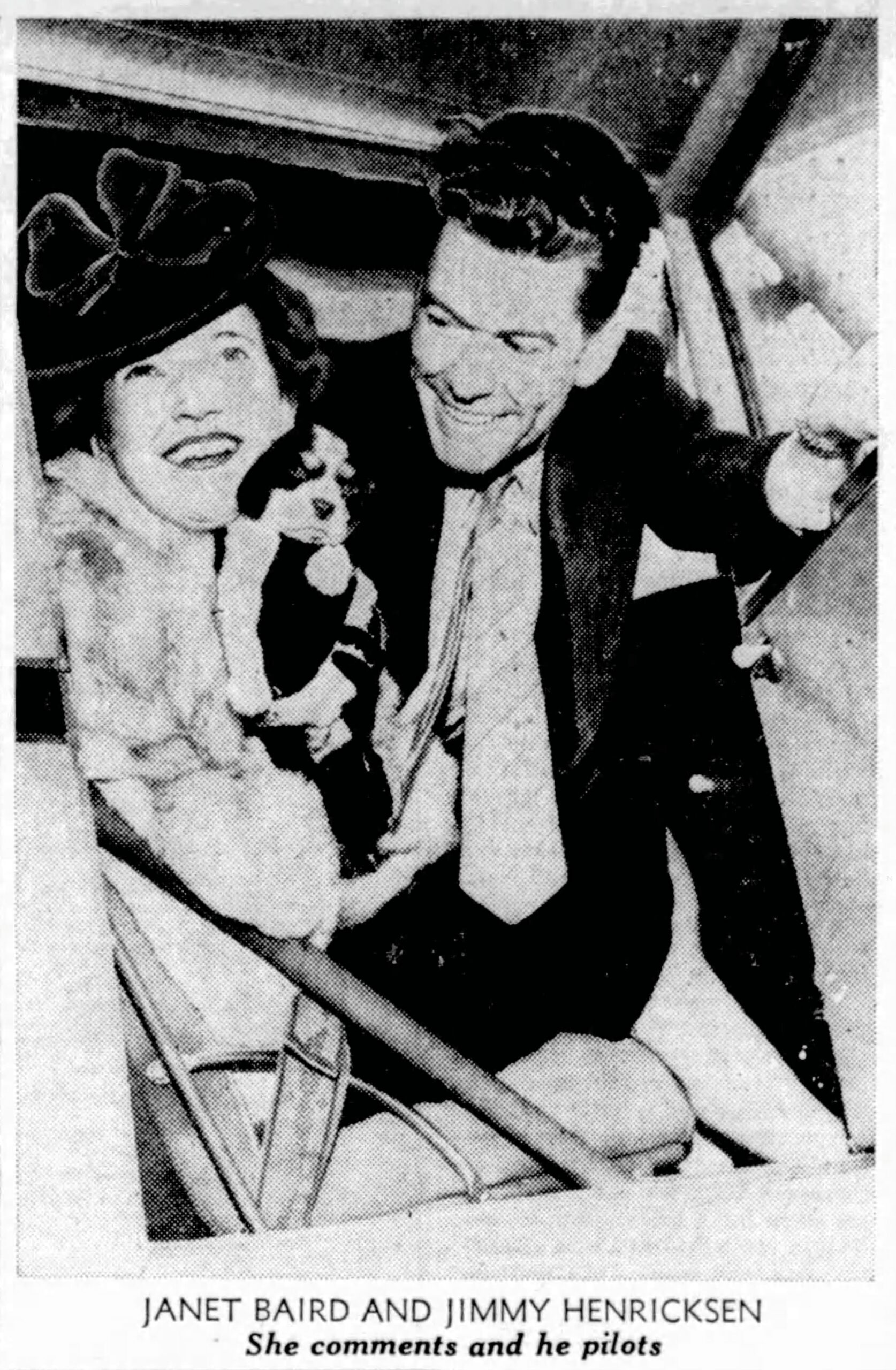
As Baird told it, she was getting her hair done when Henriksen sent her a puppy wrapped in cellophane. “We decided we had to give him a good home,” Baird told the San Francisco Chronicle. The couple decided on a “quickie” wedding in Reno, but had their plans to fly there foiled by thunderstorms and reportedly wound up tying the knot a few days later in Carmel.
That was in mid-1939, a time when Janet Baird was still being heard on KGO. Though she was a media darling (Caen, in his On The Air Lanes column, bestowed on her a “Radiorchid”, writing “The material is fair, her voice swell indeed, which makes the general effect tops”), it seems Baird’s life was moving in new directions.
She became a mother (her daughter Margaret “Peggy” Baird would go on to work on the Jeopardy TV show and be heard on the Canadian Broadcasting Corporation). Janet Baird’s name vanished from radio listings by 1940.
She moved to New York City, where she became an advocate for a number of causes, from women’s rights to reproductive rights to aging with purpose. She worked with legendary birth control crusader Margaret Sanger and at one point, installed a “hotline” telephone in her New York apartment. In the late 1960s, Baird had set up an arrangement with the government of Yugoslavia, where abortion was legal. After counseling her often-tearful callers, Baird would sometimes arrange flights to Belgrade where a safe, legal abortion was available in the years before that was commonly the case in the United States. She told an interviewer years later that she was only a voice on the phone; she never met any of the women who called for help. Nor did she tell her bosses at Bonus Gifts (see below) what she was doing; that job made her highly-visible in many conservative parts of the country.
Baird served as the executive director of an organization called The Foundation for Forty-Plus Living. That work led her to edit a book of essays, These Harvest Years (Doubleday), which offered practical advice and solutions to the challenges of aging. Baird was barely 40 when the book came out. Doing promotional work for the book, she dropped quotes such as, “We train children to be happy adults. It’s high time we trained adults to be happy old people.”
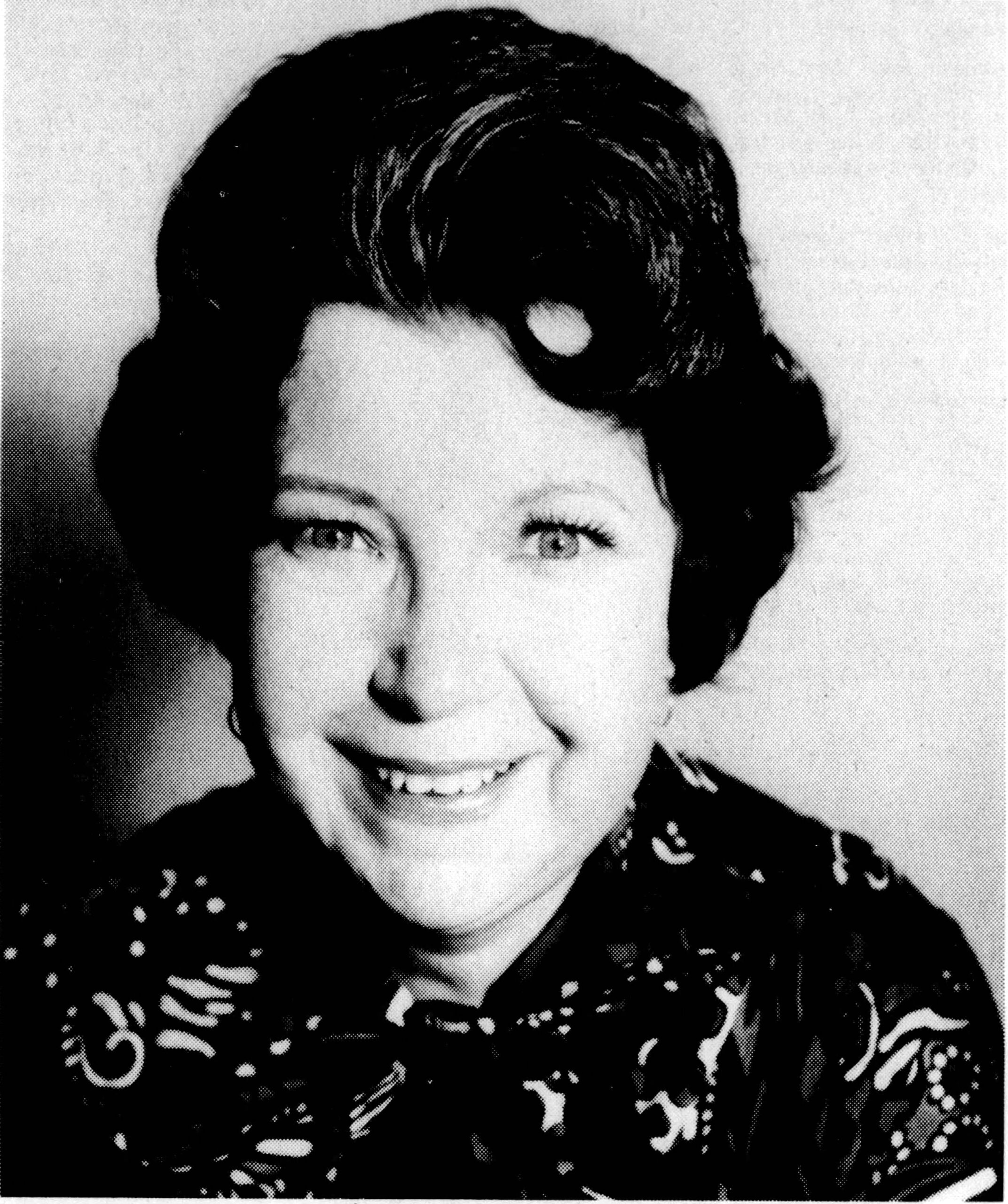
Janet Baird would become a New York-based public relations executive for the Coty beauty products empire. She found time to ghostwrite several books. And by 1967, she was moving on to something else: she became “Mrs. Bonus Gifts”.
The job entailed hopping from city to city, mostly in the South, aboard a Learjet. Baird would then meet with local media to pitch the Bonus Gift program, which gave grocery shoppers bonus points that could be exchanged for cash or the trading stamps that were popular in the 1960s and ’70s. Baird told the Greensboro, NC News & Record, “I was tired of that rat race where status was measured by a corner office, the number of windows in it, carpet on the floor and a circular desk. I’ve had all that. I’m enjoying being out among the people.”
The Janet Baird of this era would tell interviewers about her love for cooking and sewing, sometimes sharing recipes she said dated back to her youth in the Bay Area.
In 1970, Baird saw British Columbia for the first time. She was aboard a helicopter, carrying her to her daughter Peggy’s wedding on the Fitzsimmons Glacier. She was captivated, and ready for another change.
In a 1972 Vancouver Sun interview, Baird said, “When I went to Whistler for the first time and saw all that fantastic country, I thought how crazy it was, at this time in my life, to stay in a city.” She soon found a small space for a new business, a former laundromat attached to a service station near the base of the Whistler Mountain ski gondola. She became a cook and caterer. Her take-out food business called “Supper’s Ready” offered skiers an array of pre-cooked food they could take back to their cabins and condos after a day on the slopes.
Janet Baird would live in British Columbia for the rest of her life. She was quoted several times over the years about what she called her favorite theory of aging: “As you get older, you shouldn’t do things for the last time. You should start doing things for the first time.”
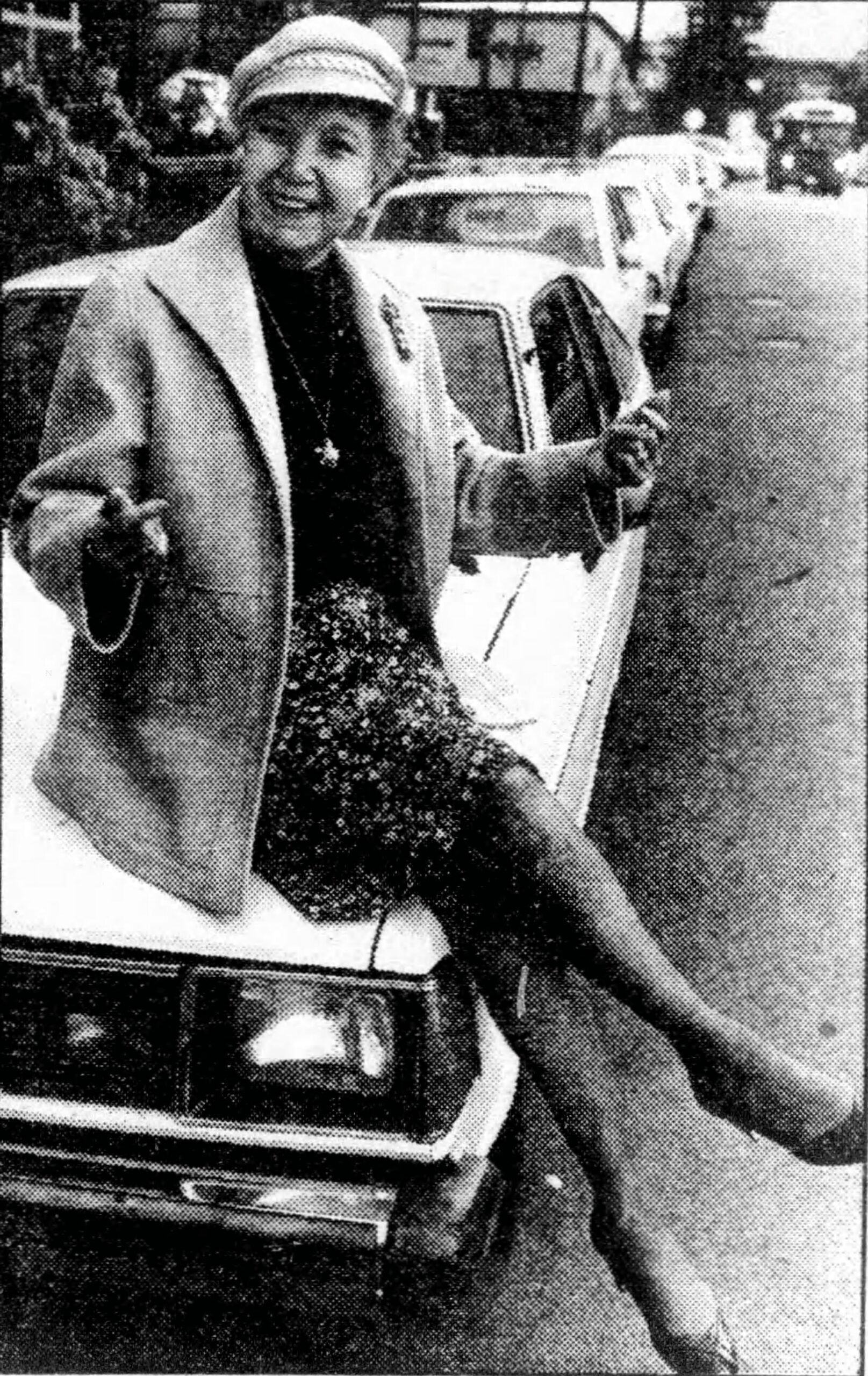
Posing on the hood of a car just after her 75th birthday, Baird reminisced about her long-ago San Francisco radio days. “When I was 28, I was doing 11 radio talk shows a week for NBC,” she told The Province in Vancouver, BC. “I was offered the chance to be ‘the voice’ of Treasure Island at the San Francisco World’s Fair [Golden Gate International Exposition] in two year’s time, and I turned it down. I figured, you see, that by then I’d be 30. THIRTY! ‘Heck’, I thought, ‘I’ll be too old to care about working’.”
That Treasure Island offer had come when Janet Baird was a true radio star. Much later in life, while playing the role of “Mrs. Bonus Stamps”, she reminisced about that 1937 day in the deep-sea diving suit. “That was just before my baby was born,” she said. “It was the last silly thing I did.”
Janet Baird died in her sleep at home in Vancouver on October 12, 2005. A brief obituary said “she was a pioneer broadcaster at NBC in San Francisco, an early aviator, an author, a publicist, a teacher and a tireless advocate of women’s rights, particularly in the area of birth control.”
What a remarkable woman and well-lived life! Thanks for sharing this wonderful bio.