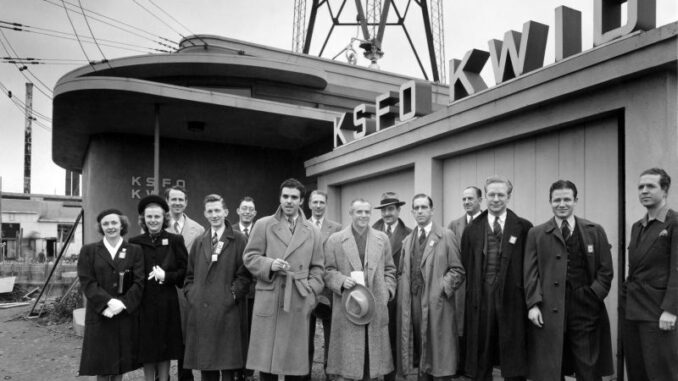
When KSFO threw the switch to begin broadcasts from its new 5,000 watt transmitter site near San Francisco’s Islais Creek in September 1937, the facility was heralded as among the finest in the industry. At the time, CBS was leasing the station from Wesley Dumm’s Associated Broadcasters for $25,000 per year plus 1/7 of the station’s gross revenue above $175,000.
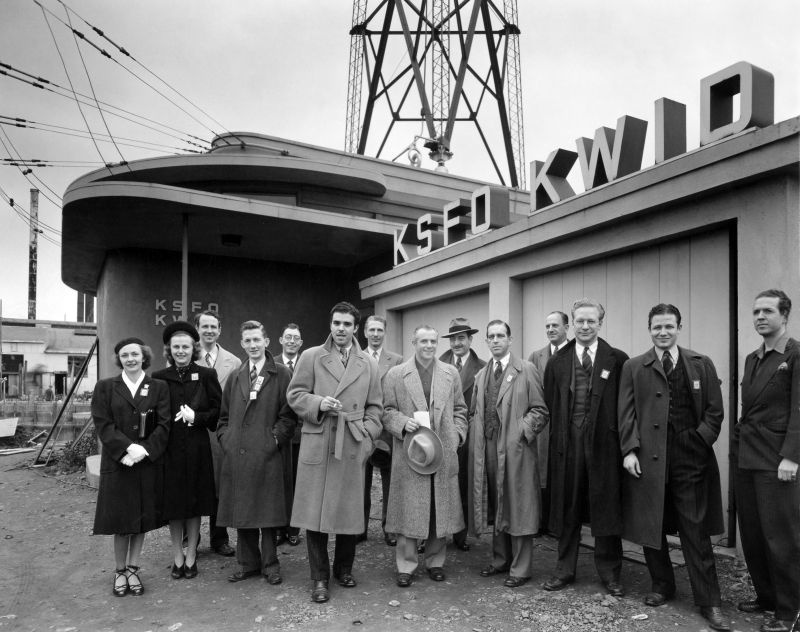 By the time a group of KSFO staffers and their guests posed in front of the facility during World War II, the site was also housing two shortwave stations: 100,000-watt KWID and 50,000 KWIX (later KWID-II) had been put on the air within weeks of the Pearl Harbor attack. The big shortwave transmitters required expansion of the 1937 Art Deco building, and the bayside lands nearby sprouted antenna arrays to handle their broadcasts.
The busy transmitter site hummed along as changes took place for KSFO. In November of 1938, the Federal Communications Commission had issued a surprise ruling invalidating CBS’s lease of KSFO. Station leases, it ruled, although they had previously been allowed by the Federal Radio Commission, would no longer permitted under the terms of the new Communications Act of 1934 that created the FCC.
With the lease invalidated, KSFO reverted to affiliate status with CBS. CBS eventually dropped its relationship with KSFO and transferred its affiliation to KQW, which it later purchased. KSFO was obliged to move out of the Palace Hotel studios, owned by CBS, where it was replaced by KQW. KSFO occupied temporary studios on the 17th floor of the Mark Hopkins Hotel on Nob Hill from April of 1942 until the following August, while permanent facilities were being constructed as an annex to that hotel.
KSFO moved its studios to the Fairmont Hotel in 1955, and the station was sold the following year to Gene Autry’s Golden West Broadcasters. It was under the careful guidance of Manager Bill Shaw that KSFO cemented its legacy as one of the Bay Area’s most successful radio stations. This was done with a skillful blend of personality music programs, local news and local sports. The result was a station where each of these three program elements complemented each other to the extent that it was sometimes hard to distinguish one from another.
Fast-forward to the 1990s. KSFO’s days as a “full-service” station were well behind it. Now airing a talk format, the station was purchased by Capital Cities/ABC in 1995. Ownership changed. The format changed. The studio location changed several times. But the signal still emanated from the aging facility near Islais Creek.
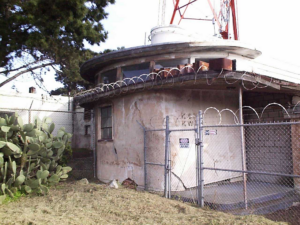
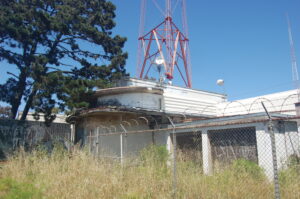
By 2012, KSFO was in the hands of Cumulus Media. That’s when radio historian John Schneider and station engineer Art Lebermann paid a visit to the transmitter site. Schneider snapped a photo, roughly focused on the same spot shown in that 1940s image above. Behind the chain link fence and razor wire, the decay was evident. The stylized lettering that could be seen above the entrance bays in the earlier photo was still there–but the letters had fallen over.
KSFO’s decline continued through the 2010s and into the 2020s. Local programming largely vanished.
In November 2024, Cumulus shifted the KSFO call letters to another legendary San Francisco dial position: 810 AM. In the process, the historic KGO call letters were discarded. KSFO’s longstanding 560 frequency was occupied by KZAC, which itself went silent on March 3, 2025.
Just over a year later, the Bay Area Radio Museum paid the historic KSFO transmitter site a visit, rescuing historic artifacts including hundreds of audio recordings from KSFO, KGO and other stations that had been part of group ownership of the two stations at various times.
The transmitter building no longer held any transmitters and a final photo from roughly the same familiar angle, snapped in April of 2026, serves as an epitaph to this once-proud facility. The weeds have grown taller, the call letters are no longer visible, and ownership was moving forward with plans to remove the broadcast towers from the site.
A footnote: on August 5, 2026 Cumulus surrendered the license for the 560 AM frequency in San Francisco to the Federal Communications Commission.