Sometime in the 1960s, two denizens of the Russian River area in Sonoma County started talking about putting a new radio station on the air. By 1975, Robert J. Booth and Michael Erickson, doing business as Communications Associates, had filed the paperwork for an FM station at 97.7 on the dial. The station was to be licensed to the community of Monte Rio, with a transmitter site on Pool Ridge, north of the Russian River.
The call letters KRJB were a nod to Booth’s initials. He handled technical matters, while Erickson was in charge of programming. In fact, Erickson lived at the station and was eventually the only full-time staff member, signing the station on and signing it off six days a week.
KRJB began test broadcasts in late 1977 and after a few false starts, began fully-licensed operations in 1978. “Bob” Booth paid homage to a friend and neighbor, the late wireless pioneer Gilson Vanderveer Willets, known as “Radio Rex”. Calling Willets “a very great man”, Booth said KRJB would be dedicated to his memory.
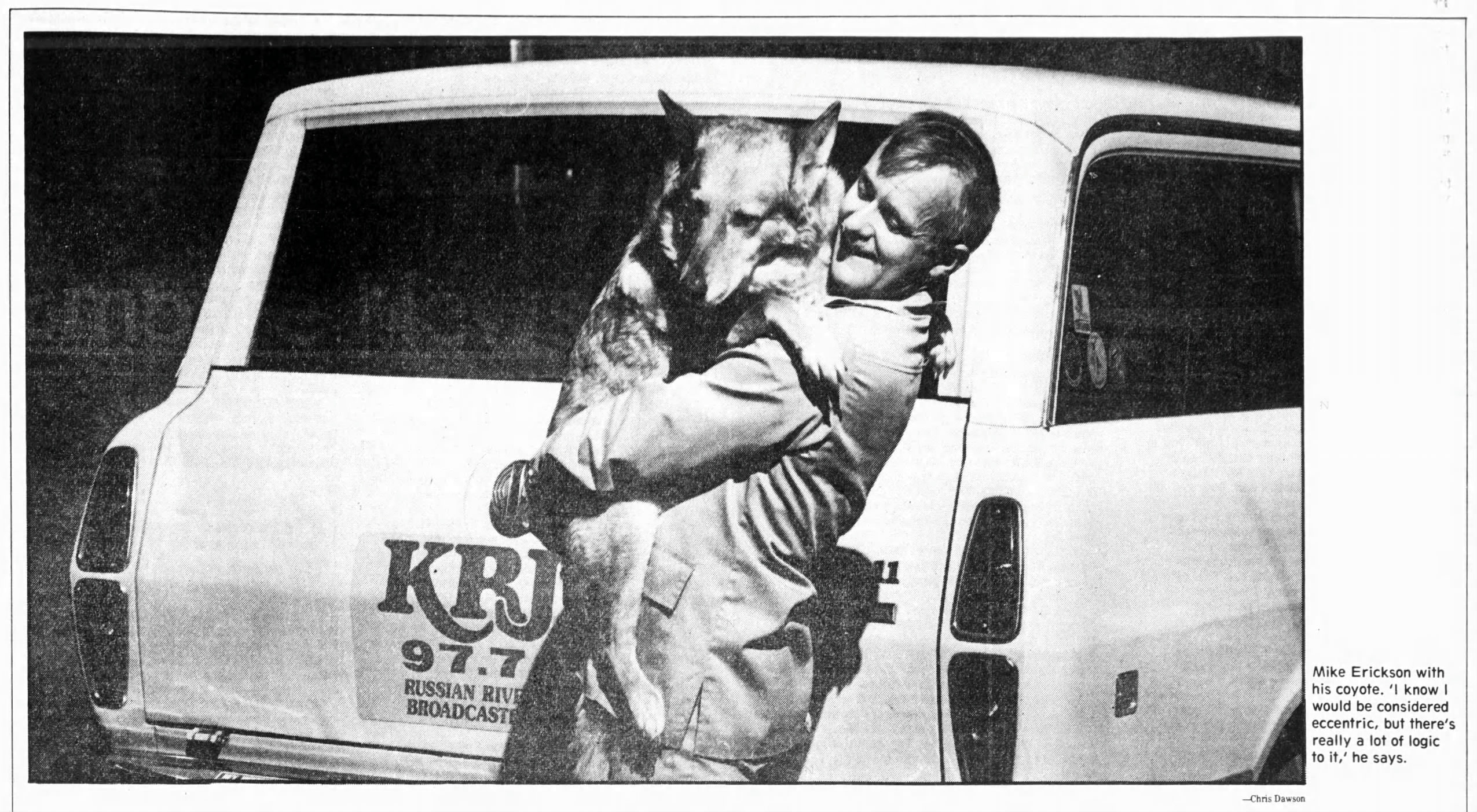
To say KRJB’s programming was all over the map would be factually accurate. Erickson, a British native, selected a wide variety of content, ranging from BBC lectures to pops concerts from New Zealand to serialized readings of classic novels to a Jack Benny special, interspersed with local material. Erickson was an unmistakable presence when he wasn’t at the KRJB studios, traveling the area in the station vehicle that held his two pet coyotes in the back.
KRJB’s quixotic approach to the radio business certainly wasn’t making Booth or Erickson wealthy. In fact, as a 1982 Santa Rosa Press-Democrat feature pointed out, they couldn’t even cover the station’s estimated $2,800 monthly operating costs from their two steady sources of advertising revenue: a Guerneville grocery and a pizza parlor.
KRJB had found a few boosters. One of them was San Francisco Chronicle columnist Charles McCabe, who enjoyed listening to the station during his visits to the Russian River area. McCabe called the station “one of the great amenities of the area”, pronouncing KRJB to be “just about the best radio station I’ve ever heard in this country”.
McCabe’s endorsement would find its way into a “For Sale” advertisement Booth and Erickson placed in Broadcasting magazine in 1982. Asking for a pie-in-the-sky $4.2 million price, their ad pointed out the station’s potential: it was, after all, a Class A FM stereo signal with 24-hour operating authorization and a signal that reached the booming Santa Rosa area. The ad concluded with the hopes that the buyer would “retain (the) good reputation (the) station has earned for community service”.
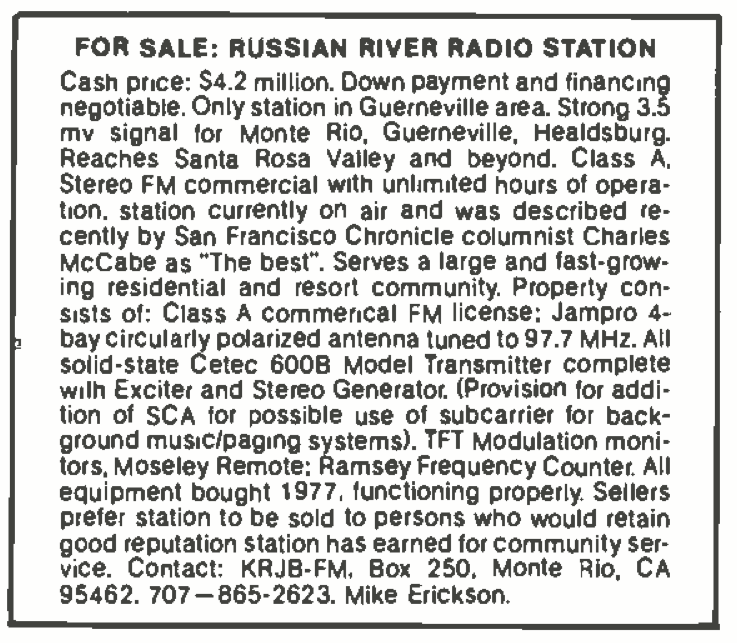
As it turned out, KRJB wasn’t worth $4.2 million or anything close to that amount. Another three years would pass before Booth and Erickson found a buyer: Michigan broadcaster Robert Liggett. The selling price to Liggett’s Southcom, Inc. was a reported $565,000: $125,000 in cash and the remained in a note payable over 12 years at a 10% interest rate.
Southcom would re-christen the station KKBR with plans to move the transmitter to Mt. Jackson, add a new main studio in West Santa Rosa, and set out to become a countywide station. Radio veteran Casey Stangl was handed the reins and installed a more traditional format: popular music presented by live disc jockeys. KKBR, by the way, was the station’s legal set of call letters for only about a week before it shifted to KMGG.