
The story of KPLS actually begins with the end of KJAX, which broadcast on 1150 AM in Santa Rosa for two and a half years before going dark on July 1, 1962.
It took eight months to put together a deal to offload the dormant KJAX to a new owner at the bargain price of just $2,500. The buyer was the Polaris Corporation, an Indiana banking and real estate company. Polaris was on a western expansion move, buying KXOA AM and FM in Sacramento at about the same time.
Just getting FCC approval of that deal took five months. And from there, it was eight more months before the station, with the new call letters KPLS (PoLariS), would actually sign on.
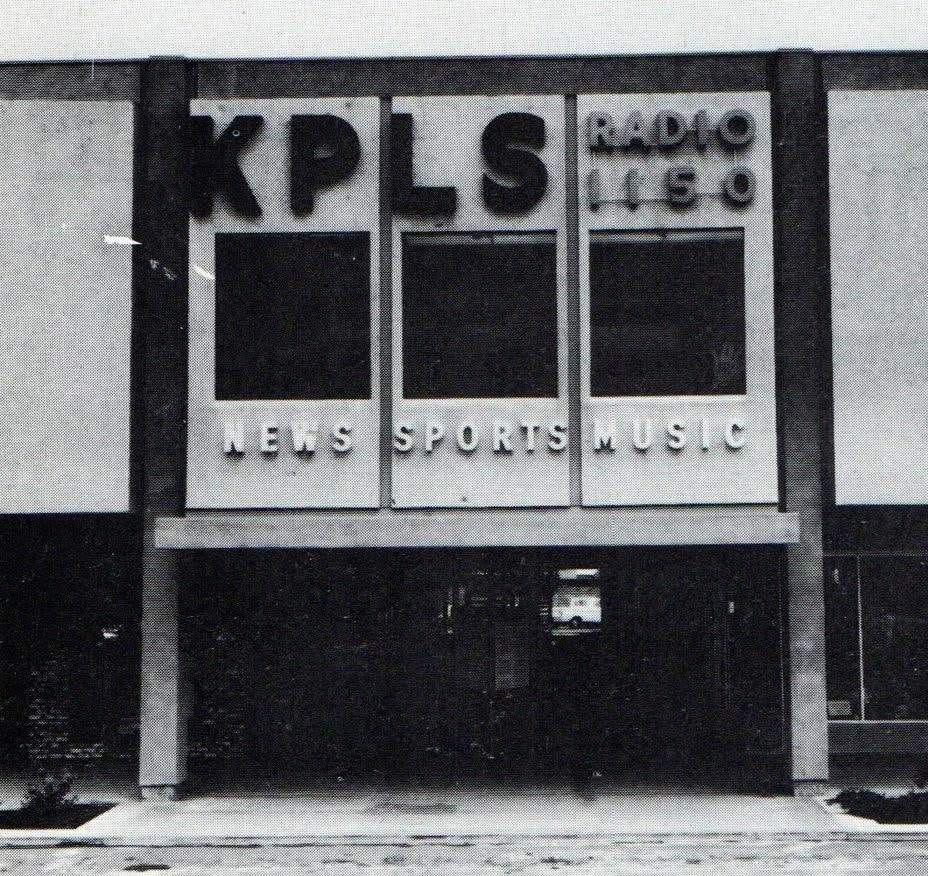
Polaris bought $25,000 worth of new equipment and new studios were built on the second floor of Coddingtown Mall. There were setbacks, including being burglarized twice in October and November of 1963 by teenagers who police said made off with $1,400 in equipment (they were accused of burglarizing KVRE as well).
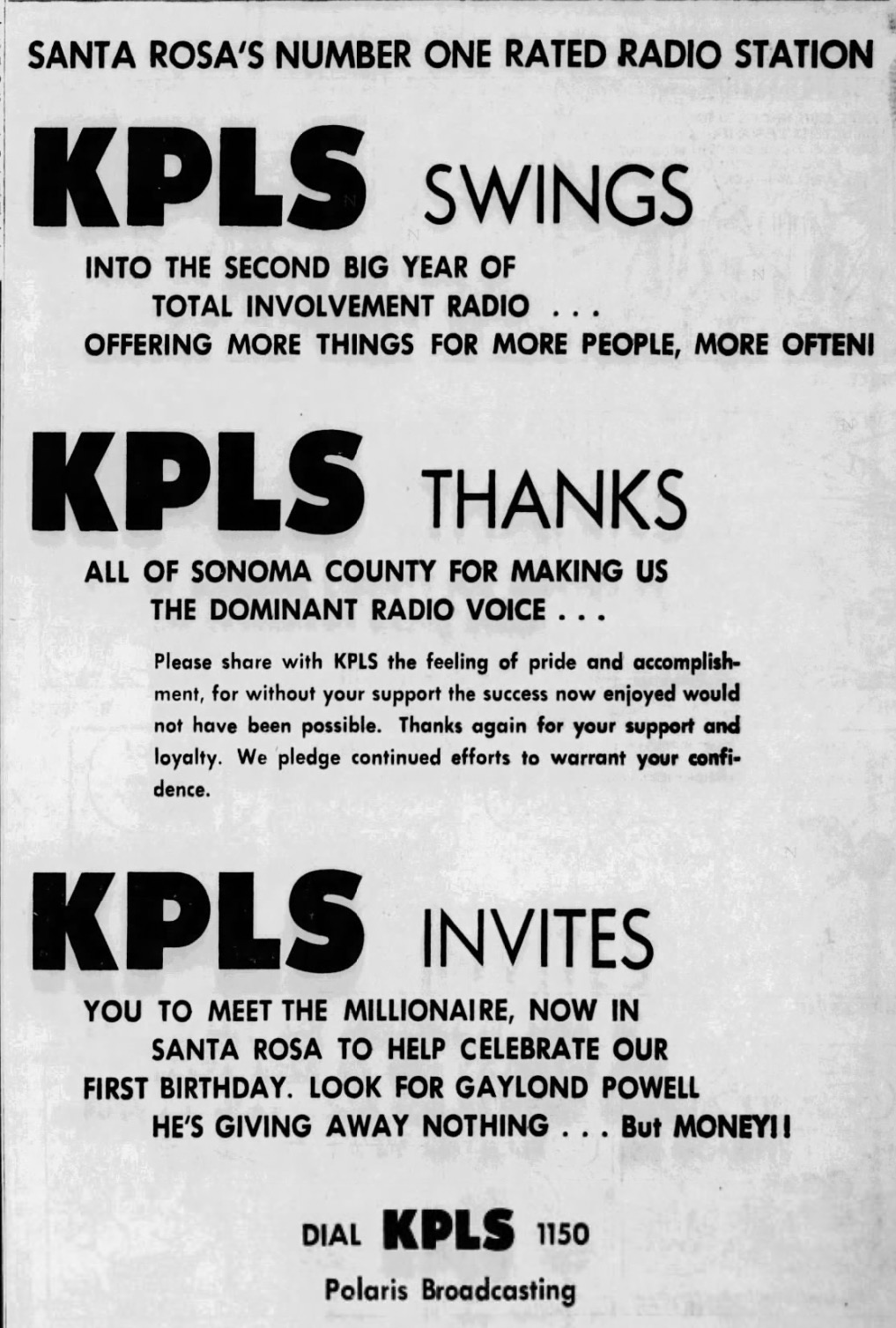
The originally planned air date of March 1, 1964 couldn’t be met. Nor could an April 4th premiere publicized on the front page of the Press Democrat newspaper five days in advance. Just two days before the scheduled launch, technical issues at the transmitter interfered.
Finally, on Sunday, April 19, 1964, at 11:50 a.m. (a time selected to match its 1150 AM frequency), KPLS began broadcasting. Listeners heard a station identification, the National Anthem, a special recorded message from California Governor Edmund G. “Pat” Brown, and a welcome from station manager Robert Ordonez. Audio of this broadcast is held in the ReelRadio archive at the North Carolina Broadcast History Museum.
Ordonez said “extensive research” had resulted in a “dynamic new concept in radio programming.” Richard Shively, Polaris Broadcasting’s Executive Vice President told the audience that Polaris promised Sonoma County a “first class radio broadcasting service” and that “only as we serve you, do we prosper.”
Listeners were then introduced to KPLS’ “Six Swinging Gentlemen”, Michael C. Allen, Les Thompson, Bruce Allen, Pete Gross, Phil Dark and Paul Stewart, and a personality-and-jingle-heavy Top 40 sound.
The “dynamic new concept” wasn’t too different from what was being done on San Francisco’s KYA or Oakland’s KEWB, but its local Santa Rosa focus made KPLS stand out in Sonoma County.
Despite what appeared to be immediate success, including a #1 Hooper rating by September of 1964, Polaris announced it was putting KPLS up for sale in December of 1965. Asked by a Press Democrat reporter why, Polaris’ Vice President of Finance James A. Goese replied: “Because of its size. It’s too small.”
Santa Rosa was, by far, the smallest city where Polaris owned a station, but all the hype leading up to KPLS’ launch revolved around “growing, dynamic” Sonoma County, and that was still an indisputable fact.
Goese told the Press Democrat the asking price would be between $150,000 and $175,000 and that there were already four bids. If that was true at the time, it’s not how it shook out. The station sold five months later for $115,000 to Mr. and Mrs. Joseph Stamler. Mr. Stamler had resigned as Polaris Broadcasting’s CEO just a month before the deal was announced.
 For the first few years under Stamler, what had been loud outside promotion of KPLS fell to a whisper. But the hits, as they say, just kept on comin’. KPLS got Gold records for being the first station in the country to play Andy Kim’s “Baby I Love You” and Eric Burdon and War’s “Spill The Wine”, and the Press Democrat printed each week’s KPLS top ten for years.
The station was making money. Revenues were up 15% for the first half of 1970 compared to the same period in 1969, according to a story in the Press Democrat of August 23, 1970.
But a little over a week later, there was controversy in the same newspaper. Two couples, James and Claudia Harden and Howard and Dorothy Guspech, said they had put a $5,000 deposit down on an agreement to buy KPLS from Stamler for $225,000 two years earlier—in September of 1968. They were asking a judge to force the sale.
It was one of those “whatever happened to…” stories. The incident doesn’t show up again in the Press Democrat archives online and no records can be found in the Sonoma County Superior Court’s online system.
In 1974, there was news of an actual sale of KPLS, this time for $300,000 to Radio 1150, Inc. of Marin County. One of the three principals of that group, and the only broadcaster, was Hugh Turner, former owner of KTIM in San Rafael and KBLC in Lakeport. In the announcement, Turner talked about more community involvement, additional news coverage, and—a survey indicating that: “People want a sweeter type of music.”
The hits? They stopped comin’ in the spring of 1975. A midday talk show, an old-time radio mystery program in the evening and what folks discussing it more recently on a Facebook Santa Rosa memories page describe as “big band” music re-defined KPLS.
What music there was on KPLS under Turner appears to have been secondary. The Press Democrat’s format description by 1976 read “Mutual network news, sports, information.”
In early 1979, after four years, Turner sold KPLS, more than doubling his money. The sale price this time was $630,000. The new owner was Kilibro Broadcasting, owners of KFIV AM and FM in Modesto and KTOM-AM/KWYT-FM in Salinas.
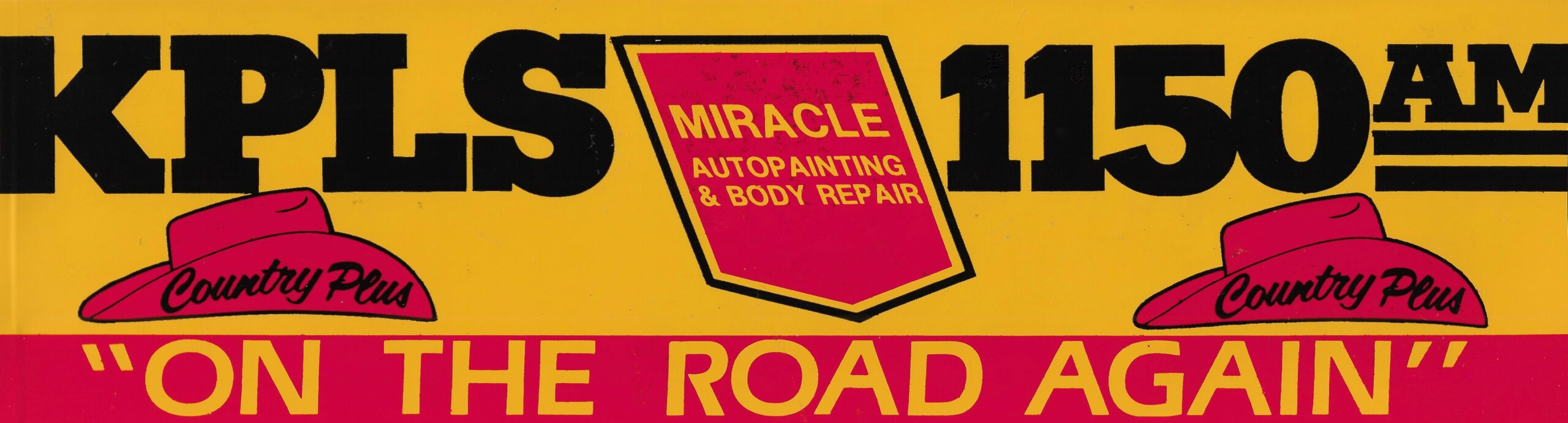
The new owners made big changes. No more signing off at midnight. KPLS went 24/7. And it went Country. November 28, 1979 was the day KPLS became “Country Plus”.
How’d they do? That depends on who you asked. Arbitron surveyed Sonoma County from April 10 to May 5 of 1980 and the ratings company said KPLS failed to get enough listeners to meet ratings standards. Eight stations showed up, and the top three stations were San Francisco signals—KGO, KFRC and KCBS.
A week later, KPLS rebutted Arbitron with a survey from an obscure Arizona-based rating company that showed KPLS with enough listeners to show up—in ninth place.
Ratings were never mentioned again, but business must have been good, because in 1984, after five years, KPLS sold again, this time for $1.5 million—more than double what Kilibro paid for it.
The new owners were called Cardinal Communications. They were a group from San Francisco that included former Stanford football player John Paye Sr., Jim Myers, the Vice President of the Radio Advertising Bureau, and Bill Daisa, the sales manager at KOIT.
The new big city owners made some major market moves, including hiring veteran San Francisco newscaster John Ferris (KYA, KFRC).
In the summer of 1988, the FCC granted KPLS’ application to double its nighttime power from 500 to 1,000 watts. Nobody knew it at the time, but that was the decision that would seal KPLS’ doom in the not-too-distant future.
There were other changes, too—a move of its studios and offices from Coddingtown to downtown, and the adoption of AM Stereo.
In radio, the really big changes often start small. In November of 1988, KPLS hired local legend Bill Bowker as Program Director. He brought with him a Sunday night blues hour that he had been doing at KVRE, an eclectic FM music station, which had changed call letters to KXFX and gone mainstream album rock.
KPLS General Manager Tom Taffee told the Press Democrat: “We’re not doing KVRE at KPLS. We’re just expanding the Country format.”
That may have been true when Taffee talked to the paper in November, but by February, he had literally turned KPLS into KVRE. Over the objections of KXFX, which claimed it would be harmed by listener confusion, KPLS asked the FCC for the KVRE call letters and got them. It then revamped its format into a more modern type of Country with music from artists like Bonnie Raitt, John Hiatt, Ry Cooder and David Lindley.
But the call letter switch lasted less than 90 days. A Sonoma County judge agreed with the owners of KXFX that the KPLS-to-KVRE call letter swap was “confusing to the public and damaging to KXFX” and issued a preliminary injunction against 1150 AM’s use of the KVRE call letters. General Manager Taffee then asked the FCC for—and got—the calls KRVE.
Most people would call that “a fast one”. KXFX owner James Kefford said he wasn’t going to pursue it any further: “I’d just as soon let it die.”
The controversy over call letters masked some real behind-the-scenes drama. Less than a month later, KRVE was on the front page of the Press Democrat again. Now the station was going dark, and Bill Bowker wasn’t in the mood to cover for his bosses, saying Cardinal Communications: “…has a long history of financial problems. We couldn’t deal with the possibility of coming in one morning and finding the IRS. There was a possibility that we weren’t going to get paid. We’re dedicated, but not that dedicated.”
Bowker detailed negotiations to sell KRVE, with a price tag of $1.4 million, though as Bowker noted, that included a substantial amount of debt: “And that seems to be the stumbling block.”
The music stopped and the transmitter was turned off on June 8, 1989. Bowker said he hoped it would be a “brief interruption” until new owners took over.
It was not.
It was a year before the notice of sale appeared in Broadcasting magazine. First Down Productions, a company with no other broadcast interests, had bought the station from Cardinal Communications. Not for $1.4 million. Not even close. The sale price was $25,000.
First Down Productions was owned by John Paye, Jr. There are two reasons that name would be familiar. He was a two-sport star at Stanford and tenth-round draft pick for the 49ers in 1987, who spent two years with the team—and he was the son of John Paye, Sr, the principal owner of Cardinal Communications, which was selling the station.
The Press Democrat reported that Paye, Sr. turned down offers as high as $1.6 million for the radio station, including one from the original KVRE-FM’s co-founder Cindy Paulos, who offered $300,000 for the radio station and $1.3 million for the transmitter tower and the land it sat on.
It also reported that the FCC was apparently never notified (as required) that the station had gone silent a year earlier and that Cardinal Communications owed Sonoma County $5,000 in back taxes.
The story got juicier a month later, when the Press Democrat interviewed Robert Fenton, the head of Kilibro Communications, which sold the station to Cardinal in 1985. Fenton was suing Cardinal Communications and John Paye, Sr., claiming that he loaned Cardinal one million dollars of the $1.4 million dollar sale price and that Cardinal defaulted.
Fenton said he tried to foreclose on the station in 1986, but that Paye’s bankruptcy involving a business interest in Arizona prevented that. He alleged that Paye had transferred the valuable transmitter site to Paye’s now-bankrupt company.
And he said the $25,000 deal to shift ownership of 1150 AM to Paye, Jr. was an attempt to defraud him. Fenton said it was a plot in which Paye, Jr. would default, and leave Fenton with no recourse.
Paye, Sr. got Fenton to drop his objection to the transfer by providing him with an affidavit that Fenton said would help him foreclose on the transmitter site. Fenton’s plan would be to sell the land to developers for housing, which would mean 1150 AM would need a new transmitter site.
By November, 1990, the station was back on the air, with local bakery operator Ambrosio Vigil leasing airtime on KRVE from Paye, Sr. and playing Spanish-language music from 9 a.m. to 5 p.m.
In March of 1991, the FCC granted new call letters—KMXN. And in March of 1992, the FCC approved the transfer of the license to First Down Broadcasters and John Paye, Jr.
By the time KMXN was mentioned again in the Press Democrat, it was July of 1992, and the format had been changed to Christian Top 40, from Oldies, meaning the Spanish-language format was short-lived.
In October of 1993, the radio listings for KMXN shifted from “Christian Rock” to “Christian Talk”.
The next mention of KMXN came in the fall of 1995, and as usual, there was some controversy. The transmitter tower land had been sold, and KMXN needed a new tower site. Local residents weren’t happy and wrote letters to the editor of the Press Democrat, prompting a reply from the station’s assistant engineer.
The new towers never came to pass. In the summer of 1997, the FCC approved transfer of KMXN from First Down Productions to Citicasters, which by then had been purchased by Jacor. The sale price was $100,000.
What did a rapidly-growing major broadcast chain like Jacor (soon to be acquired by Clear Channel, now iHeart Media) want with a troubled AM station in a town like Santa Rosa?
Remember the 1988 nighttime power increase from 500 to 1,000 watts? Jacor had bought a station at 1150 on the AM dial in Los Angeles and wanted to increase its power to 50,000 watts day and night. KMXN was the only thing standing in the way.
Six months after Jacor purchased KMXN, it took the station dark and turned the license in to the FCC, which deleted the frequency from Santa Rosa’s allocations. What began with great fanfare on April 19, 1964 ended with silence on January 28, 1999, when the KMXN call letters were deleted from the FCC’s database.
James Harden was also embroiled in controversy over KNAC in Long Beach at about the same time.
I did the “Mark Oldies” show on KVRE before it was sold. Later, Bill Bowker got me a gig on KAFE, and after KAFE closed down, Bill Bowker got me a gig at KRVE/KMXN. (I still have a KRVE / 1150 T-shirt.) I believe the studio was in the building that formerly housed KZST, before they built their studios on north Mendocino Ave. In May of 1992, I did a Sunday evening show, which I still have the recording of, with Cliff* and Wayne. It was likely the last oldies show before the shift to Spanish language. *Cliff had a little record store next to the Marlow Safeway, called WeBeCD.
You missed the real reason KJAX (later KPLS) was built which had to do with Central Valley radio politics. The Gamble Bros owned KJOY in Stockton (1000 watts) and they couldn’t increase it’s power because it would overlap with other stations they owned in the Valley. Their cross-town competitor KRAK (1140) was planning to go from 5 Kw to 50 Kw and extend their coverage to Sacramento. The Gambles built first adjacent 1150 (KJAX) in Santa Rosa to throw a monkey wrench into these plans.
KRAK eventually got 50 Kw but it was from a much more expensive 6 tower directional array northeast of Sacramento with a coverage pattern precisely tailored to curve around KJAX. After this was built the Gambles shut down KJAX and attempted to sell it.
Nor was this a one-off by the Gambles. When their other cross-town rival KSTN (1420) wanted to increase their day power to 5 Kw Non-D the Gambles shoehorned in KJAY (1430) Sacramento, a minimum power, 500 watt directional daytime only station. This forced KSTN to go 5 Kw directional and restrict their daytime coverage towards Sacramento to what they already had at 1 Kw.
I was CE at KPLS during the Hugh Turner days and found the dirty details of 1150 vs 1140 in a file buried in the old transmitter site studio. I don’t know what happened to it.