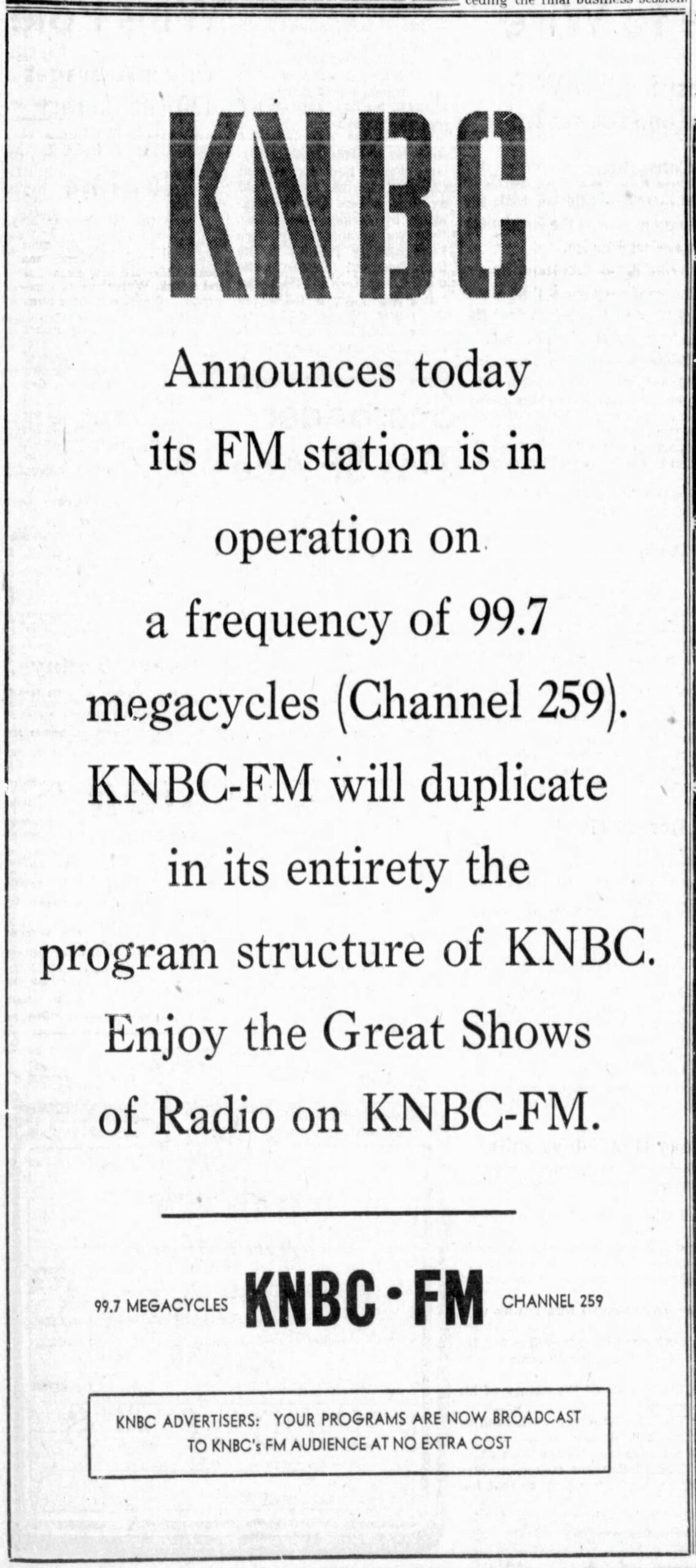
 KNBC-FM began regular operations on May 15, 1948, simulcasting the signal of legacy National Broadcasting Corporation (NBC) station KNBC. It was the culmination of an effort begun by NBC in 1944 to secure a Bay Area FM license. The call letters would be changed to KNBR and KNBR-FM in 1962.
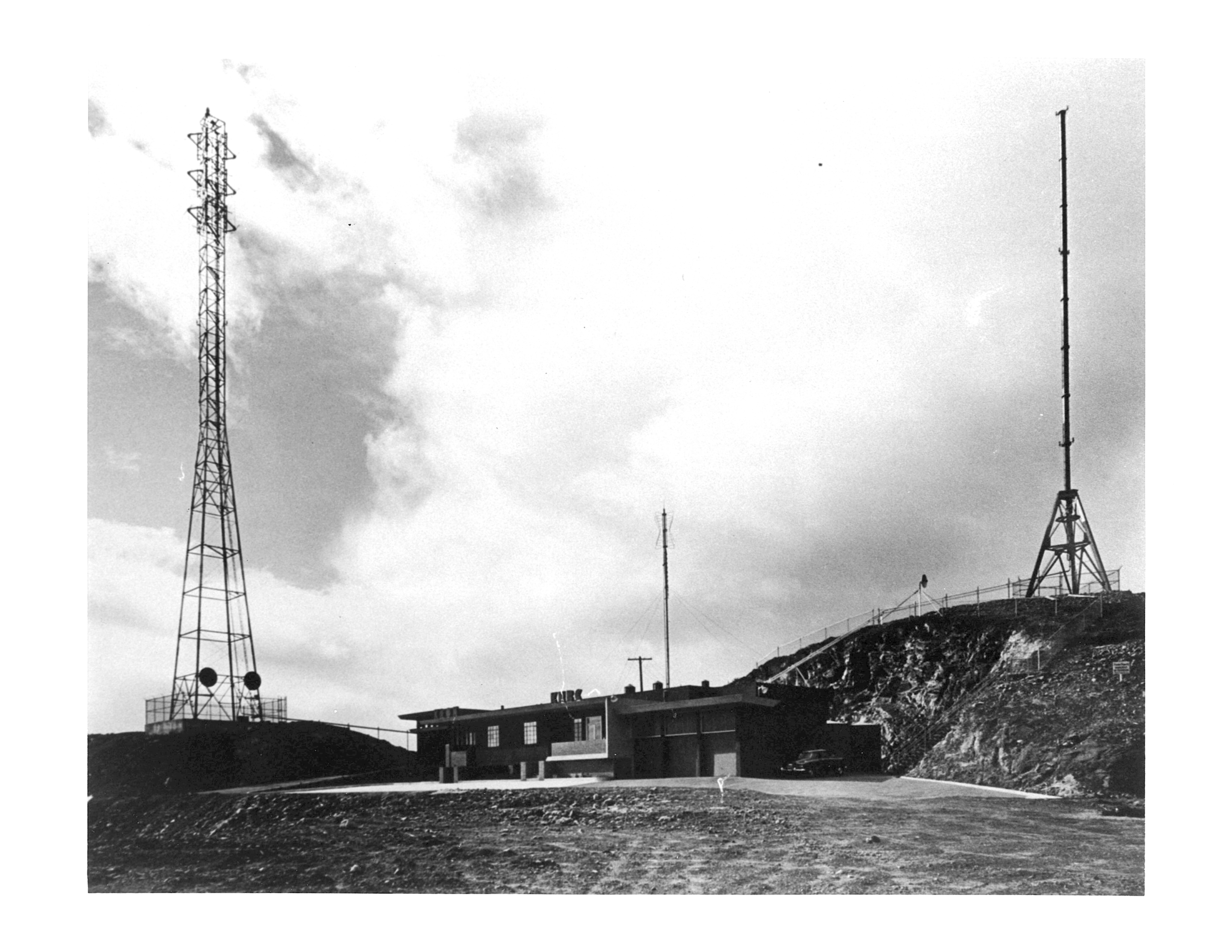
The FM station’s original 3,000 watt transmitter was at a temporary site in Belmont, where the KNBC AM transmitter was situated. That would be replaced in the fall of 1949 by a permanent FM facility atop San Bruno Mountain, where a 45,000 watt transmitter and the higher terrain gave the station a solid signal and coverage area. The changeover took KNBC-FM off the air for 16 days.
Within months of its launch, NBC executives had signed KNBC-FM up with the Broadcast Measurement Bureau, an early attempt by the advertising and broadcasting industries to create reliable audience-measurement statistics. FM radio was still in its infancy, but broadcasters had high hopes; a few weeks after the launch of KNBc-FM, the New York Times reported, “The new art of frequency modulation radio has had a rapid growth since the war. In 1945 there were fifty-two stations on the air and some 495,000 receivers in use. Today-less than three years later-there are 517 commercial FM radio stations and twenty non-commercial, educational outlets making FM service available to an estimated audience of 60,000,000 [nationwide].”
The business reality of early FM radio was that broadcasters weren’t making money on the new stations. Quite a few stations launched in that boom after World War II went dark; even the network-owned efforts like KNBC-FM were bets on a brighter future rather than an immediate profit. As proof, one could look at published advertising rates: in 1949, KNBC-FM, KGO-FM and KCBS-FM were all listed as offering “bonus” advertising. This meant a client who aired spots on the main AM station got the FM ads for free.
Through the 1950s and early ’60s, there was no need to consult newspaper radio listings to find out what was on KNBC-FM. It was exactly what was airing on the AM side. The listings did, however, differentiate the stations in one way: while KNBC operated 24 hours a day, KNBC-FM went off the air at 1 a.m. each night, returning to the air around daybreak.
On November 11, 1962, KNBC became KNBR and the sister FM station’s call letters were accordingly changed to match. NBC wanted to assign the KNBC call letters to its Los Angeles television station, and it was left to KNBR and KNBR-FM general manager William Decker to explain that the new call letters stood for “National Broadcasting Radio”.