The original plans for the American Broadcasting Company’s Bay Area FM station called for it to transmit on 96.9 MHz. ABC’s initial paperwork, filed in 1944, called for a transmitter location on Mt. Diablo. A 1946 Conditional Grant from the Federal Communications Commission was superseded by a construction permit for KGO-FM that moved the station to 106.1 on the dial (channel 291).
When KGO-FM began broadcasting on November 3, 1947, it became the first network-owned FM station in the Bay Area. Its transmitter was located at the former General Electric factory in East Oakland (home of KGO’s AM transmitter), but ABC would shortly announce the purchase of the six-acre Sutro Mansion site in San Francisco to serve as home for the FM station and the soon-to-be-launched KGO-TV.
At the outset, KGO-FM was on the air from 3 PM to 9 PM daily. On launch day, the paid-placement newspaper column Bob Franklin’s Radio News (written by KGO promotion manager Bob Laws) noted that the station would “carry the first FM broadcasts of network programs in this area.” Laws went on to say that Abbott and Costello would be the “first big-time comedy show broadcast over local FM,” adding that the show was chosen over other network possibilities because it did not include music from an instrumental orchestra. Laws claimed American Federation of Musicians leader James C. Petrillo said no program with live music could be broadcast simultaneously over an FM station and an AM station–likely a reference to attempts by the AFM to exert more control over the broadcast industry.
By mid-1948, KGO-FM was on the air from 6 AM to midnight, with newspaper listings showing it was simulcasting the programming on KGO. Listeners would hear a top-of-the-hour station identification saying, “This is KGO and KGO-FM”. KGO’s Laws penned another Bob Franklin column saying the mirror-image programming was thanks to an agreement with the musicians’ union.
The station remained a part-time operation into the 1950s, though arrangements were made starting in 1953 to sign on at 11 AM on Saturdays to carry Metropolitan Opera broadcasts from New York. San Francisco Chronicle columnist Terrence O’Flaherty wrote a piece in early 1953 extolling the virtues of buying an FM radio receiver, saying “Once it has been properly installed, chances are the listener will not be satisfied with anything else.” He noted in that column that KGO-FM was broadcasting “an exact duplication” of sister station KGO.
In late 1954, the station was off the air; newspaper reports suggested there’d been problems at the transmitter. In fact, ABC was preparing to shift the station to a new frequency, 103.7 MHz, which became KGO-FM’s new home on January 14, 1955. The shift included a move to the Sutro Mansion transmitter site and a beefed-up signal.
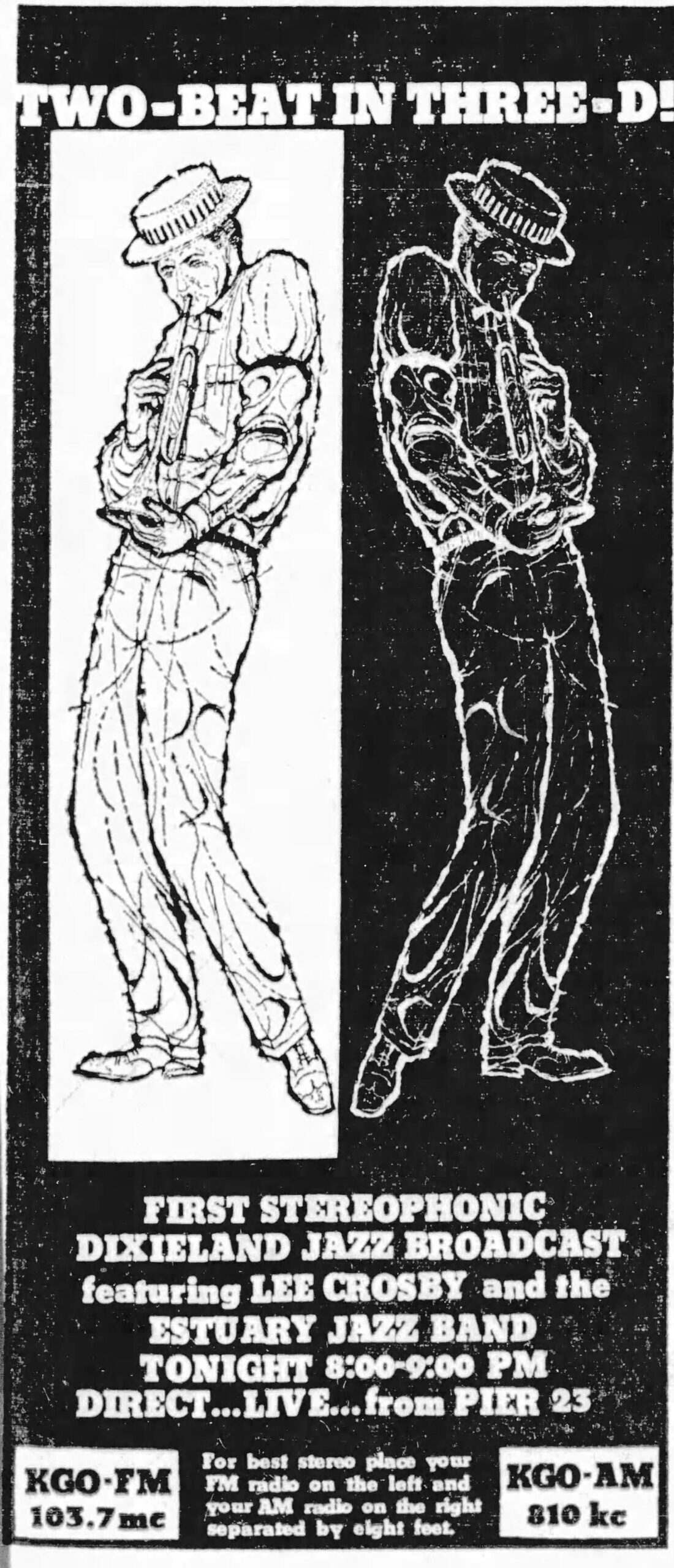
For the next dozen years, KGO-FM was largely a simulcast of KGO. San Francisco Examiner columnist Dwight Newton mocked this in 1956, writing “KGO-FM programming has the imagination of a turtle, nothing but AM duplications.” Every so often, there’d be a creative effort such as the 1959 live “stereo” broadcast in which listeners were encouraged to tune one radio to KGO and another to KGO-FM and set them eight feet apart. Of note: that broadcast featured Dixieland bandleader Lee Crosby, who would go on to own KMPX.
In 1965, ownership requested an exemption from the FCC’s new non-duplication rule which limited co-owned FM stations to carrying no more than 50 percent of their sister AM station’s programming. In 1966, KGO-FM split from KGO programming while other co-owned FM stations were doing the same thing to comply with the non-duplication rule. KGO-FM’s choice was an automated rock format.
Examiner columnist Newton noted the wholesale abandonment of simulcasting. “The disk jockey is disappearing,” he wrote. “The announcer is disappearing. The FM satellites are installing fantastic automation equipment.”
The resulting format change found KGO-FM running an automated music mix, sans live announcers, that ran the gamut from The Beatles and Strawberry Alarm Clock to Cher, Ed Ames and Bobby Vinton, with a smattering of Soul and Oldies thrown in.
In 1968, KGO-FM returned to simulcasting its AM counterpart’s News/Talk programming for four hours each day. On February 24, 1969, KGO-FM became a key outlet for ABC Radio’s syndicated progressive rock “Love” format.
Between New Year’s Day 1971 and May 1982, the station, remaining under ABC ownership, was known as KSFX. Upon returning to the KGO-FM call letters, the station carried ABC’s “ABC TALKRADIO” feed, which included personalities from a number of the company’s talk-formatted stations. KGO’s Owen Spann was among those in the lineup. This would be the last programming heard under the KGO-FM call letters.
In mid-1983, trade journals announced the station was being sold to Davis/Fowler/Weaver Broadcasting for a reported $5.5 million. “Weaver” was Bill Weaver, who ran San Jose’s KLOK. The station would get new call letters, KLOK-FM, and a new Adult Contemporary format.