The Camelot-like existence of Los Gatos station KTAO is a reminder that radio has often been a medium of great excitement and possibility.
KTAO lasted only five years (1969-1974), but they were memorable ones.
KTAO’s predecessor was KLGS, the first station ever licensed to Los Gatos, which went on the air in 1966. KLGS was a family affair: Richard “Dick” Ingraham and his father Donald Ingraham built it; Donald’s wife Bernice was listed as a co-owner. Richard would serve as general manager as well as chief engineer.
Studios, complete with an all-stereo audio chain including microphones, were at the foot of University Avenue in downtown Los Gatos while the transmitter site was almost 1900 feet above sea level in the hills above Lexington Reservoir. Local newspapers reported the station would broadcast “adult varied popular” music from noon until midnight every day.
A year after KLGS went on the air, The Peninsula Times Tribune reported an 80% ownership interest was being sold to Beverly Hills-based Video Corp. The August 1967 article said Video Corp. was emerging from bankruptcy and planning to diversify by buying radio stations. There’s no evidence that the deal ever got as far as the Federal Communications Commission.
The Ingrahams and their Western Stereo Corporation did sell the station in early 1969. The newly-formed Tomentose Broadcasting Company paid $127,500 to acquire KLGS. Tomentose was co-owned by veteran community radio operator Lorenzo Milam and a former Random House executive named Bill Ryan, who had relocated to Los Gatos. Dick Ingraham was to stay aboard as chief engineer and consultant.
Soon after closing the deal, Milam and Ryan rechristened the station KTAO and that’s when things got interesting.
Milam would later write a book entitled Sex and Broadcasting: A Handbook on Starting a Radio Station for the Community. KTAO served as a real-life test kitchen.
Milam’s approach to community broadcasting was eclectic, to say the least. Geoff Alexander, who spent time on the KTAO staff as a teenager, would later recall: “KTAO was famous for 72 hour Flamenco and Indian music marathons, live avant-garde jazz shows, lengthy audio collage mixes, and festivals of Bulgarian music, but anything and everything was programmable, as long as it was non-commercial in nature, and ‘made good radio’.”
Milam put out a weekly program guide (here’s a 1970 example). In a typical edition, he proclaimed that KTAO was “filled with high debts and higher goals”. He told readers, “This operation survives by a few sparse commercials, & by selling our program guide for $7.50 (for nine months, if poor), and $15.00 (for a year, if not).”
Oakland Tribune columnist Bob MacKenzie (later an award-winning television reporter at KTVU and KGO-TV) was among those who’d never seen anything quite like it. “This is one kinky document,” MacKenzie wrote in August 1970.
Apparently unaware that the author was the station owner himself (by 1970, Milam had bought out Bill Ryan), Mac Kenzie went on to say, “Whoever the author is, he can write. Sometimes, when he is in a steam about something, he will begin to weave words together in a beatific chant, working up more indignation as he goes along. In the latest edition he takes off on the schools of broadcasting that teach announcing and DJ techniques to young hopefuls, ‘taking them and plucking $400 or $750 or $1000 from their innocent hands and dragging out for nine weeks those simple ideas and deeds of radio communication which can be taught in hours.'”
The last part cinched the prose as Milam’s work: he wouldn’t let anyone who’d attended broadcasting school in front of a microphone at KTAO.
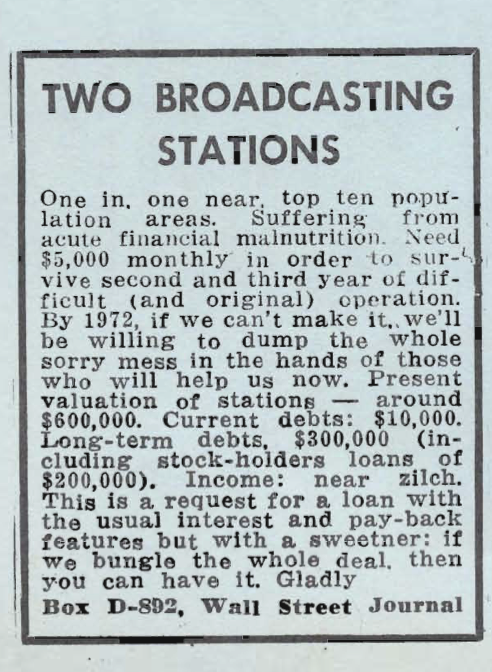
Money was a constant problem for KTAO. In the spring of 1970, Milam placed an ad in the Wall Street Journal, seeking a loan to keep KTAO and KDNA/St. Louis (another Milam project) afloat.
A few weeks later, Milam wrote in one of his weekly program guides that he’d received no meaningful offers. “I figure,” he wrote, “that we have about three weeks before the people to whom we owe money will begin to make frightening rumbling noises.”
The whole thing rumbled to a conclusion in early 1974, when Milam sold KTAO to Ethnic Radio, Inc. for $250,000.
The new owners changed the call letters to KRVE and banished the weirdness in favor of all-Portuguese programming.
Ethnic Radio was led by Joaquin Esteves, who would eventually add to the lore of the Los Gatos 95.3 frequency by vanishing in 1988. Police suspected foul play but the case has never been solved.