The story of San Bruno’s KSBR is one of the more remarkable in Bay Area radio history, though the station itself left few memories among the listening audience. It was largely an on-air laboratory for its owners to test their products: some of the world’s best vacuum tubes.
While most radio stations were trying to figure out how to connect their programming with an audience, the owners of KSBR were trying to connect their vacuum tubes to would-be buyers. To achieve this, they built a “blowtorch” of an FM station. At the time, it was the most powerful radio station in the United States. Media coverage routinely made note of that fact.
KSBR was launched by a pioneering Bay Area electronics company, Eitel-McCullough Corp. It had been founded by amateur radio enthusiasts Bill Eitel and Jack McCullough in 1934. The company would soon be selling high-efficiency vacuum tubes under the “Eimac” brand, and business boomed during World War 2 as Eimac tubes powered military radar systems.
Licensed under the name Radio Diablo and under the direction of station manager Orrin H.”Hank” Brown, KSBR operated at 10o.5 MHz beginning on March 3, 1947. The following month, KSBR became the nation’s first 50,000 watt FM station. This was barely a year after the Federal Communications Commission had re-allocated the FM band from 42-50MHz to 88-108MHz. At that time, it was estimated there were no more than 15,000 FM receivers in the Bay Area.
A few months after the station’s launch, chief engineer Leigh Norton delivered a paper about KSBR to a meeting of the West Coast Institute of Radio Engineers. The group had gathered in San Francisco in 1947 to mark the 35th anniversary of Lee DeForest’s discovery of the detector tube–an accomplishment which earned him the nickname “The Father of Radio”.
At the outset, studio and transmitter were in San Bruno where early reports indicate plenty of tinkering was going on. A May 1947 dispatch by Redwood City Tribune columnist Ray Spangler noted that KSBR was “broadcasting from 3 p.m. to 9 p.m. daily–well, almost daily. Sometimes the boys tear out the equipment and start all over with a new idea.”
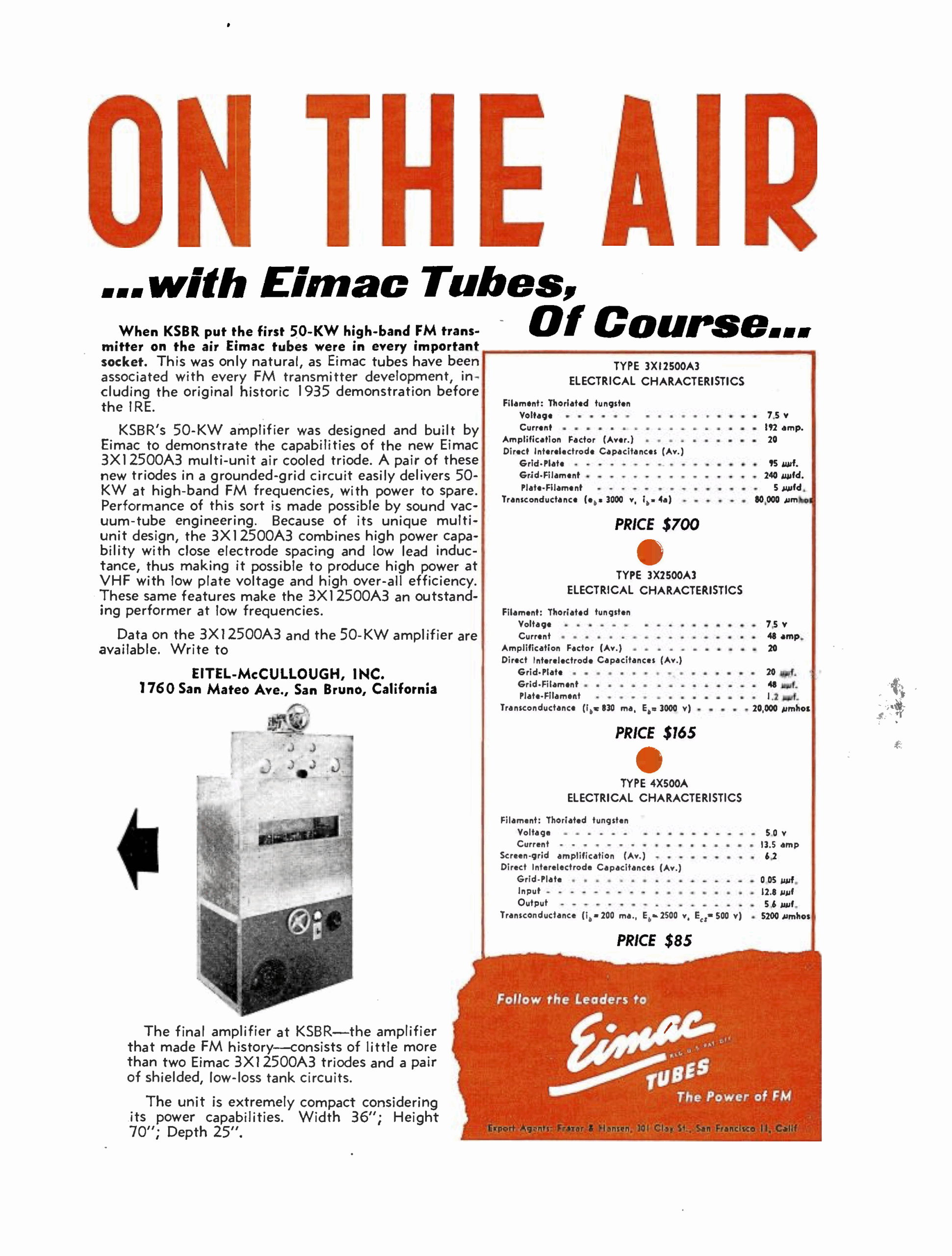
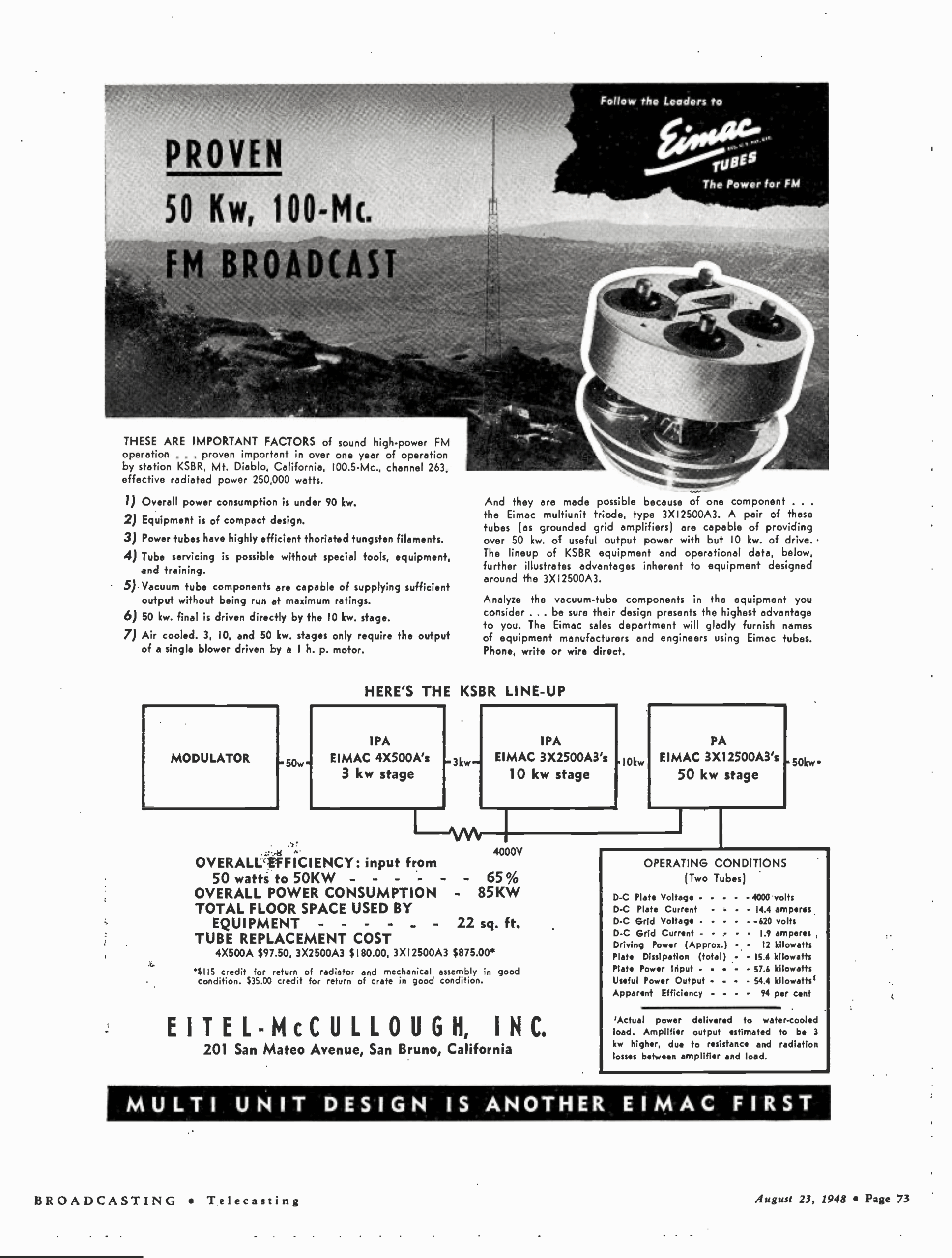
Ultimately, the studio in San Bruno linked audio to a site high on Mt. Diablo where the transmitter was located. The first broadcast from the new site took place on June 4, 1948 and featured comments from Governor Earl Warren and a host of Hollywood celebrities as well as a performance by a symphonic group assembled to showcase the high-fidelity FM signal. Eitel-McCullough engineers designed and built the transmitter, which used eight 3X2500A3 triodes, four in parallel on each side of a push-pull circuit, delivering approximately 50 kW to an antenna with sufficient gain to give an effective radiated power of 250,000 watts. This resulted in an exceedingly broad coverage area for an FM station–reportedly, a 300-mile radius.
KSBR was notable not only for the power of its transmitter but also for the way it received some of its programming. KSBR became the first West Coast station to sign on to the new Continental FM Network, which broke new ground by distributing programming on 1/4″ Rangertone audio tape. Rangertone had already left an indelible mark on the broadcast industry by providing the machines that generated the unforgettable NBC chimes. The use of the Rangertone tape system became common at KSBR; in one instance, the station recorded coverage of the arrival of a women’s air race at Bay Meadows for playback after a college football broadcast.
The Continental FM Network plan was to send programming from network flagship station WASH in Washington, DC via a high-fidelity landline to facilities in New Jersey, where the audio would be recorded on tape. The tapes then would be flown cross-country to San Francisco International Airport for pickup and eventual airing on KSBR. In September 1948, KSBR participated in the first-ever live coast-to-coast broadcast exclusively on FM stations, carrying a military band concert originating from WASH.
Prior to the 1948 season, KSBR executives announced the station would carry San Francisco 49ers games with Bud Foster providing the play-by-play. The 49ers were still playing in the All-America Football Conference; it would be two years before they entered the National Football League.
1949 saw the launch of the California Network. Though regional networks had popped up elsewhere in the country to serve smaller independent AM stations, KSBR’s effort was the first in the Far West. Programming was delivered simply: affiliate stations tuned in to KSBR’s powerful signal and rebroadcast it. Some of that content was the aforementioned Continental FM Network programming.
In 1950, KSBR linked up with the Tidewater-Associated Oil sports network, which broadcast football games from more than a dozen Western colleges.
Radio Diablo had designs on becoming a sort of Television Diablo. The company became deeply involved in efforts to secure one of the TV licenses being freed up after the World War 2 freeze. One allocation, for Channel 13 in Stockton, was in the company’s sights. The goal was to transmit from the same site on Mt. Diablo occupied by KSBR; calculations were that the signal would cover Stockton as well as much of the Bay Area.
In 1953, Eitel-McCullough handed over control of Radio Diablo to another company with a significant name in the radio business: Hoffman Radio and Television. Owner Les Hoffman would become the new licensee of KSBR. At the time, Hoffman had been pursuing the yet-to-be-awarded license for a new San Jose television station that would become KNTV. His acquisition of Radio Diablo wound up putting him in control of what would become KOVR (the call letters chosen for the big coverage area Channel 13 would enjoy). The TV station went on the air in September 1954 (KSBR had been silent for several months during construction of the KOVR transmitter).
After the launch of KOVR (Radio Diablo would be renamed Television Diablo), it seems that KSBR became an afterthought. Despite that pioneering high-powered signal, the station made no further news and was gone from the airwaves by 1959.
The call letters went unused until 1975, when Southern California’s Saddleback College launched its own KSBR.
As for Eitel-McCullough, the company moved into a new multi-million-dollar plant in San Carlos in 1958. When a radio signal was bounced off the moon, the task was accomplished with a giant Eimac klystron tube. The company soon became the world’s largest independent manufacturer of electron power tubes used in satellite communication and a host of other applications including nuclear research and computer data networks. In 1965, Eitel-McCullough merged with Silicon Valley giant Varian Associates.
RELATED EXHIBITS:
Eimac tube advertisement citing KSBR, Broadcasting Magazine June 1947