The Bay Area’s first commercial FM station, KRCC went on the air on February 2, 1947. The station’s studio and transmitter sat atop Nicholl Knob, a high point in what’s now known as the Miller-Knox Regional Shoreline Park. KRCC operated on FM channel 284, 104.7 MHz. The 50,000 watt transmitter was in service just six hours a day at the start.
Launching an FM station in 1947 was an uncertain venture, even more so for an operator without the revenue of an existing AM station to fall back upon. KRCC’s licensee was the Contra Costa Broadcasting Company, headed by John “Jack” Galvin Jr. Richmond Independent business manager Warren Brown Jr. was listed as secretary of the corporation. Galvin’s father John Galvin Sr. had been publisher of the Independent for over thirty years and the younger Galvin held a share in the ownership of the paper.
Brown made news several months before the station went on the air, revealing that one enterprising job applicant had delivered his application by way of a transcription recording. It was a clever move, however Contra Costa Broadcasting hadn’t yet received the necessary equipment to actually listen to the applicant’s record.
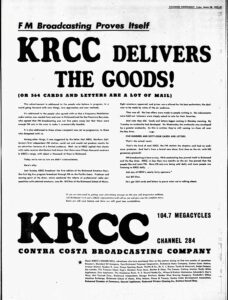
Once on the air with Phil Bernheim serving as station manager, KRCC offered a variety of musical and variety programs and seemed to make an immediate connection with an audience it believed was waiting for FM broadcasts. A full-page ad in March 1947 claimed the station had received hundreds of cards and letters from people enjoying what they heard in the station’s first few weeks on the air. By July 1947, the station boasted of a letter from the ad agency for the Breuner’s furniture store chain, saying the “cost per response” for ads airing on KRCC was dramatically lower than for other radio campaigns Breuner’s had run.
Already the first commercial FM station in the Bay Area, KRCC claimed another “first” in September 1947 when it installed a high-fidelity 15,000 KHz line to relay live performances from Hambone Kelly’s, an El Cerrito nightclub. The Lu Watters Yerba Buena Jazz Band played the inaugural performance. Click here to hear a performance captured on transcription disc and preserved at the Bay Area Radio Museum.
KRCC soon entered into an agreement with San Rafael’s new AM station KTIM under which KTIM would re-transmit four hours a day of KRCC programming. The technology behind the syndication arrangement was simple: KTIM would tune an FM receiver to 100.7 and pass the signal being received from Richmond on to its own transmitter. KRCC’s general manager told Broadcasting magazine, “This is an ideal way for an independent FM station to get ‘off the hook’. We expect to get enough revenue from our share of the time sales to keep the FM operation in the black.”
Some of KRCC’s airtime was filled with programming provided on transcription discs by the Lang-Worth service offered by New York City-based Langlois & Wentworth. The service leaned heavily on public domain music.
In March 1948, control of KRCC was transferred to Leo Owens, a Texas newspaper publisher and broadcaster who had purchased the Independent from the Galvins a few months earlier. Filings with the Federal Communications Commission indicate Owens paid $15,000 to acquire a controlling interest in the station.
Published rate cards show the station was asking $5.50 for a one-minute commercial (volume discounts available) and an hour of air time could be purchased for $30.
Whatever early excitement may have existed for the Bay Area’s first commercial FM station, the cold business realities had sunk in by the summer of 1949. A brief item in Broadcasting magazine in August 1949 noted that a pending KRCC construction permit had been deleted at the request of the owner; the reason given was “economic”.
By April 1950, KRCC was off the air and trustees of the Contra Costa Junior College District briefly considered acquiring the station to broadcast instructional programing. A year later, San Francisco AM station KPOO (it would become KSAY by the time it began broadcasting) served notice that it had purchased the defunct station’s transmitter tower and planned to build a second tower and bury copper ground wires at the Nicholl Knob site (that project never panned out).
In early 1951, the KRCC call letters were re-issued to Colorado College in Colorado Springs, CO where they graced that state’s first non-commercial FM station and are still heard today.