KFMR succeeded Fremont’s KHYD in 1964 after the purchase of the station by Southern California businessman Fred Sinasek and his family, operating as Dell Broadcasting Corp. Soon after taking control of the station, they filed with the Federal Communications Commission for permission to boost the station’s power and in early 1965, KFMR installed a new transmitter with 3,000 watt output. The station would change hands several times over the next dozen years.
Adelle Malloy, part of the family behind Dell Broadcasting, served as the station’s “program coordinator”. Her son Jim served as sales and promotion manager. The station routinely referred to itself with two hyphens: K-FM-R.
In 1967, Dell Broadcasting sold KFMR for a reported $50,000 to Group IV Broadcasting, led by two men associated with Tucson, AZ TV station KGUN. Group IV was led by Robert Ripley. At the time of the sale, Adelle Malloy gave a quote to the Fremont News Register that was surely recognizable by many small-station operators: “We’re taking our first vacation in 2 1/2 years.”
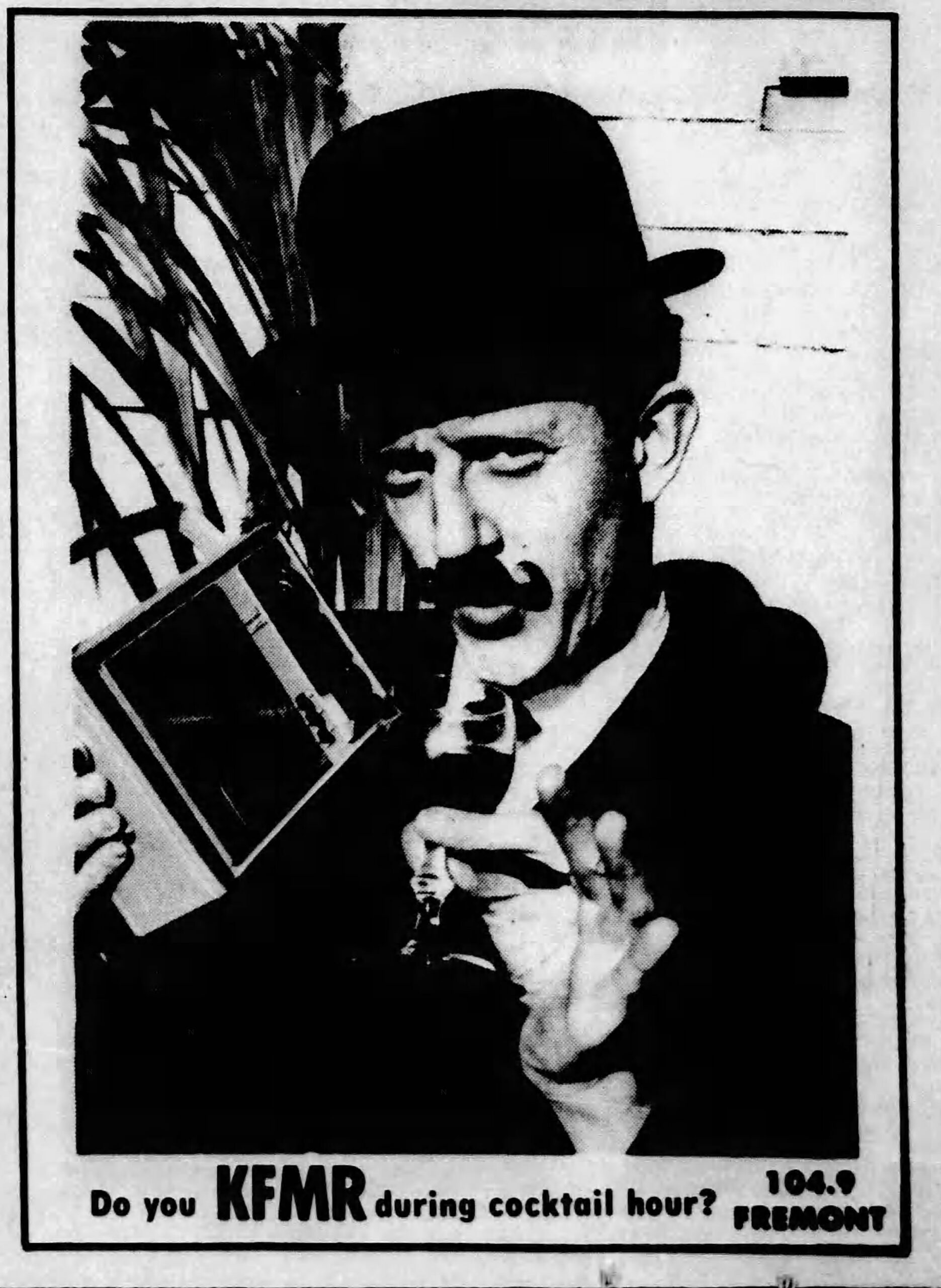
Fremont resident Ken Weiss was installed as general manager and KFMR beefed up its promotions and programming. Riffing off an ad campaign launched by the new ownership, Weiss affixed a sign to his car reading “Did you KFMR today?”
The station began carrying Cal State-Hayward (now Cal State-East Bay) football games during the 1967 season. The new ownership group also set up a subsidiary business: a custom-recording operation called Broadcast Recorders.
A year into its ownership, Group IV switched to stereo broadcasting and launched a format it called Stereo ’68. The music mix would be modern but light: the likes of Percy Faith, Barbra Streisand, and George Shearing. That didn’t last long: KFMR went country.

Billing itself “Metropolitan Stereo Country”, the small suburban station was able to bring aboard a major star in country music and broadcasting. Ralph Emery covered both morning and afternoon drive time. Other hosts in the country format were John Schneider, Ed Donahue and Lee Smart, who station promotions pointed out had come from country legend Buck Owens’ Bakersfield powerhouse KUZZ. The station also began boasting that it had “non-stop news” under the leadership of news manager Ken Weiss, who must have been a very busy man.
Ken Canada had been installed as general manager. In early 1970, he announced the hiring of Don Muow as sales manager and Muow commented on the “phenomenal growth of KFMR and the Fremont area.” The part about Fremont was certainly true; the city had nearly doubled in population between 1960 and 1970 and would soon surpass 100,000 residents.
A young Wisconsin broadcaster named Mel Michaels arrived and teamed with Rick Stephens to launch weekly broadcasts of high school games among teams in the local Mission Valley Athletic League.
In the summer of 1970, Group IV’s Robert Ripley sold KFMR for $200,000 to Robert Bell, who had broadcasting interests in the Midwest. Ken Weiss moved on to a marketing and promotions job with the Fremont Hub shopping center merchants’ association. When asked why KFMR had been put up for sale, Weiss told The Argus, “There just hasn’t been enough community support.”
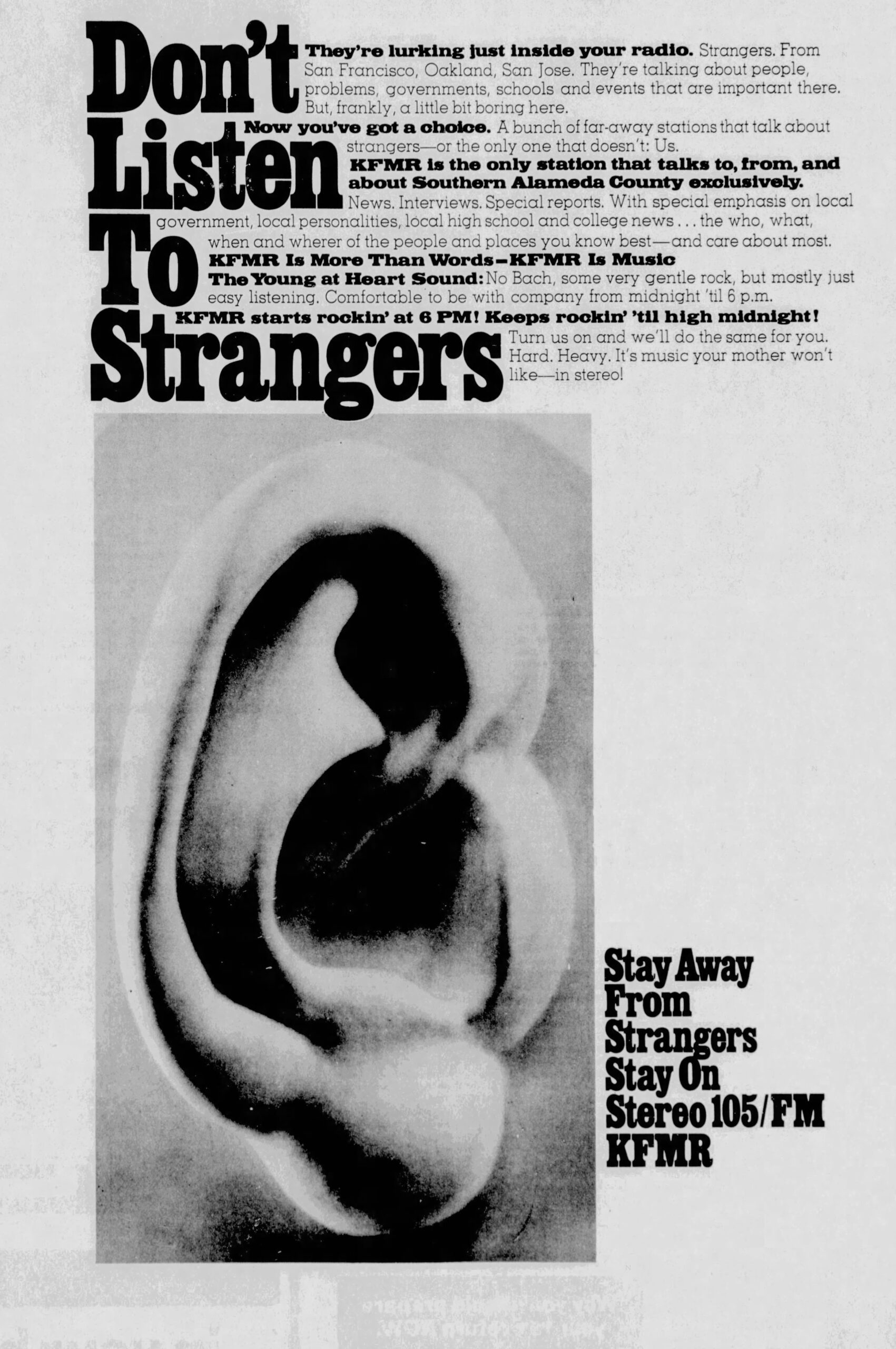
The new owners made another push for relevance, doubling down on “local” with an ad campaign that told would-be listeners that KFMR served them in a way that the big-city stations in San Francisco, Oakland and San Jose wouldn’t. The station picked up Oakland A’s games in time for the team’s 101-win 1971 season and amped-up local news and public affairs coverage. Golden State Warriors coverage was added for the 1971-1972 season.
None of it worked.
By 1974, KFMR was calling itself “The Christian Voice of the Bay Area”, broadcasting brokered religious programming from studios on Williams Street in Fremont’s Centerville District.
In 1978, Bell’s Alameda Broadcasting would sell the station for $500,000 to Spanish Metro, Inc., a group headed by Salinas station owner Robert Williams. New ownership, programming a Spanish language format and billing the station as La Chiquita, switched the call letters to KDOS in July 1979.