
In the long history of Bay Area radio broadcasting, the short life of Oakland station KFYI is one of the more remarkable stories.
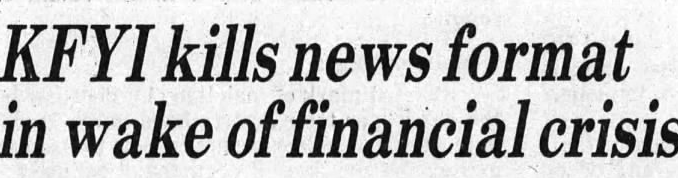
KFYI (1310 AM) went on the air with an all-news format in December of 1984 and shut it down less than four months later, burning through millions of dollars in what virtually every industry observer saw as a quixotic effort to take on market powerhouses KGO and KCBS.
Even before the doomed news operation hit the airwaves, there was controversy because the format change ended the legendary run of KDIA at that spot on the dial. The long-popular soul music station held a place of honor and importance to the East Bay’s Black community. An Oakland Tribune report on the format change referred to KDIA as a “monumental institution” in the Black community.
What had been the “Lucky 13” KDIA vanished on December 9, 1984 when the call letters were switched to KFYI. The all-news programming stumbled out of the starting gate the next day. Early reviews were not kind: one local media observer was quoted as saying the station sounded “like wire copy coming out of a speakerphone.”
On April 5, 1985, the all-news sound was gone, and on July 3, 1985, the station was again KDIA.
Forty years later, a number of former KDIA staffers described their experiences to the Bay Area Radio Museum. Their recollections are presented here, lightly edited where necessary for clarity.
ERIC SPILLMAN
A University of California graduate, Spillman would go on to a lengthy career as a reporter at KTLA television in Los Angeles.
I was hired as a news assistant at KFYI as I was finishing up my last semester at UC Berkeley in late 1984. It would be my first position actually working in a newsroom, and it seemed like an exciting opportunity. Everyone who was hired there had aspirations to move up to the next level, and since I had dreams of becoming a reporter, I felt the job would be a great stepping stone.
We spent at least a week or two rehearsing for our debut day of broadcasting, and very quickly we developed a great esprit de corps. I remember a manager there named John (Wheeling) who was a terrific teacher and motivator. From the beginning, he outlined a clear plan for what he wanted to achieve. I think everyone really believed in what we were doing. We felt that the Bay Area could use another source of information on the radio, and we were committed to the enterprise. The station was located in a one-story building near the Oakland Airport, and I remember distinctly Friday evening staff happy hours at a local bar, where they’d have a lingerie show (that was before Human Resources would have made such an outing impossible).
The station was full of characters who had big goals and were quite talented and funny. Just about everyone possessed a biting sense of humor, and it made me understand that working in a newsroom was something I wanted to do for the rest of my life.
We had been working for several months, and I think everyone was proud of our product.I’m sure we had only a minuscule audience, but nevertheless, we all thought we were doing well.
Then one day, I noticed that one of my health insurance claims had not been paid by the company. I was curious as to why, so I called the insurer and was told that KFYI had not been paying its premiums. So basically, we no longer had health insurance.
I told my co-workers what was going on, and so we had advance notice that the end was near. Nobody was too surprised when owner Adam Clayton Powell III announced that KFYI would be going off the air. It was clear that he had never had enough capital for this project. KFYI had only lasted a few months, and we were all out of a job.
Later that year, KDIA came back on the air on AM 1310 and I remember tuning in to hear the slogan:“KDIA: The Boss of the Bay Is Back to Stay!” Truthfully, when you consider the history of the place and how beloved those call letters were, it should never have left.
But we were all better for having worked at KFYI. Just about everyone advanced to a better job elsewhere.
JIM TAYLOR
Taylor was heard for many years on Bay Area stations KSJO and KCBS. He also served as an anchor for CBS Radio News.
KDIA. The Lucky 13. The Bay Area’s only soul station. The first place I heard James Brown. Solidly respected in the Black community with its coverage of issues germane to its listeners. That’s what got replaced with something the Bay Area arguably did not need: a third radio station devoted to news. But it was surely welcomed by out of work journalists. A bunch of us.
We were a disparate group of hopefuls who answered the call and gathered in sparkly new facilities off Hegenberger Road in Oakland. A couple of “names” but mostly young people like me looking to break into an all news format. Many of believed it was the most “job secure” place to be in radio. Ha ha.
We sat on the floor because chairs hadn’t arrived. And we learned about the all news structure –what constitutes an “A” story, how the hourly news wheel works. All news to me. But the kind of cred my resume needed. After years in rock and roll radio I was learning the serious side. The job security side. Ha ha again.
But since I was a news newbie the new management offered me a deal: two anchor shifts on the weekend…if I worked as an entertaining traffic reporter Monday through Friday. So yep, from our first day on the air until the place went dark some months later I worked seven days a week.
And what did KFYI sound like? At the time KCBS News Director Charlie Seraphin told a reporter the product sounded like wire copy read through a couple of cans with string. He may not have been far off.
KFYI also hewed to a time honored tradition: after-work in the nearest bar. For that there was The Flanker, owned by former Raider Fred Biletnikoff. Future TV anchor Ken Bastida and I could be found there often, lamenting our situation.
Because clearly revenue was not coming in. And something had to give. We started wondering aloud who would be the first to go. Sometimes in situations like that it becomes apparent. There was one guy, one of those “names”. With each passing day he seemed to slump more and more, disappearing into his rumpled suit. Ken and I nicknamed him “the dead chicken in an overcoat”. You just knew he’d be the first to be let go. What we didn’t realize: he would be getting a jump on the rest of us as the Bay Area was soon to be flooded with out of work news people
I think it lasted less than four months. The boss, Adam Clayton Powell III, gathered us all in the newsroom to say: it’s not your fault. In the back of the room John Emm stood up to answer: “No, Adam, it’s YOUR fault”! Then he picked up the IBM Selectric typewriter at his desk and walked out the door. In the few days that followed there was security to walk people to their cars.
In many ways KFYI was a huge bust. But out of it came a bunch of us who survived to eventually make it to where we wanted to go. People like Ruth Wertzberger Carlson, who transitioned to being a very successful travel writer. The aforementioned John Emm found years of gainful employment at KGO. Dick Fitzmaurice went on to a healthy career with Pacific Bell. Steve Bitker logged many years at KCBS. Me too! Bastida doesn’t need a mention as we all know how well things turned out for Kenny.
Thank you Adam Clayton Powell III. But please don’t start another radio station.
So there you go. I figure you don’t need stories of cocaine and marijuana use and abuse. What a wicked ride that was.
I would like to emphasize the optimistic outlook we all shared at the beginning. We cared about the little newsroom that could. Or couldn’t. The battle against all odds. It was quite an experience.
RUTH WERTZBERGER CARLSON
Carlson is a University of California graduate who worked at KCBS prior to joining KFYI. She would spend many years managing public relations for West Valley College in Saratoga before launching a career as a travel writer and author.
KFYI was my big chance. The news director wanted me because I was an editor at the news station KCBS, but I only agreed to the job if he occasionally let me be a reporter on the weekend.
It meant I didn’t have to leave the Bay Area to go on the air and the overwhelming advice back then was start out in a small town if you wanted to be “talent.” I was lucky enough to leave Iowa at age 17 so the thought of leaving two things I loved-San Francisco and my boyfriend Rich Carlson, a KRON-TV cameraman-was unthinkable.
So I left KCBS, like a lot of others, to join what we thought was going to be a successful start-up radio station since it was funded by Adam Clayton Powell III.
We had some time before we were fully operational so the news director would hold meetings to discuss our vision. It was an unbelievable luxury in a world where you expected to walk in the door and get the needle moving.
The editor’s job I had down pat despite the fact my desk was next to a friendly anchor named Ken Bastida who loved to chat. My reporting skills left something to be desired. On my first assignment, covering St. Patrick’s Day, I became enamored with my own copy and took forever to deliver a story so long it would never run today. Later I redeemed myself with a year-end round up of all the celebrities who had died.
To build cameraderie, the news director and sales manager often invited the nighttime staff to join them for cocktails at a nearby dive bar. I was often the only woman there watching sad-looking women parade around in lingerie they were selling. It was the ’80s …if you were a woman, you laughed about it…and ignored the sports announcer’s Playboy calendar above his desk. Women wanted to be part of the boys’ club…not troublemakers.
There were rumors the station was floundering and most of us were quietly looking for other jobs. But it still felt shocking the day Powell announced the station was kaput. KCBS’ Lynn Jimenez called me for reaction, and I feel badly to this day I was too upset to talk.
One anchor was so angry he started picking up typewriters (this was the age before computers) and throwing them in the trunk of his car.He also suggested we pool all our money, save the station and run it ourselves, an idea which didn’t get any traction.
Despite everything, KFYI may have been the best thing to happen to us. The colleagues I keep in touch with have all had very successful careers. As for me, Rich suggested I try public relations which turned into a fulfilling career. So, in a way my big chance worked out after all.
DICK FITZMAURICE
Fitzmaurice’s Bay Area radio career included time at KCBS, KCBS-FM and KNEW. He would later spent many years as Director of External Affairs for Pacific Bell.
Key Players
Adam Clayton Powell III – owner.
Powell III had worked for WCBS Radio and CBS News in New York so he had some credibility – at least on paper. He said his lifelong dream was to own an all-news radio station. He was particularly pleased, I recall him saying, that his dream came true in the San Francisco market.
The day that he appeared at an “all-hands-on-deck” meeting to tell the news staff it was fired he commented that his company was “positioned” exactly as he wanted. It was a fact about which those of us who were about to go on unemployment failed to become excited. So much for a dream come true.
John Wheeling – News Director
John came from WCBS – I don’t recall him being the news director there – maybe Managing Editor. John was smart and funny. All in all, a pleasure to work for.
Don Budd – Assistant News Director
Good guy but don’t recall much about his background.
Morning Drive
The station adopted the Westinghouse all-news format. There were three anchors per hour, each handling 20 minutes then going back to the newsroom to write the next hour’s 20 minute stint. John Emm, Don Budd and Dick Fitzmaurice were the morning drive anchors.
Eddie Alexander – Sports Director
Eddie (aka Walt Alexander) had worked at KRON TV in the early 70s, moved to LA ,then San Diego. He ran into some legal issues and eventually came back to the Bay Area and KFYI. He was always – I mean always – up tempo. This was true in real life as well as on-air. I remember greeting him in the mornings with, “Hi Eddie, how ya doing?” and his reply was most often a very enthusiastic, “I am ROLLIN’!!” It’s a phrase Linda and I adopted and say to this day; perhaps not as often as Eddie but often enough that he lives in our memory.
Also residing in our memories is the term “little” when Eddie mentioned Boston College’s Doug Flutie. Flutie was in the news quite a bit for winning the Heisman Trophy but then being 285th in the NFL draft and playing his first year of pro football with the New Jersey Generals. Every single sportscast involving the Flutie saga, Eddie started with something like, “Little Doug Flutie was named the Heisman Trophy winner yesterday” or “Bad news for little Doug Flutie.” When his name comes up today – as it does from time to time – Linda and I automatically correct the announcer for not adding the “little.”
Other Staffers
Jim Taylor – Traffic and reporter
Jim worked later at KCBS – then became a network anchor at CBS Radio in New York
Ken Bastida – anchor
Ken went on to work at KCBS and then moved to KPIX TV for a long run as an anchor
Steve Bitker – reporter
I thought Steve and I had a good rapport on the air, and we did. But it turns out Steve has a good rapport with everyone – on or off the air. Steve also went on to KCBS as Sports Director.
Linda Lease – editor, reporter
Linda was an intern at KCBS from Mills College. She was a desk assistant, phone screener and editor. She moved to KFYI to become a full-time editor. She and I met at KCBS, moved to KFYI and were both without jobs two months before our wedding in June of 1985. Once back from our honeymoon, Linda got a job with Metro Traffic, and I was hired as a reporter at KNEW.
Keven Guillory – editor as I recall – maybe a part time reporter, too.
Keven was an excellent editor, good news sense. I also remember him being very funny. He went on to work for NPR and had a very successful career.
Eric Spillman – editor
KNEW hired Eric in 1985 to replace me as a reporter when I left for Pacific Bell. Eric went on to be a TV reporter at KTLA in Los Angeles.
KCBS was one of the first – if not the first – newsrooms to be computerized. It was remarkable how good that first generation was, how much easier it made processing news stories and how easily we adapted to it. My first day at KFYI was filled with a certain degree of excitement until I walked in, looked around the newsroom and saw there were electric typewriters at each workstation! “Oh man, no computer,” I said. “Oh well, it won’t be that bad,” I added, trying to put a positive spin on it. True, it wasn’t that bad, but I sure missed the word processing capabilities of the KCBS computer.
The other (related) issue was the somewhat cumbersome news “tree” – a sort of gigantic lazy Susan, where news copy was stored in envelopes. Anchors received the news story line-up from the editor and pulled the appropriate envelopes for use in rewriting the stories for air. KCBS had a similar system prior to computerization but it was long forgotten — until arriving at KFYI.
The Flanker
KFYI studios were in Oakland just off Hegenburger Road. Across the street was The Flanker Restaurant and Bar, owned by [former Oakland Raiders star] Fred Biletnikoff. It became the KFYI conference room. Any time there was an especially trying news day, someone would yell, “Flanker!” and people would filter in after their shifts. The day the station went dark I recall the place being pretty much overrun.
MIKE PECHNER
Pechner worked at numerous Bay Area radio stations over the course of his career as a meteorologist. He was inducted into the Bay Area Radio Hall of Fame in 2013.
Adam Clayton Powell III was the “owner” and G.M. The studios had been at the Bay Bridge flatlands—the facilities of the long established African American AM station KDIA.
In the brief time I was on the air (I did the weather) I saw them spend lot of money on a new audio board, cars with brand new Motorola state-of-the-art two-way radios, and repeaters all around the Bay for coverage, including one on Mt. Diablo.
Having worked at KCBS starting in 1968, I had KCBS to use as a comparison for the amount of reporters Powell hired and it was considerable, which added to the payroll.
I had just been fired by KCBS News Director Ted Feurey so I was looking for another place to land. We had a big sales staff at KFYI, as I recall, but with KSFO-KYA, KCBS, KGO and KNBR the top billing stations it was an uphill battle to say the least.
I know they couldn’t sell my weather forecasts, because I asked several times. I think my pay was $1000 a month and we were paid bi-weekly. We had heard rumors after several months that things were not going well and that money was tight.
The station finally shut down because of the start up costs and the inability to sell enough airtime to support it. I did not get my last paycheck of $500.I found that our final checks were not forthcoming. So I filed suit in Small Claims Court. To my surprise, Adam Clayton Powell III showed up.The Judge asked him under oath, if here were the owner, he said “no”, and he gave the Court the name of the broadcasting company.I sued again, naming the company, but by time I got a court date the delay in re-filing cost me, as the company had filed bankruptcy and dissolved.
KEN BASTIDA
Bastida, a member of the San Francisco State University Alumni Hall of Fame, worked at several Bay Area radio stations before joining KPIX-TV for a lengthy career as a news anchor. He was elected to the Bay Area Radio Hall of Fame in 2026.
Looking back on KFYI, I have honestly nearly no memory of the experience…except for the great people who I met there. Folks like Dick Fitzmaurice, and John Emm, and Jim Taylor and Ruth Wertzberger. Beyond that, it was exciting starting something from the ground up…but also frustrating as well.
I remember our “Newsroom” consisted of 8 foot long portable tables and chairs and a few typewriters.
The place had a couple of Toyotas they used for “news cars”, and some recording equipment. Mic bugs, etc. A couple of studios and tape machines, audio boards, etc.Very basic stuff.
Hopes were always very high of taking down the mighty KCBS someday…but that was a pipe dream perpetuated by the owner. As it turned out, the place didn’t have the capital to continue broadcasting.
I was one of the first ones hired and took a chance, having spent the previous 2 years freelancing at KGO, KMEL, K-101 etc., and I believe the KFYI “experiment” lasted about 3 months before our paychecks started becoming delayed.
Oh well…One of the many broadcasting experiences I had throughout my 43 year career.