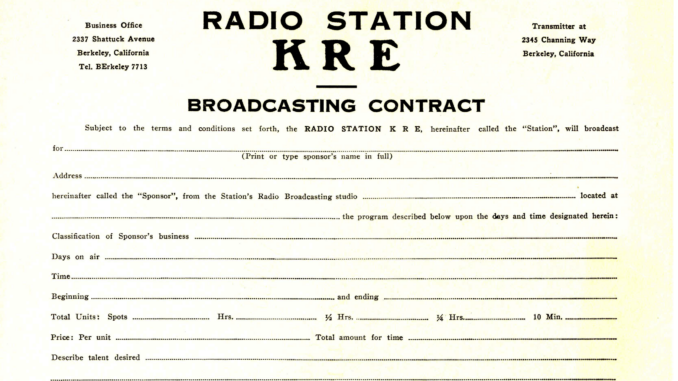
We offer here an example of the business of broadcasting. The paper original “Broadcasting Contract” form from Berkeley station KRE is held in the Bay Area Radio Museum archives.
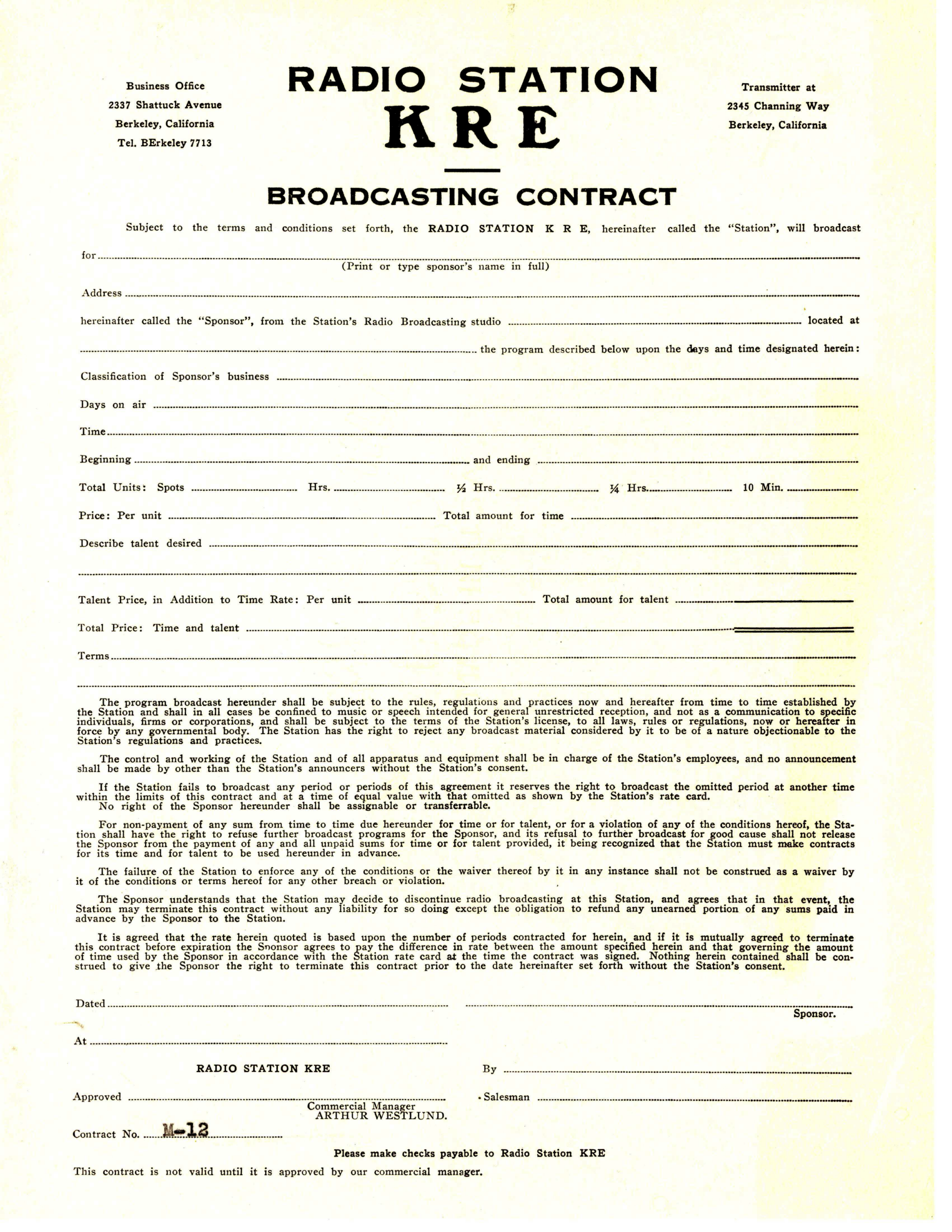 (Click image to view full size)
While we can’t be certain of the exact date this form would have been in use, a few clues are available that help us make an educated guess: sometime between 1933 and 1937.
The reference to the station’s transmitter being at 2345 Channing Avenue would appear to put its use before mid-1937. Prior to that time, the station’s transmitter was situated on the property of Berkeley’s First Congregational Church on Channing Way (the church had purchased the station in 1927 and operated it until selling it to the Chapel of the Chimes mortuary in 1930). In mid-1937, the transmitter was moved to a new location at the foot of Ashby Avenue.
The 2337 Shattuck Avenue address given for KRE’s business office places the station at the Glenn-Connolly Building, where KRE moved in 1933. Prior to that, the offices and studios had been at the Capwell Central Market in downtown Oakland. This was a supermarket owned by Capwell’s Department Store, and located across the street from the store. KRE broadcast from the Capwell location, where a glass-enclosed studio was built allowing the public to watch radio being made, during the day, and from the First Congregational site as well as studios at the Claremont Hotel at night.
The church received a petition from nearby residents, complaining that the studio monitor speaker could be heard through the station’s open window, piercing the quiet of the neighborhood at night. The church asked KRE to find another studio location. Since the Capwell facility wasn’t available at night, station manager Arthur Westlund needed to find a new home, thus the move to the Glenn-Connolly Building.
Of curiosity is Arthur Westlund’s listed title: “Commercial Manager”. In fact, Westlund was the overall manager of the station. As the president of the Chapel of the Chimes, he assumed responsibility for KRE when the mortuary took over the station. The contract form makes clear that no agreement was final until Westlund signed it.
The contract appears to be an industry standard form with KRE’s details added on. An advertiser might have purchased a flight of “spots” (recorded or live commercials) or purchased air time in blocks ranging from ten minutes to multiple hours.