Set the Wayback Machine for 1932: radio is a vibrant business in the Bay Area with a number of important stations on the air and NBC’s new network operations creating a hub of radio program production in San Francisco. At the same time, in faraway Hawaii, it’s a different story. Two stations are on the air and programming is almost exclusively local since the available technology didn’t yet support network distribution.
Travel to Hawaii occurs at a leisurely pace: a shipboard voyage from San Francisco takes five days and air travel from the West Coast to Hawaii is three years in the future.
That’s the backdrop for the stunt pulled off by Honolulu station KGMB in November 1932.
Hawaiian musician Johnny Noble had been a regular on KGMB practically since the station first signed on in March 1930. Radio stations and bandleaders had a mutualistic relationship in those years: the musicians got exposure for their real jobs (live gigs), while the stations got free programming. A win-win. Noble would go on to make his mark as a creator of the hapa haole sound in which traditional Hawaiian arrangements were paired with English-language lyrics.
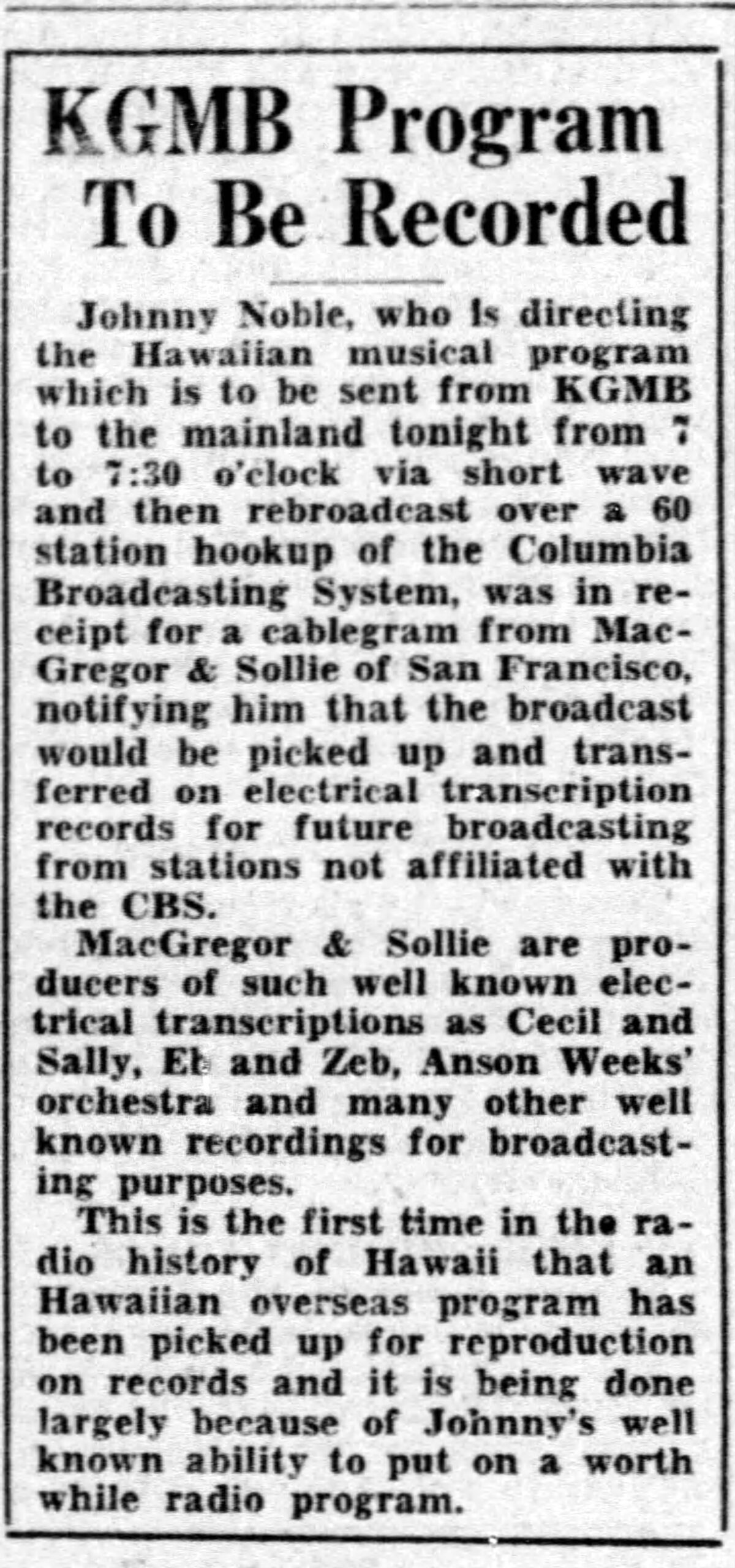
Our story here focuses on the night of November 11, 1932. Noble, the musical director at the Royal Hawaiian Moana Hotel, had spent a busy few months earlier in the year in California. He’d accompanied a group of Hawaiian musicians to play engagements at the Biltmore Hotel in Los Angeles and a Shriners convention in San Francisco. Then it was back to L.A. to perform for events at the 1932 Olympic Games and do some film and recording work before heading back to Hawaii.
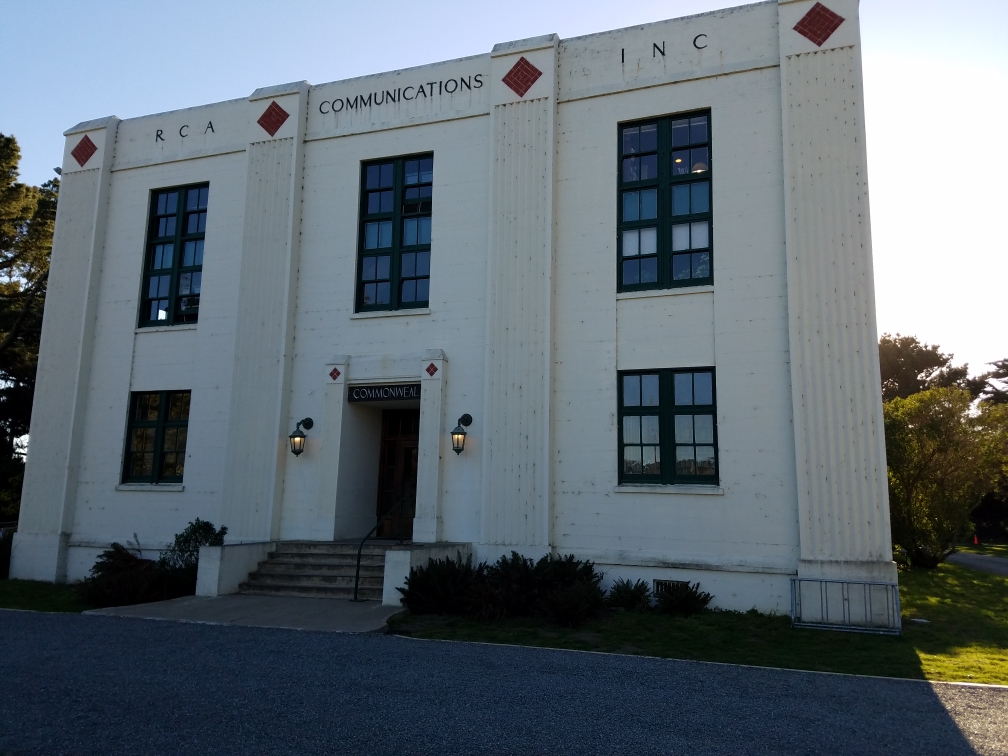
On the night of November 11, a complicated arrangement allowed Noble’s Royal Hawaiian performance to be heard Stateside. The show was carried by remote pickup to KGMB’s studios. From there, the signal was sent via telephone line to the RCA shortwave station at Kahuku. The transpacific shortwave transmission was picked up at RCA’s big receiving facility in the Marin County town of Bolinas, from which the signal was carried by Pacific Telephone and Telegraph lines to San Francisco.
And from a PT&T switching center in San Francisco, the Hawaiian music performance was distributed to more than 60 stations on the CBS network. Contemporary news reports indicated nine separate broadcast amplifiers were required to pull it off.
The story doesn’t end yet. One of the CBS network affiliates was San Francisco’s KFRC, from which the 30-minute broadcast was patched through to the Mission Street facilities of MacGregor & Sollie. The pioneering recording facility was already in the business of recording and distributing electrical transcription (ET) discs containing radio content. That night, the MacGregor & Sollie team captured the sounds of Hawaii direct to disc.
By December 1st, copies of those ET discs had been shipped back to Honolulu, and on December 2, KGMB used the ET discs to air the same show it had carried on November 11. Johnny Noble’s music had traveled a remarkable path, from Honolulu to San Francisco and back.
As the Honolulu Star-Bulletin noted, “Although the records and the broadcast from them cannot possibly have quite the clarity of the original broadcast, the reproduction is surprisingly accurate.” The newspaper noted that the program, delivered on two discs, missed a few bars of one song when the recording engineers had to change discs.
The Star-Bulletin was impressed: “As an example of the magic of modern radio, it was unique, and as a demonstration of the possibilities of Hawaii programs being given national distribution, it was impressive.” A side benefit: the Honolulu replay of the original KGMB broadcast gave Johnny Noble his first opportunity to hear what his band sounded like on the air.
It wasn’t the first time the shortwave link had been used to carry radio programming from Hawaii to California. The May 1932 National Foreign Trade Council convention in Honolulu–the first ever held outside the U.S. mainland–was considered of such significance that CBS made arrangements to carry some of the speeches over its network, achieving the “hop” to San Francisco via the RCA shortwave system.
The Hawaii-to-California shortwave relay link became a regular way to carry programming to and from the Mainland. On New Year’s Eve 1932, CBS staged what was described as the most extensive network broadcast yet attempted: 25 different orchestras in eight cities, each providing a 15-minute segment of live programming. KGMB and Honolulu contributed a feed from the Royal Hawaiian.