In the spring of 1964, Eugene Warner and F. Wellington Morse, who’d been involved in Bay Area broadcasting since the early 1920s, sold their Walnut Creek-licensed FM station KWME to an entity called Stereophonic Broadcasters Inc. for $65,000. The purchasing entity was owned by advertising executive Alfred Pettler, who owned 51% of the company, and KDIA employee Harold Hirschmann, who held the remaining 49%. The buyers would soon change the call letters to KDFM.
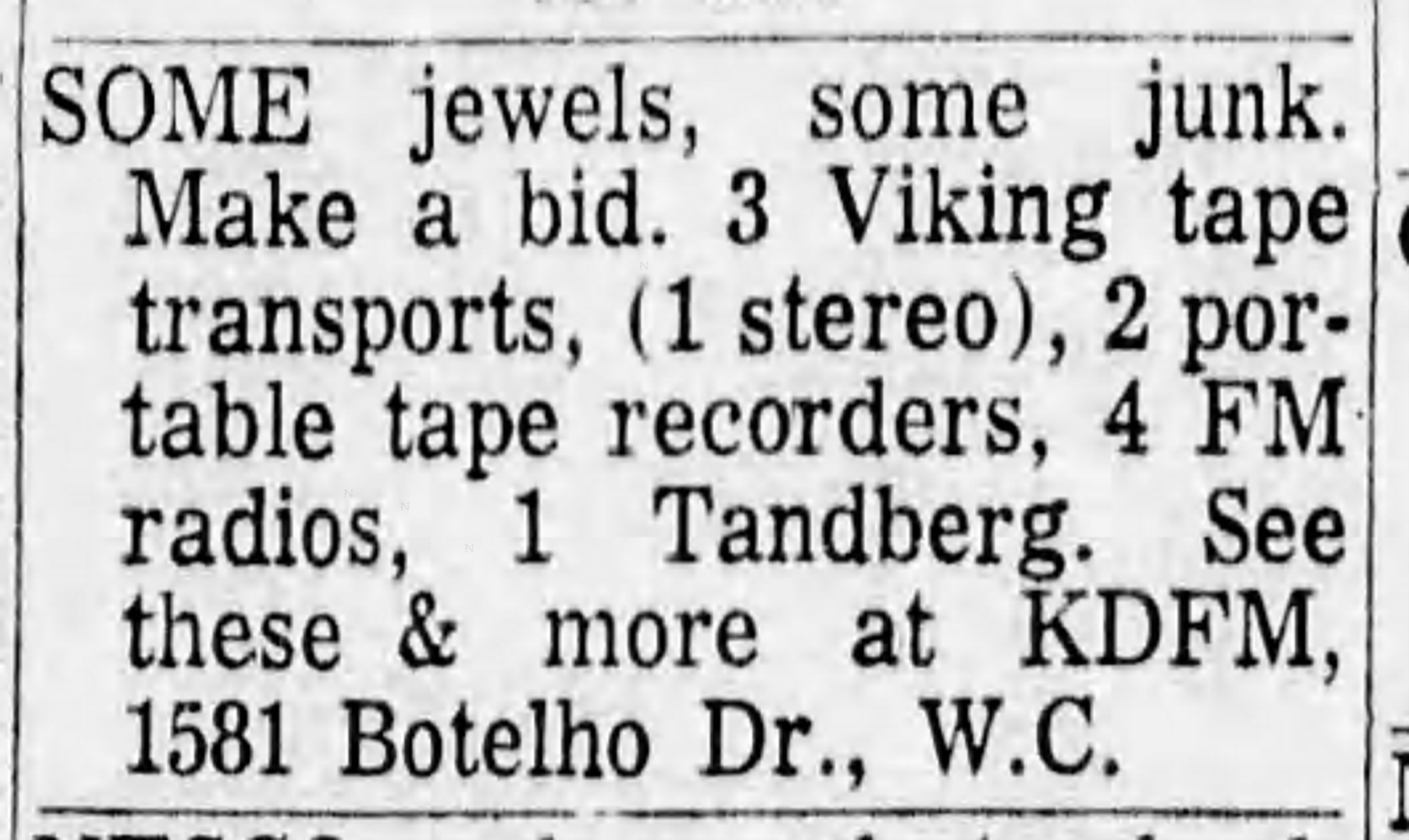
What they inherited was a 250-watt station running an automation system that broadcast “fine music”–show tunes and classical recordings, for the most part. They also apparently inherited some gear they didn’t want, as evidenced by a classified ad the station placed in the Contra Costa Times offering broadcast and electronics gear to the highest bidder.
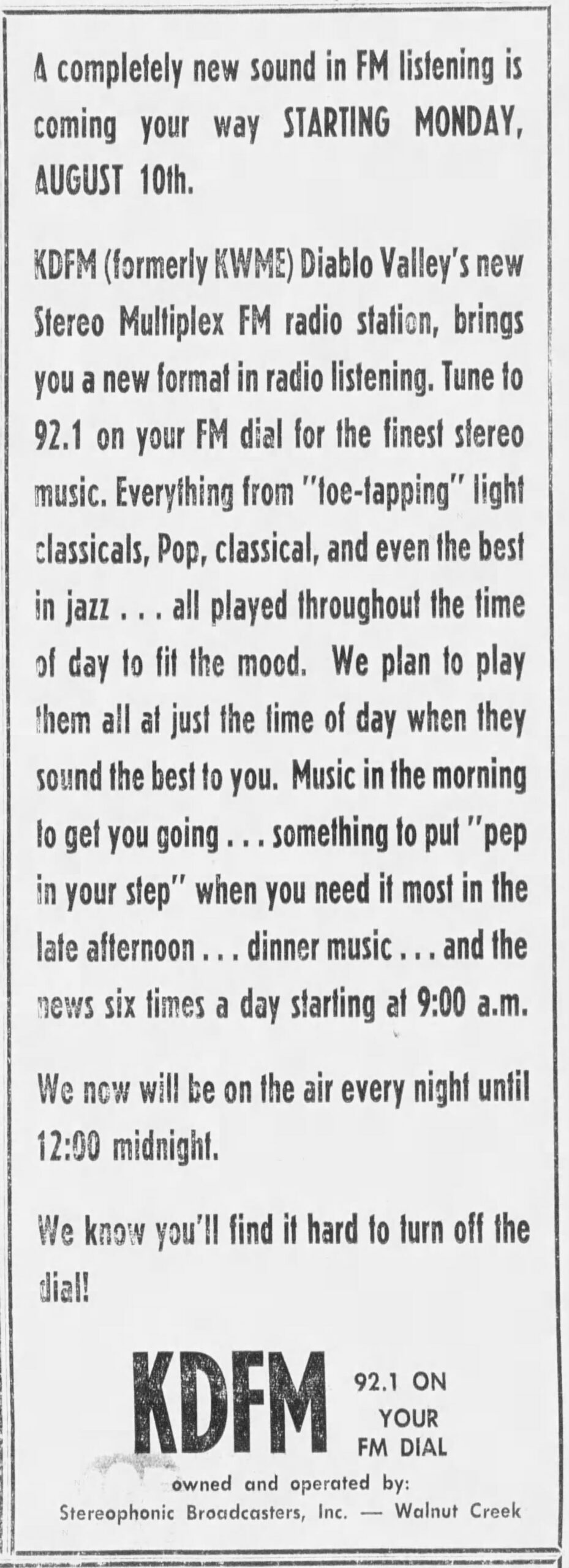
They served notice that the musical mix would be broadened–a bit–and announced a midnight signoff. Six hourly newscasts would be broadcast starting at 9 AM.
By mid-1965, general manager Chris Christensen (formerly a sales executive at Westinghouse Broadcasting) announced that the Federal Communications Commission had granted the station’s request to boost power from 250 watts to 3,000 watts and that a new transmitter would be on line later that summer (it would actually take another year to get the job done).
The boost would greatly increase the station’s coverage area. Given the hilly topography of the inland East Bay, distant FM stations often had trouble providing a solid signal in the Diablo Valley.
John Himes was named station manager and Lee Gordon held the title of news editor. Himes would leave within a few years to take a job with the Rossmoor senior community’s in-house TV station.
In early 1966, the station began signing on at 8 AM and signing off at 1 AM, an increase of one hour at each end of the broadcast day. Around that same time, the station was boasting that it had “over 50 local and 10 regional” advertisers buying air time to reach the growing Diablo Valley audience. After the new higher-powered signal went on the air, the station ran an ad in the Contra Costa Times “signed” by advertisers congratulating the station on its improved signal. They ran the gamut of local accounts from A-1 Floor Covering to William’s Design Jewelry.
In late 1971, Stereophonic Broadcasters published a legal notice saying it had sold KDFM to the Schofield Broadcasting Company, led by Dick Schofield and Wayne Hoffman. The owners of KWUN in Concord challenged the sale, arguing that because Schofield Broadcasting already owned KKIS in Pittsburg, the company would own the only two full-time stations operating in Contra Costa County. It took the FCC until the summer of 1973 to deny KWUN’s “monopoly” claim and allow the sale to proceed for a reported $207,250.
Schofield did leverage its ownership of the two stations on the business side as well as the programming side. 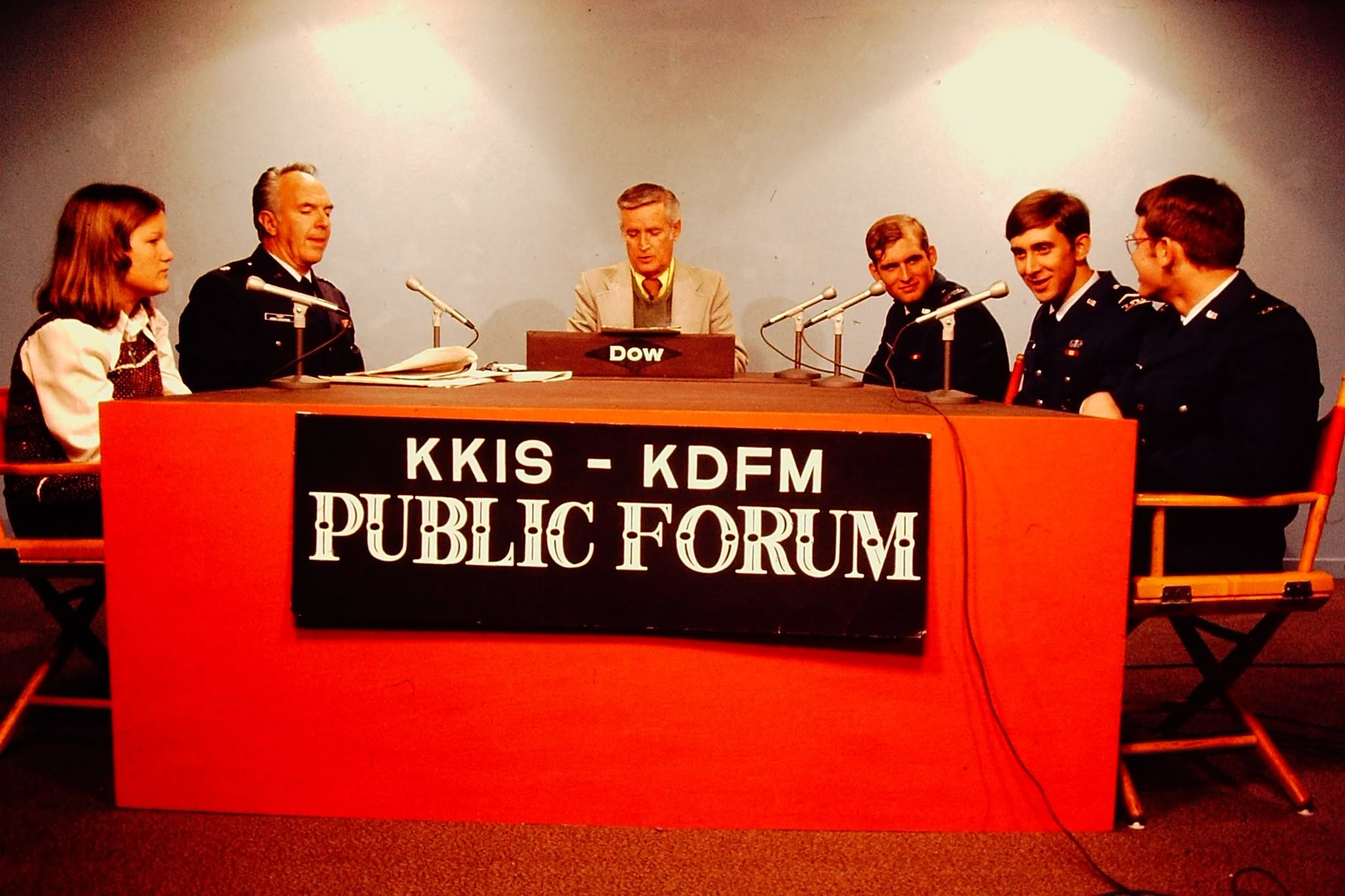
A hot local issue at the time was the proposed consolidation of Lafayette, Moraga and Orinda into a single city. KKIS and KDFM jointly broadcast a public affairs program on the issue, advertising themselves as “The Stations That Get Involved”. It was among many joint public affairs broadcasts by the two stations.
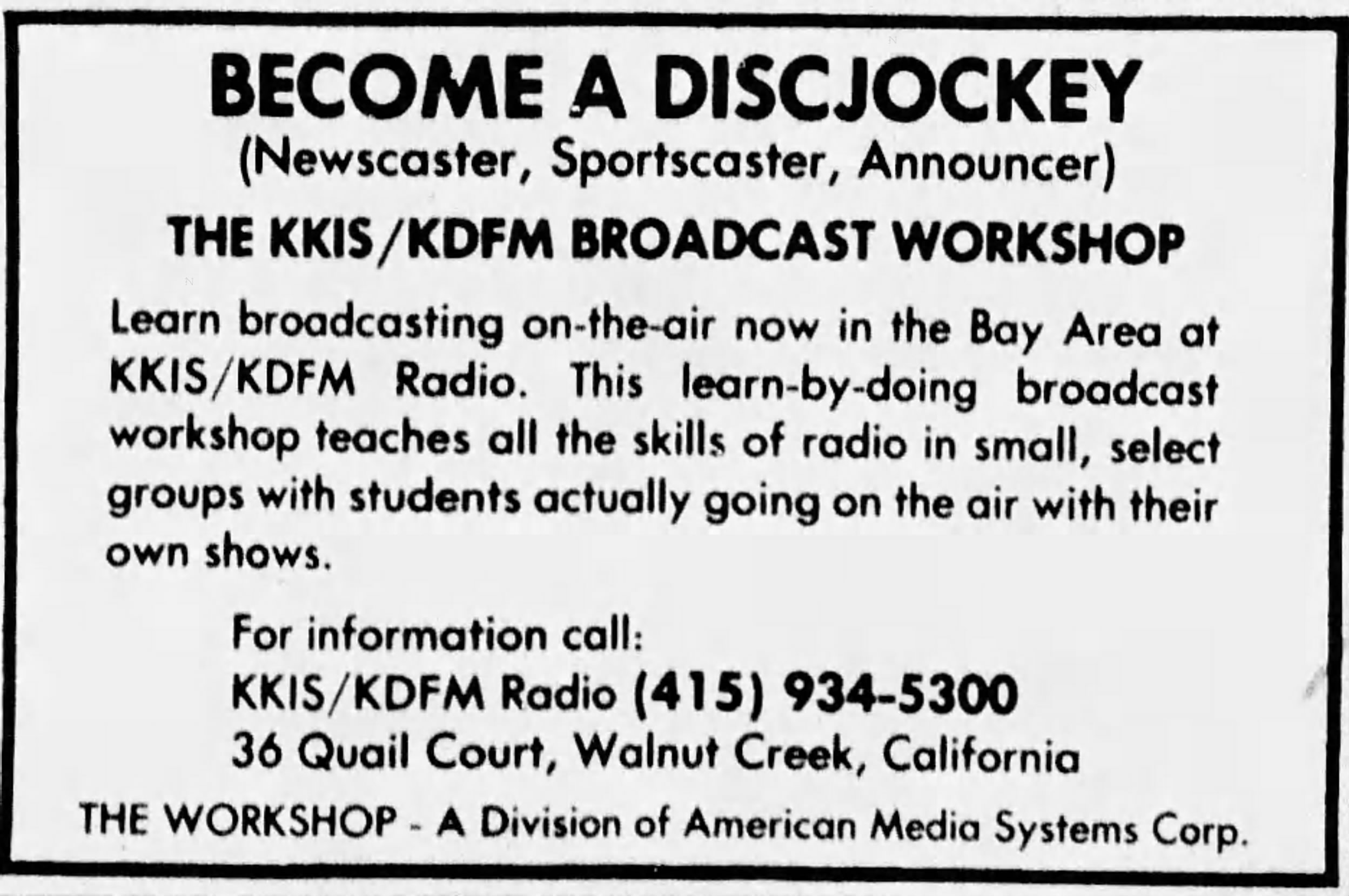
Though the stations were licensed to cities in a major metropolitan area, there was quite a gulf between their operations and the “big-city” stations across the East Bay hills. It’s hard to imagine any of the powerhouse stations offering to let a radio announcing school use its airwaves for live broadcasts!
KDFM’s programming continued in the late 1970s as automated “beautiful music”. The music was so innocuous that it was piped through the speaker system on Walnut Creek’s city bus lines.
In the summer of 1983, Schofield Broadcasting announced it was selling KKIS and KDFM. By then, KKIS co-owner Philip Hoffman had become president of Schofield Broadcasting. The buyers, in a reported $1.7 million transaction, were brothers Harry and James Chabin (each with 50% interest). Jim Chabin had been an executive with CBS in Los Angeles.
Chabin Communications Corporation would immediately file to change the call letters in Walnut Creek to KINQ and to blow out what Jim Chabin called “elevator music” (he went on to say that it was aimed at an audience of “50 to dead”), replacing it with an automated mix of oldies and recent pop hits.
A bit more than three years later, Chabin would end all doubt about the joined-at-the-hip nature of the Pittsburg and Walnut Creek stations. The new call letters in Walnut Creek would be KKIS-FM.
RELATED EXHIBITS:
KDFM Walnut Creek: A 1969 Photo Gallery